
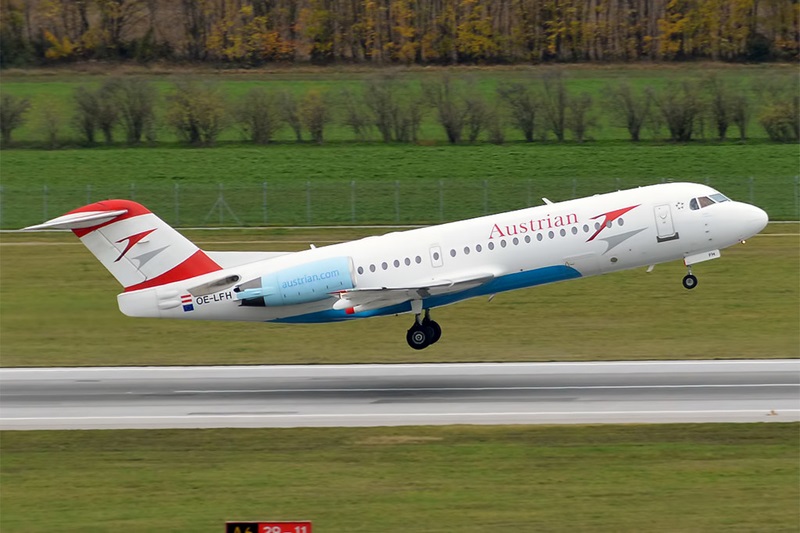
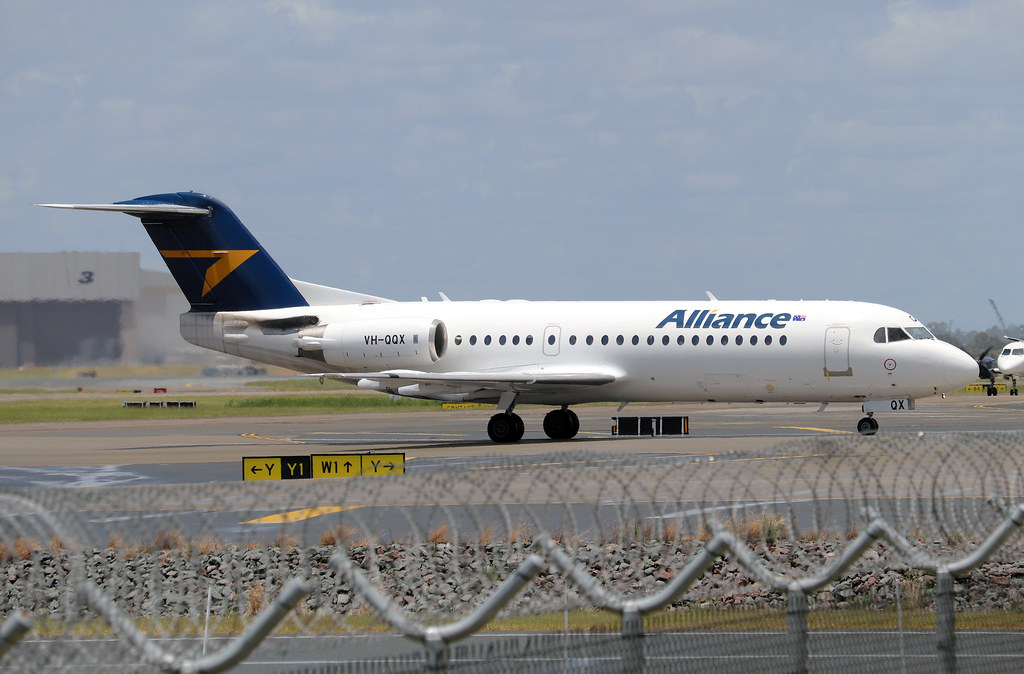
The Fokker 70, commonly referred to as the F70, is a medium‑range regional jet developed and produced by Fokker in the Netherlands. Designed to fill the gap between the Fokker 50 turboprop and larger short‑haul jets such as the Boeing 737 and McDonnell Douglas MD‑80, the F70 offered airlines a modern, efficient aircraft tailored to high‑frequency regional operations.
The aircraft features a narrow‑body fuselage, rear‑mounted engines, and a T‑tail configuration. Its design was heavily based on the successful Fokker 100, with the fuselage shortened by 4.62 metres (15 ft 2 in) to create a lighter, more economical jet suited to thinner routes. The wings, empennage, and flight deck remained largely unchanged from the F100, ensuring commonality for operators flying both types.
Power came from two Rolls‑Royce Tay 620 engines, a slightly less powerful version of the Tay 650 used on later Fokker 100s. For the F70’s reduced size and weight, the Tay 620 provided ample performance while maintaining excellent fuel efficiency.
A distinctive feature of the F70 was its hydraulically operated tail‑cone air brake—often called the “clam shell” brake. Similar to the system used on the BAe 146 / Avro RJ, the two halves of the tail cone opened to increase drag, allowing rapid deceleration in flight and on landing. This capability enabled the F70 to meet the steep 5.5% glide slope required for operations at London City Airport.
Both the Fokker 100 and Fokker 70 were modernised derivatives of the earlier Fokker F28 Fellowship, continuing Fokker’s tradition of producing practical, reliable regional aircraft.

At‑a‑Glance Summary
| Item | Details |
|---|---|
| Manufacturer | Fokker, Netherlands |
| Type | Medium‑range regional jet airliner |
| First Flight | 4 April 1993 |
| Entered Service | 1994 (with Ford Australia and later European operators) |
| Crew | Two |
| Passengers | Up to 85 (typical layouts 72–79 seats depending on class configuration) |
| Engines | 2 × Rolls‑Royce Tay 620 turbofans |
| Range | 3,410 km (1,841 nm) |
| Cruise Speed | Mach 0.77 (456 kn / 845 km/h) |
| Notable Features | Tail‑cone clam‑shell air brake; steep‑approach capability for London City Airport; shortened Fokker 100 fuselage; commonality with F100 systems and cockpit. |
| Number Built | 47 aircraft |
| Production Years | 1992–1997 |
Development Timeline
| Year | Milestone |
|---|---|
| Late 1980s | Airlines request a smaller jet to complement the Fokker 100 on thinner regional routes. |
| 1990 | Fokker begins design studies for a shortened Fokker 100 derivative, later designated the Fokker 70. |
| 1992 | Prototype construction begins. The fuselage is shortened by 4.62 metres (15 ft 2 in) compared to the F100. |
| 4 April 1993 | First flight of the Fokker 70 prototype, powered by two Rolls‑Royce Tay 620 engines. |
| 1994 | Certification achieved. Early deliveries begin, including Ford Australia and European operators. |
| 1995 | British Midland becomes the first major European customer, expanding the type’s presence across Europe. |
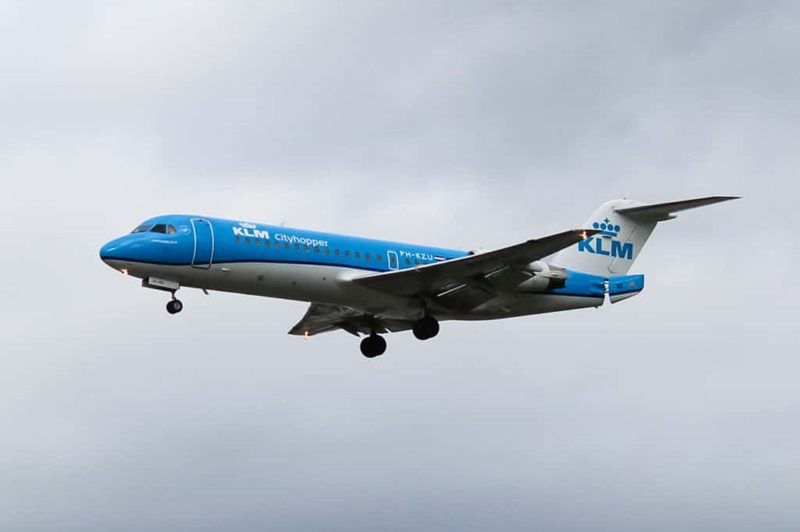
| 1996 | KLM Cityhopper introduces the F70, eventually becoming the largest operator of the type. |
| 1997 | Production ends after 47 aircraft due to Fokker’s bankruptcy, though the F70 continues in service for decades. |
History
By the late 1980s, airlines were increasingly seeking aircraft that could operate efficiently on thinner regional routes—services that did not justify the capacity of larger jets such as the Boeing 737 or McDonnell Douglas MD‑80. At the same time, turboprops like the Fokker 50 and ATR series were still widely used, but many carriers wanted a faster, more comfortable jet alternative for short‑to‑medium‑range operations. This demand created a clear gap in the market, and Fokker responded by developing a smaller derivative of its successful Fokker 100.
The solution was straightforward and cost‑effective: shorten the Fokker 100’s fuselage by 4.62 metres (15 ft 2 in) while retaining the same wings, tail, and modernised flight deck. This approach allowed Fokker to offer a new aircraft with excellent commonality for existing F100 operators, reducing training and maintenance costs. The resulting aircraft, designated the Fokker 70, was lighter, more economical, and ideally suited to high‑frequency regional routes.
Power was provided by two Rolls‑Royce Tay 620 engines, a slightly less powerful version of the Tay 650 used on later F100s. For the F70’s reduced size and weight, the Tay 620 delivered strong performance and excellent fuel efficiency. The aircraft also inherited the distinctive tail‑cone clam‑shell air brake from the F28 and F100. When deployed, the two halves of the tail cone opened to increase drag, enabling rapid deceleration in flight and on landing. This feature allowed the F70 to meet the steep 5.5% glide slope required for operations at London City Airport—one of the most demanding approaches in Europe.
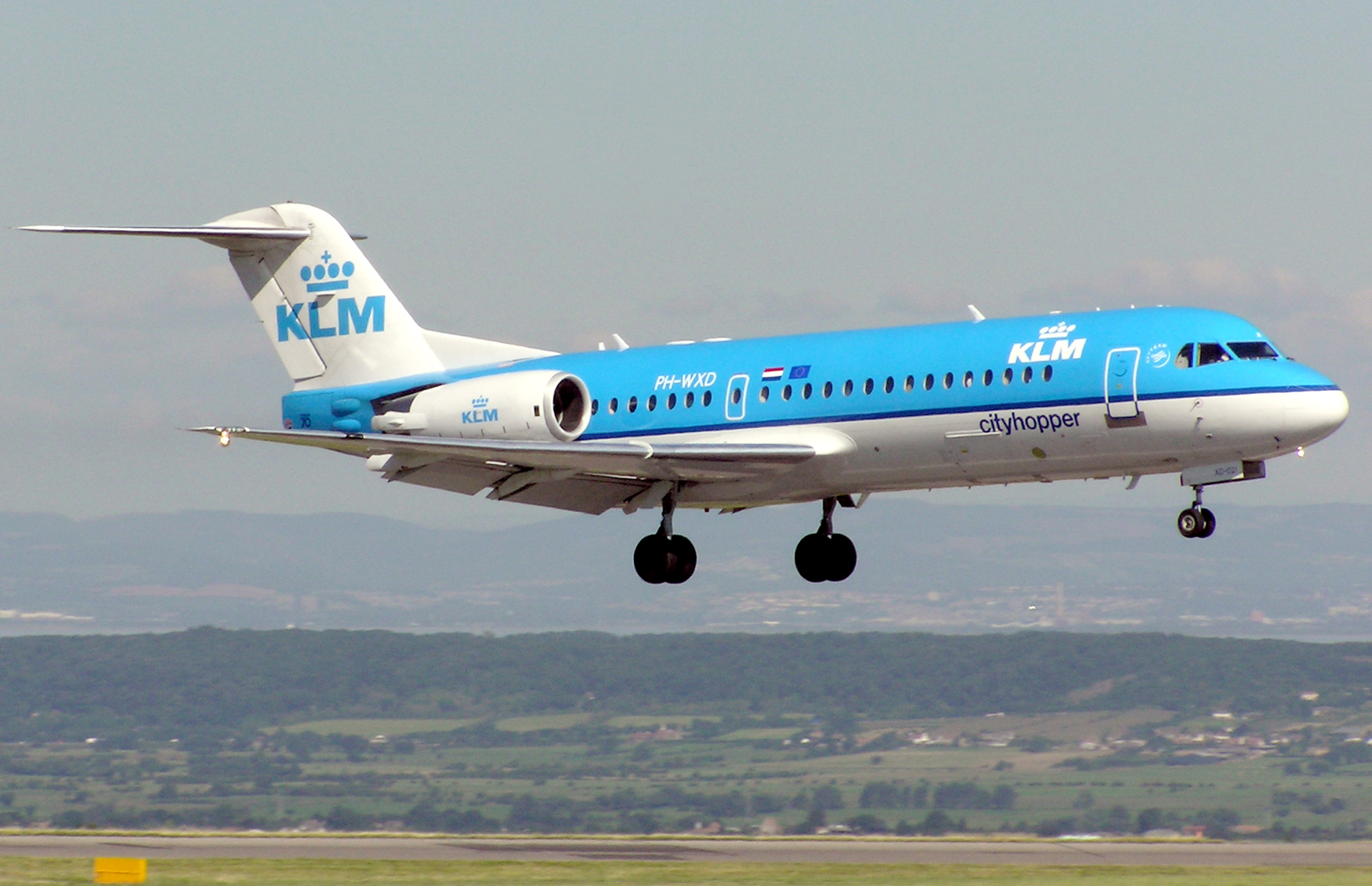
The F70 made its first flight on 4 April 1993, and certification followed in 1994. Early deliveries included Ford Australia, but the aircraft soon gained traction in Europe. British Midland became the first major European customer, helping establish the type across the continent. KLM Cityhopper later emerged as the largest operator, flying the F70 extensively on short‑haul routes throughout Western Europe.
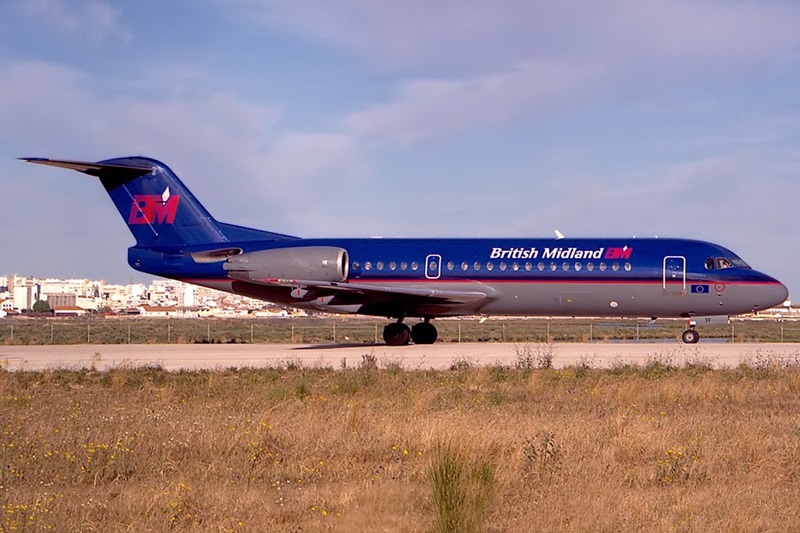
Despite its strong performance and positive reception, the F70’s commercial success was limited by Fokker’s financial difficulties. Production ended in 1997 after only 47 aircraft were built, following the company’s bankruptcy. Nevertheless, the F70 continued to serve reliably for decades, particularly with European carriers such as Austrian Airlines and KLM Cityhopper, both of which operated the type until the mid‑2010s.
Although its production run was short, the F70 played an important role in regional aviation. It offered airlines a jet with excellent performance, steep‑approach capability, and strong commonality with the F100. Many operators praised its reliability, comfort, and ability to operate from challenging airports. Today, the F70 is remembered as a capable and well‑engineered aircraft that extended Fokker’s legacy of practical, efficient regional airliners.
Specifications
| Type | Fokker 70 |
|---|---|
| First Flight | 04 April 1993 |
| Crew | Two |
| Passengers | 1 Class – 85 (Seat pitch 76 cm / 30 in) 1 Class – 79 (Seat pitch 81 cm / 32 in) 2 Class – 72 (Seat pitch 91 cm / 36 in and 81 cm / 32 in) |
| Cabin Width (Internal) | 3.10 m (10 ft 2 in) |
| Cabin Height (Internal) | 2.01 m (6 ft 7 in) |
| Fuselage Width | 3.30 m (10 ft 10 in) |
| Aircraft Length | 30.91 m (101 ft 5 in) |
| Tail Height | 8.50 m (27 ft 11 in) |
| Main Wing Span | 28.08 m (92 ft 2 in) |
| Main Wing Area | 93.5 m² (1,006 ft²) |
| Empty Weight | 22,673 kg (49,985 lb) |
| MTOW | 39,915 kg (87,998 lb) |
| Engines (x2) | Rolls‑Royce Tay Mk 620 |
| Engine Thrust (each) | 61.6 kN (13,850 lbf) |
| Max Cruise Speed | Mach 0.77 / 456 kn / 525 mph / 845 km/h |
| Service Ceiling | 35,000 ft (11,000 m) |
| Range (Fully Laden) | 3,410 km / 1,841 nm / 2,119 mi |
Assembly
The Fokker 70 was assembled at Fokker’s main production facilities in Woensdrecht and Schiphol, where the company had already established efficient manufacturing lines for the larger Fokker 100. By basing the F70 heavily on the F100’s structure, Fokker was able to streamline production and reduce development costs, allowing both aircraft to be built using shared tooling, jigs, and assembly processes.
Major fuselage sections were produced using the same methods developed for the F100. The shortened forward and centre fuselage barrels were assembled first, followed by the integration of the wing box and rear fuselage. The aircraft retained the F100’s wing, tailplane, and vertical stabiliser, which simplified assembly and ensured strong parts commonality between the two types. This commonality was a major selling point for airlines already operating the F100.
The Rolls‑Royce Tay 620 engines were mounted on pylons at the rear of the fuselage, a configuration inherited from the F28 and F100. The installation process was straightforward due to the shared engine architecture, and the reduced thrust requirements of the F70 meant that no major structural changes were needed. The aircraft’s distinctive clam‑shell air brake was fitted into the tail cone during final assembly, with hydraulic systems installed and tested before the aircraft moved to the flight‑test hangar.
Systems installation—including avionics, hydraulics, electrical wiring, and cockpit instrumentation—followed the same layout as the F100. This allowed Fokker to maintain a high degree of standardisation across both models, reducing training requirements for technicians and pilots. The cockpit itself was nearly identical to the F100, which made the F70 attractive to airlines seeking fleet commonality.
Once structural assembly and systems integration were complete, each aircraft underwent a comprehensive series of ground tests, including pressurisation checks, control‑surface calibration, and engine runs. The aircraft then proceeded to flight testing, where performance, handling, and steep‑approach capability were validated. After certification flights, the F70 entered customer acceptance and delivery, with early aircraft going to Ford Australia and later to European carriers such as British Midland, Austrian Airlines, and KLM Cityhopper.
Although production lasted only a few years due to Fokker’s financial difficulties, the assembly process for the F70 was efficient, well‑organised, and benefited greatly from the shared design philosophy of the Fokker 100. This approach allowed Fokker to deliver a reliable, modern regional jet with proven systems and strong operational commonality.
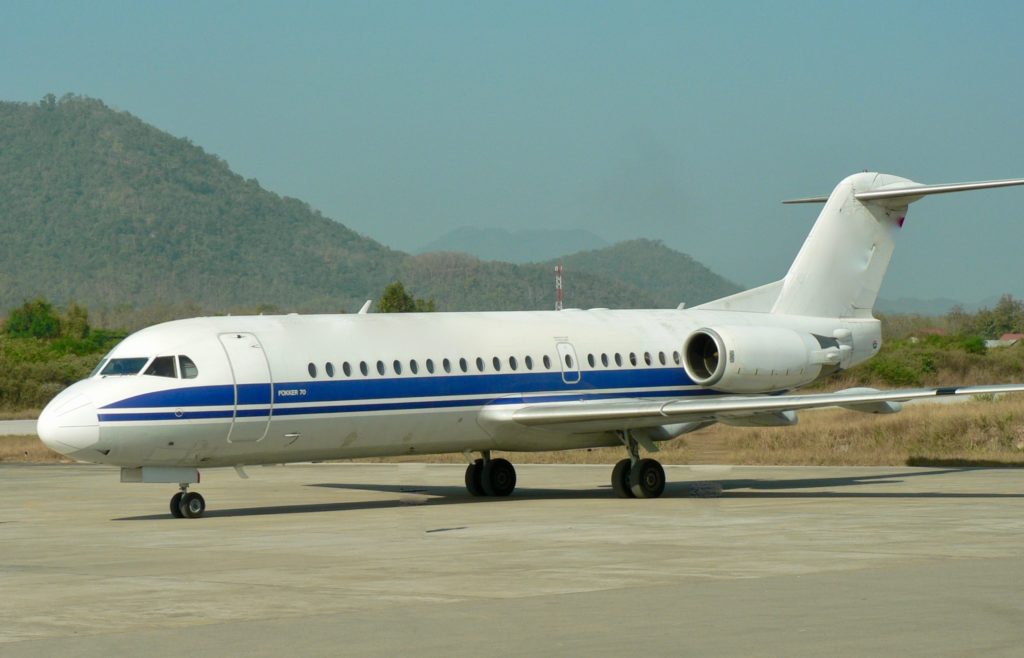
a second life with charter services once airlines had moved on.
Orders & Deliveries
The Fokker 70 achieved modest commercial success due to Fokker’s financial difficulties during the mid‑1990s. Despite strong interest from several airlines, production ended prematurely in 1997 after only 47 aircraft were built. Nevertheless, the F70 found loyal operators in Europe, Australia, and South America, and many aircraft remained in service for more than two decades.
| Customer | Orders | Deliveries | Notes |
|---|---|---|---|
| Ford Australia | 2 | 2 | Launch customer; used for corporate transport. |
| British Midland | 6 | 6 | First major European airline to adopt the F70. |
| KLM Cityhopper | 21 | 21 | Largest operator; flew the type until 2017. |
| Austrian Airlines | 15 | 15 | Operated the F70 extensively across Europe. |
| Maersk Air | 4 | 4 | Used on Scandinavian regional routes. |
| Lineas Aéreas Paraguayas (LAP) | 2 | 2 | One of the few South American operators. |
| Total | 47 | 47 | All F70s delivered between 1994 and 1997. |
Although the F70’s order book was small, the aircraft proved highly reliable and well‑suited to demanding regional operations. Its steep‑approach capability, strong performance, and commonality with the Fokker 100 made it a favourite among several European carriers. Many F70s remained in service long after production ended, demonstrating the durability and practicality of Fokker’s final generation of jet airliners.
Legacy
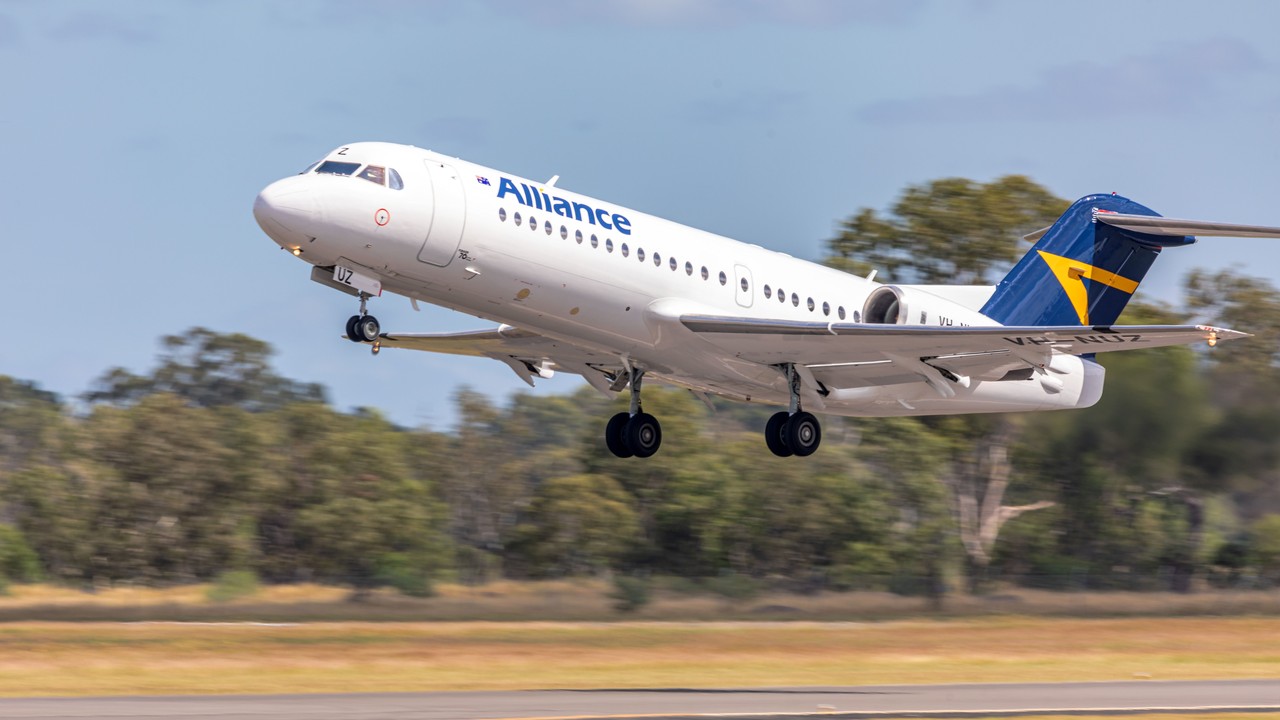
The Fokker 70 occupies a distinctive place in regional aviation history. Although its production run was short, the aircraft demonstrated Fokker’s ability to design practical, efficient jets tailored to the needs of short‑haul operators. By building on the proven Fokker 100 platform, the F70 delivered strong performance, excellent reliability, and valuable fleet commonality at a time when airlines were seeking cost‑effective solutions for thinner routes.
One of the F70’s most notable contributions was its steep‑approach capability, enabled by the clam‑shell air brake inherited from the F28 and F100. This feature allowed the aircraft to operate at London City Airport, one of Europe’s most challenging airfields. Few jets of its size could meet the airport’s demanding 5.5% glide slope, giving the F70 a unique operational niche and making it a favourite among airlines serving business‑focused routes.
Despite strong interest from carriers, the F70’s commercial potential was limited by Fokker’s financial difficulties. Production ended in 1997 after only 47 aircraft were built, yet the type went on to enjoy a long and successful service life. KLM Cityhopper and Austrian Airlines became the largest operators, flying the F70 extensively across Europe for more than two decades. Many pilots praised its handling characteristics, while passengers appreciated its quiet cabin and comfortable ride.
The F70 also played an important role in extending the legacy of the Fokker brand. Alongside the F100, it represented the final generation of Fokker jet airliners, continuing the design philosophy established with the F28 Fellowship: practical engineering, robust construction, and operational flexibility. Even after Fokker’s closure, the F70 remained a reliable and respected aircraft, proving the durability and quality of the company’s final designs.
Today, the Fokker 70 is remembered as a capable and well‑engineered regional jet that served airlines faithfully long after production ceased. Its steep‑approach capability, strong performance, and shared lineage with the F100 ensured it left a lasting mark on regional aviation. Although few examples remain in service, the F70 stands as a testament to Fokker’s enduring contribution to short‑haul air travel.