
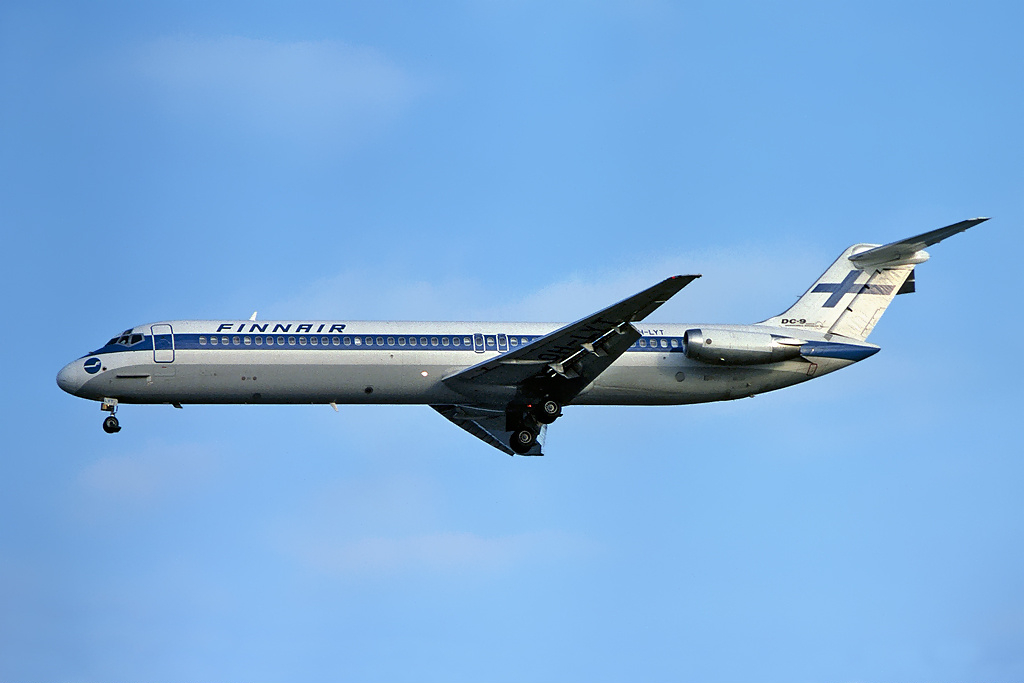
The Douglas DC‑9 is a short to medium‑range twin‑engine jet airliner and the last aircraft fully designed and produced by the Douglas Aircraft Corporation before its merger with McDonnell Aircraft in 1967. Intended to complement the long‑range DC‑8, the DC‑9 was created to serve smaller cities and remote locations with limited airport facilities.
Douglas explored several concepts during the 1950s and early 1960s, including scaled‑down four‑engine designs and studies of European rear‑engined aircraft such as the Sud Aviation Caravelle and BAC One‑Eleven. A brief licensing agreement with Sud Aviation was even signed, but abandoned due to lack of customer interest.
In April 1963, Douglas approved the final DC‑9 design — a compact, efficient, autonomous airliner capable of operating from short or unserviced airfields. The DC‑9 would go on to become one of the most successful short‑haul jetliners of its era.

At‑a‑Glance
| Douglas DC‑9 — At‑a‑Glance | |
|---|---|
| Manufacturer | Douglas Aircraft Corporation / McDonnell Douglas |
| Role | Short to medium‑range jet airliner |
| First Flight | 25 February 1965 (DC‑9‑10) |
| Variants | DC‑9‑10, ‑20, ‑30, ‑40, ‑50 |
| Total Built | 976 aircraft |
| Engines | Pratt & Whitney JT8D series |
| Successors | MD‑80, MD‑90, Boeing 717 |
Development Timeline
| Douglas DC‑9 — Development Timeline | |
|---|---|
| 1950s–early 1960s | Douglas investigates short‑haul jet concepts, including scaled‑down four‑engine designs and European rear‑engined aircraft. |
| 1960 | Proposed Caravelle licence production abandoned due to lack of customer interest. |
| April 1963 | Douglas approves the final DC‑9 design. |
| 25 Feb 1965 | First DC‑9‑10 takes flight. |
| 23 Nov 1965 | DC‑9‑10 receives certification. |
| 08 Dec 1965 | Delta Air Lines begins DC‑9 service. |
| 1966–1975 | DC‑9‑30, ‑40, and ‑50 variants introduced. |
| 1982 | Final DC‑9 delivered. |
| Post‑1982 | DC‑9 evolves into MD‑80, MD‑90, and Boeing 717. |
History
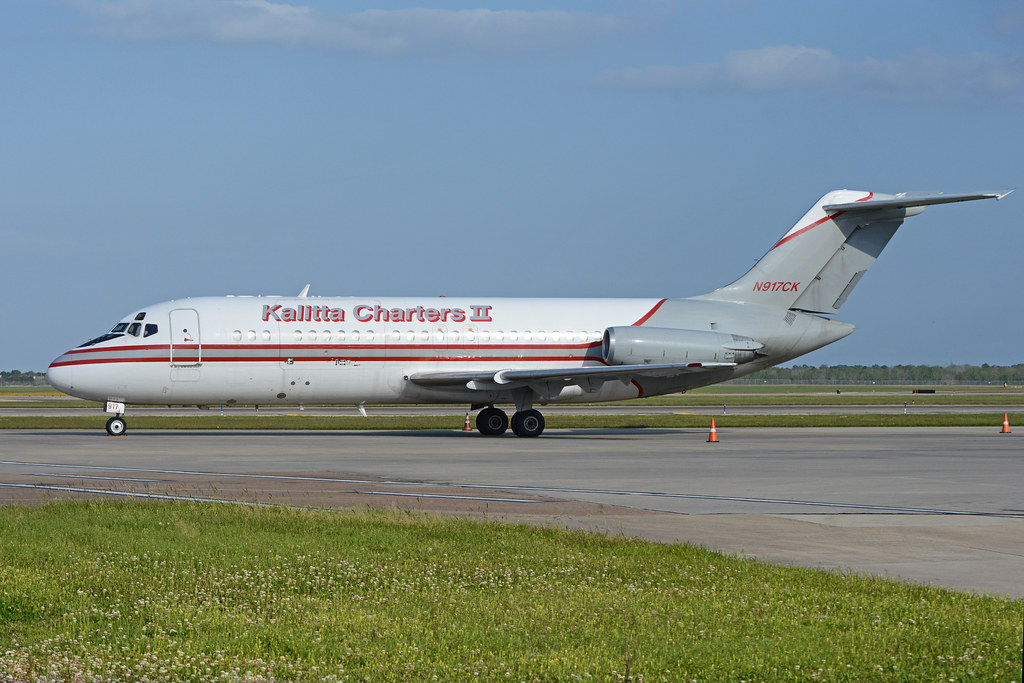
Both the Caravelle and the BAC‑111 were twin rear‑mounted‑engine airliners operating in the same short‑to‑medium‑range market Douglas wanted to enter. Douglas even signed a contract with Sud Aviation to build a Caravelle‑based aircraft under licence, but customers showed little interest and the agreement was abandoned in 1960.
Douglas returned to the drawing board in 1962 with a plan to design a 63‑seat airliner weighing 36,300 kg (80,000 lb). On 8 April 1963, the new design was approved, and the DC‑9 program officially began.
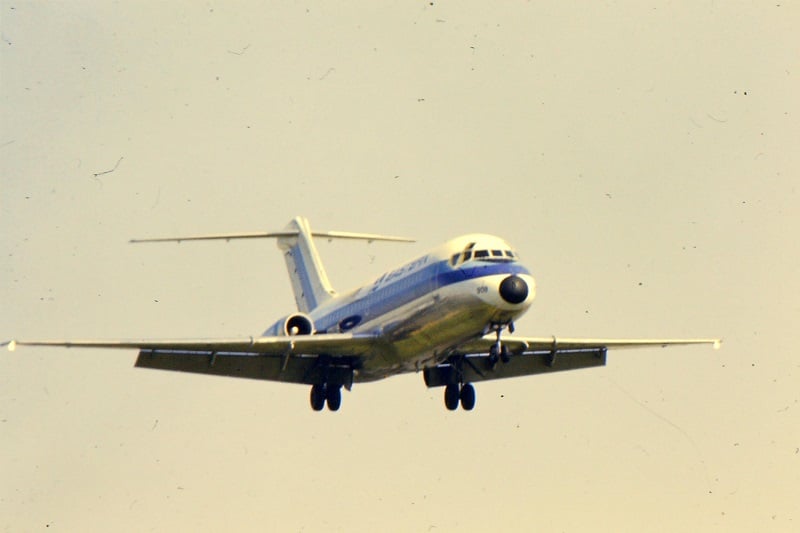
The DC‑9 design featured two rear fuselage‑mounted Pratt & Whitney JT8D turbofan engines, a T‑tail configuration, and a highly efficient wing. The first model, the DC‑9‑10, had no leading‑edge slats because the wing was designed for high lift to support short‑field performance.
This configuration offered several advantages: the absence of wing‑mounted engines allowed full‑span flaps, improving low‑speed lift; the uninterrupted wing surface improved aerodynamic efficiency; and the low stance of the aircraft made baggage handling easier.
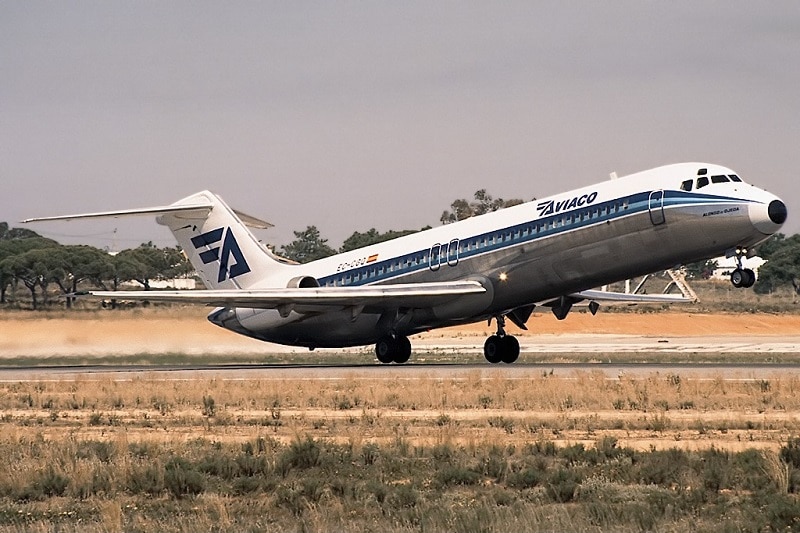
The DC‑9 was designed for autonomy at unserviced airfields. It included an Auxiliary Power Unit (APU) housed in the rear fuselage, providing electrical power on the ground and enabling engine starts without external support. A built‑in rear stairway allowed passengers to board without airport‑provided stairs.
An optional forward stairway was also available, stowed beneath the left‑hand front door. When activated, a flap opened and the folded stairway slid out horizontally before lowering to the ground. Early Boeing 737s also offered this feature.
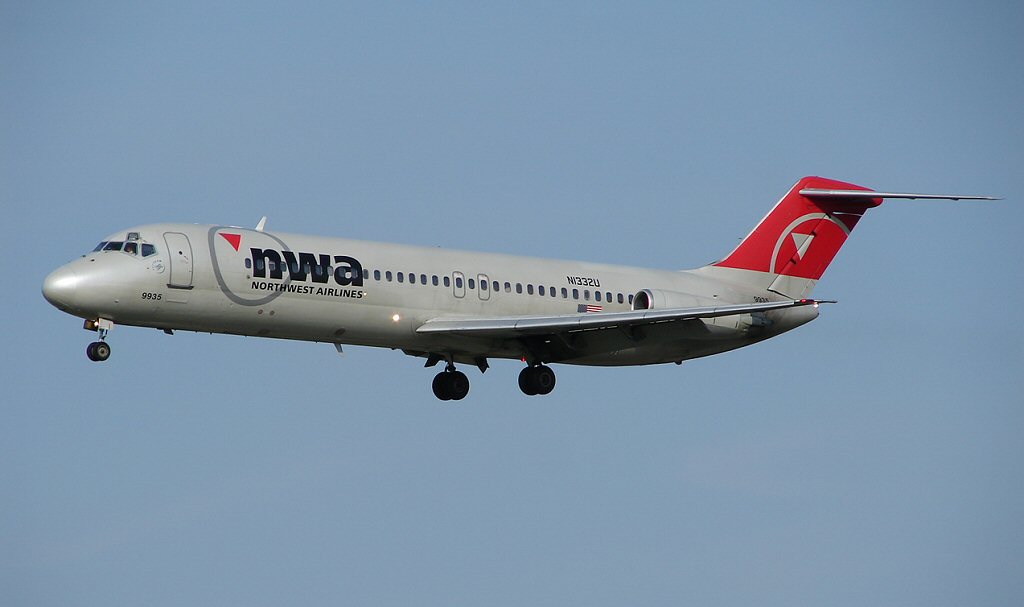
Douglas always intended to produce multiple DC‑9 variants. The DC‑9‑10 was also offered in passenger/cargo versions: the 15MC9 (Minimum Change) with fold‑away seats for overnight cargo, and the 15RC (Rapid Change) with palletised removable seats. Both included a 3.5 m × 2.1 m cargo door and strengthened floor.
New competition emerged from Boeing in the form of the 737, and Douglas responded with the DC‑9‑30. This variant featured a longer fuselage, extended wingtips, full‑length slats, and various JT8D engine options. First flying on 1 August 1966, it entered service with Eastern Air Lines in February 1967.
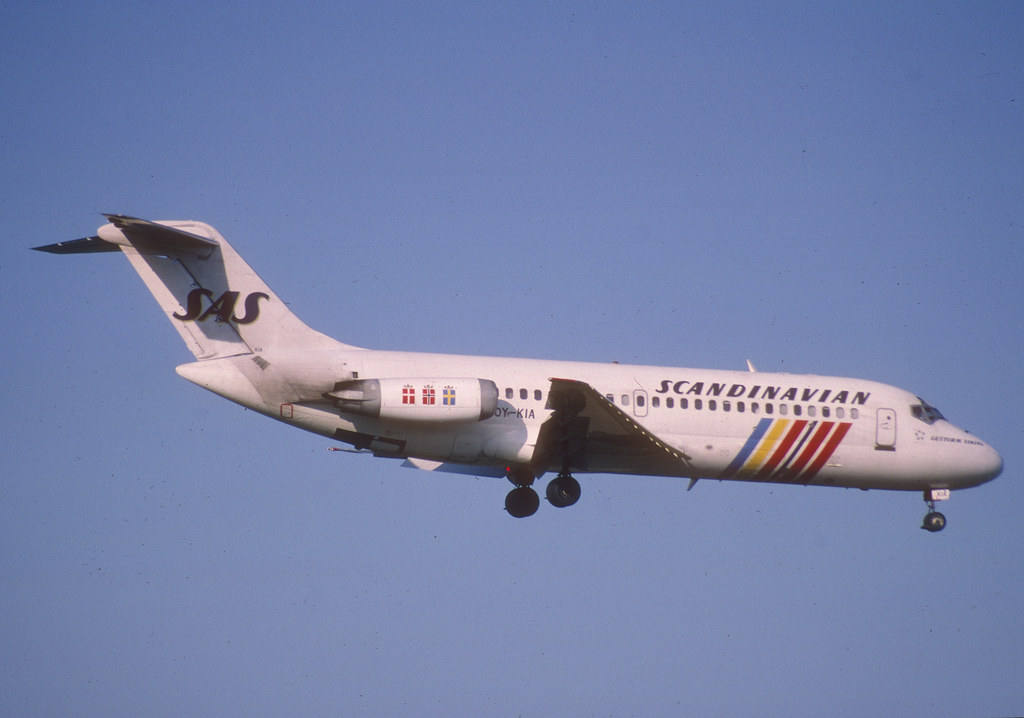
Scandinavian Airlines System (SAS) requested a short‑field variant, leading to the DC‑9‑20. It combined the DC‑9‑10 fuselage with the DC‑9‑30 wing and more powerful engines. First flight: 18 September 1968. SAS was the sole customer, ordering ten aircraft.
Douglas further lengthened the DC‑9 with the DC‑9‑40, first flying in March 1968. Seventy‑one were built.
The largest variant was the DC‑9‑50, first flying in 1974 and entering service with Eastern Air Lines in August 1975. Ninety‑six were built, seating up to 139 passengers. Improvements included spray deflectors for the nose wheel, small fins under the cockpit windows, and reverse thrust angled upward by 17 degrees — a feature developed by Air Canada.
Douglas delivered 976 DC‑9 aircraft before production ended in 1982. The design lived on through the MD‑80 and MD‑90 families, and ultimately the Boeing 717 after McDonnell Douglas merged with Boeing in 1997.
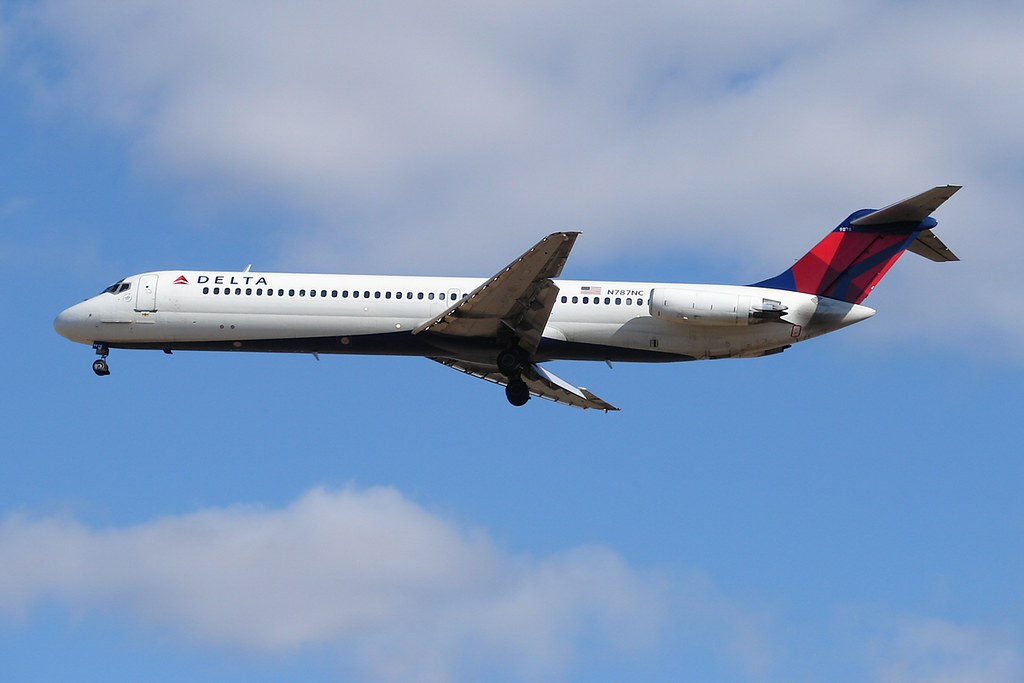
Specifications
Douglas DC‑9 Specifications Table
| -10 | -20 | -30 | -40 | -50 | |
|---|---|---|---|---|---|
| Flight Crew | 2 | ||||
| Milestones | |||||
| Maiden Flight | 25 FEB 1965 | 18 SEP 1968 | 01 AUG 1966 | 28 NOV 1967 | 1974 |
| Entry Into Service | 08 DEC 1965 | 27 JAN 1969 | FEB 1967 | MAR 1968 | AUG 1975 |
| Launch Airline | Delta Air Lines | Scandinavian Airline System | Eastern Air Lines | Scandinavian Airline System | Eastern Air Lines |
| Number Produced | 137 | 10 | 621 | 71 | 96 |
| Dimensions | |||||
| Number of Passengers (1 class) | 90 | 115 | 125 | 135 | |
| Passenger Limit by Exits | 109 | 127 | 128 | 139 | |
| Aircraft Length | 31.82M (104F 5I) | 36.36M (119F 4I) | 38.28M (125F 7I) | 40.72M (133F 7I) | |
| Height | 8.4M (27F 7I) | 8.5M (27F 11I) | 8.7M (28F 5I) | 8.8M (28F 9I) | |
| Wing Span | 27.25M (89F 5I) | 28.44M (93F 4I) | 28.44M (93F 4I) | 28.45M (93F 4I) | |
| Fuselage Width | 3.34M (11F) | ||||
| Cabin Width | 3.11M (10F 2I) | ||||
| Cargo | 17M³ / 600F³ | 25.3M³ / 895F³ | 28.9M³ / 1,019F³ | 33.2M³ / 1,174F³ | |
| Weights | |||||
| Max Takeoff Weight (MTOW) | 41,141K (90,700lb) | 45,359K (98,000lb) | 48,988K (108,000lb) | 51,710K (114,000lb) | 54,885K (121,000lb) |
| Max Landing Weight (MLW) | 37,058K (81,700lb) | 43,227K (95,300lb) | 44,906K (99,000lb) | 46,266K (102,000lb) | 49,895K (110,000lb) |
| Max Empty Weight (MEW) | 22,300K (49,162lb) | 23,879K (52,644lb) | 25,789K (56,855lb) | 27,821K (61,335lb) | 29,336K (64,675lb) |
| Max Fuel | 11,223K (24,743lb) | 11,181K (24,649lb) | |||
| Performance | |||||
| Engines × 2 | JT8D (Various models) | ||||
| Thrust | 54.5kN (12,250lbf) – 71kN (16,000lbf) | ||||
| Ceiling | 35,000F (11,000M) | ||||
| MMo | 484Kn / Mach 0.84 / 897kph | ||||
| Range | 1,300NM (2,400Km) | 1,500NM (2,800Km) | 1,200NM (2,200Km) | 1,300NM (2,400Km) | |
Orders and Deliveries
| Customers | Ordered | Delivered |
|---|---|---|
| Adria Airways d.d. | 7 | 7 |
| Aero Trasporti Italiani | 14 | 14 |
| Aeromexico | 25 | 24 |
| Aeropostal | 9 | 9 |
| Air Atlantis | 3 | 3 |
| Air Canada | 50 | 50 |
| Air Jamaica | 3 | 3 |
| Air Serbia | 14 | 14 |
| Alitalia | 38 | 38 |
| Ansett Australia | 12 | 12 |
| ATAircraft One | 7 | 7 |
| Australian Airlines Limited | 12 | 12 |
| Austrian Airlines | 15 | 14 |
| AVENSA | 3 | 3 |
| AVIACO | 16 | 16 |
| Balair/CTA | 2 | 2 |
| Bonanza Airlines | 4 | 4 |
| BWIA | 5 | 5 |
| Delta Air Lines | 77 | 77 |
| Dominicana Airlines | 1 | 1 |
| Dutch Caribbean Airlines | 3 | 3 |
| East African Airways | 3 | 3 |
| Eastern Air Lines | 96 | 96 |
| EgyptAir | 6 | 0 |
| Finnair | 12 | 12 |
| Garuda Indonesia | 25 | 25 |
| Ghana Airways | 1 | 1 |
| Hawaiian Airlines | 20 | 20 |
| Hughes Airwest, Inc. | 16 | 16 |
| Iberia Airlines | 35 | 35 |
| Customers (Contd.) | Ordered | Delivered |
|---|---|---|
| Italian Air Force | 2 | 2 |
| Japan Airlines Co., Ltd. | 22 | 22 |
| KLM Royal Dutch Airlines | 24 | 24 |
| Korean Air | 1 | 1 |
| Kuwait Air Force | 2 | 2 |
| Martinair Cargo | 4 | 4 |
| Midway Airlines | 5 | 0 |
| NEA Holdings, Inc. | 15 | 15 |
| North Central Airlines | 41 | 41 |
| Ozark Air Lines | 19 | 19 |
| Pacific Southwest Airlines | 2 | 2 |
| Pan Adria | 1 | 1 |
| Playboy | 1 | 1 |
| Purdue Airlines | 2 | 2 |
| Republic Airlines | 7 | 7 |
| Saudi Arabian Airlines | 3 | 3 |
| Scandinavian Airlines | 61 | 61 |
| Southern Airways – USA | 15 | 11 |
| Spantax | 2 | 0 |
| Standard Airways | 2 | 2 |
| Suedflug | 2 | 2 |
| Swissair | 40 | 37 |
| Texas Air Corporation | 20 | 20 |
| Tracinda Corp. | 1 | 1 |
| Trans Carib Air | 3 | 3 |
| Turkish Airlines | 10 | 10 |
| TWA | 20 | 20 |
| U.S. Air Force | 24 | 24 |
| United Airlines | 23 | 23 |
| United States Navy | 20 | 17 |
| US Airways, Inc. | 69 | 69 |
| West Coast Airlines – UK (Inactive) | 4 | 4 |
| Grand Total | 1001 | 976 |
Legacy
The Douglas DC‑9 became one of the most influential short‑haul jetliners of the 20th century. Its rugged design, autonomous features, and efficient performance made it ideal for airlines operating into smaller airports with limited ground services.
The DC‑9’s success led directly to the MD‑80 and MD‑90 families, and ultimately the Boeing 717 — a testament to the strength and longevity of the original design.
With 976 aircraft delivered and decades of service worldwide, the DC‑9 remains a landmark in Douglas’s history and a favourite among aviation enthusiasts.
>His