
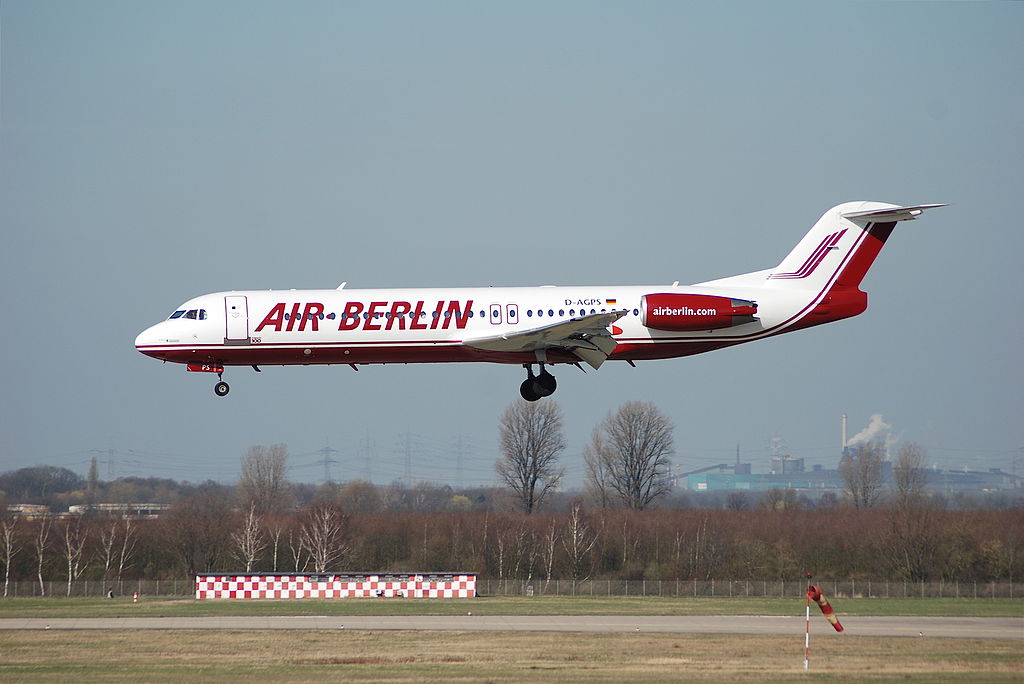
The Fokker 100, officially designated the F28 Mark 0100, is a Netherlands‑built regional jet developed during the 1980s. Designed to fill the growing demand for a 100‑seat short‑haul airliner, the F100 became one of Fokker’s most successful commercial aircraft. Its combination of modernised systems, improved aerodynamics, and increased passenger capacity made it an attractive option for airlines seeking efficiency and comfort on regional routes.
The aircraft enjoyed strong early sales, with major carriers placing significant orders soon after its launch. Its quiet operation, reliable performance, and straightforward maintenance requirements helped it gain a loyal following among operators worldwide.
Despite its strengths, the F100’s long‑term success was ultimately limited by economic pressures facing Fokker during the 1990s. The company’s financial difficulties overshadowed the aircraft’s capabilities, and production ended shortly after Fokker declared bankruptcy in 1996.
Even so, the Fokker 100 remains a respected and widely recognised regional jet. Many examples continue flying today, supported by dedicated maintenance networks and operators who value the aircraft’s dependable design and operational flexibility.
Fokker F100 at a Glance
| Category | Tay 620 Variant | Tay 650 Variant |
|---|---|---|
| First Flight | 28 November 1986 | 1989 |
| Engines | Rolls‑Royce Tay 620‑15 | Rolls‑Royce Tay 650‑15 |
| Thrust (each) | 61.6 kN (13,850 lbf) | 67.2 kN (15,100 lbf) |
| MTOW | 43,090 kg (95,000 lb) | 45,810 kg (100,900 lb) |
| Typical Seating | 97–109 passengers | |
| Range (max) | 2,450 km (1,323 nm) | 3,170 km (1,710 nm) |
| Cruise Speed | Mach 0.77 (845 km/h) | |
| Service Ceiling | 35,000 ft (11,000 m) | |
| Production | 283 aircraft built | |
| Years of Manufacture | 1986–1997 | |
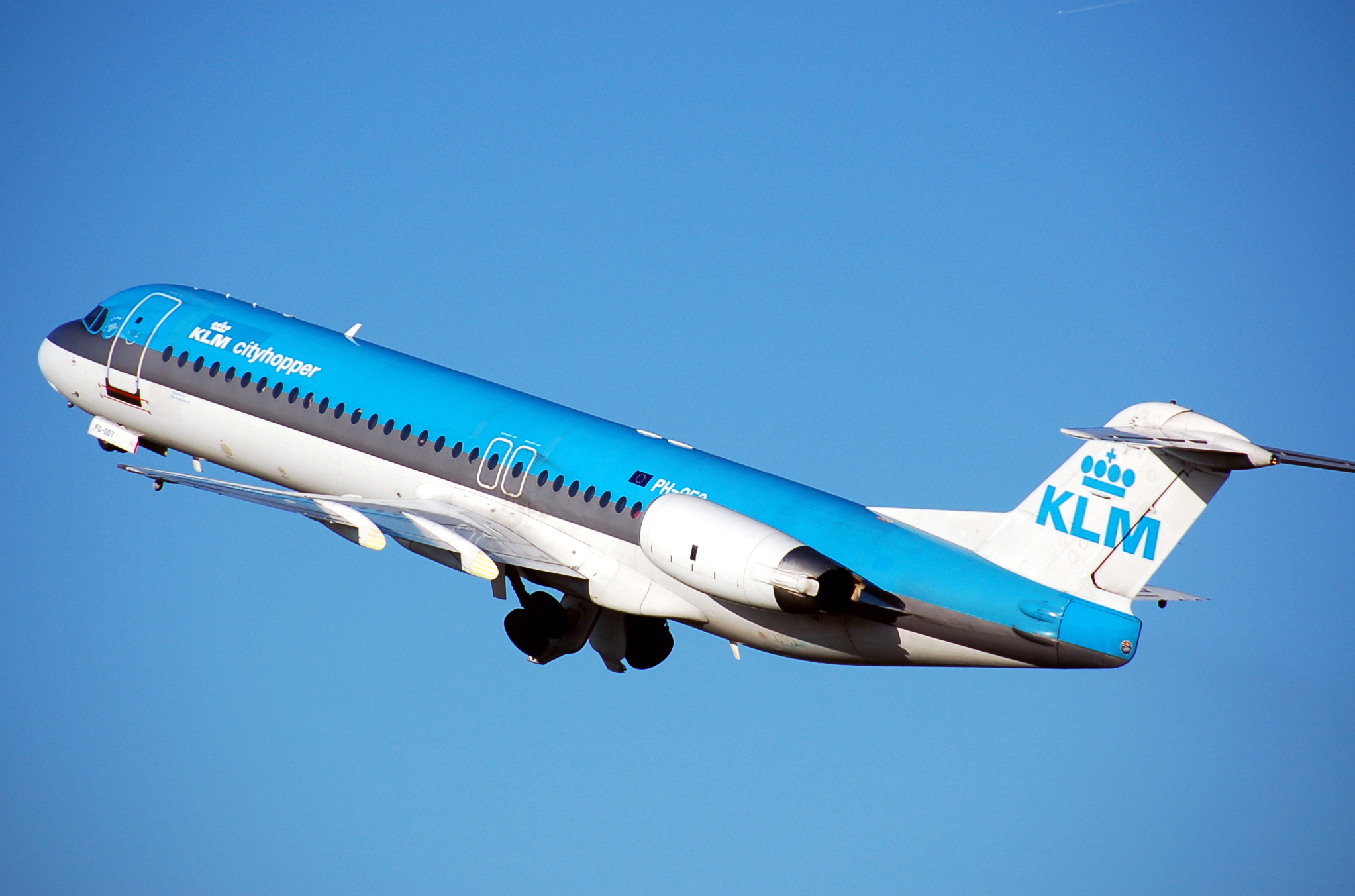
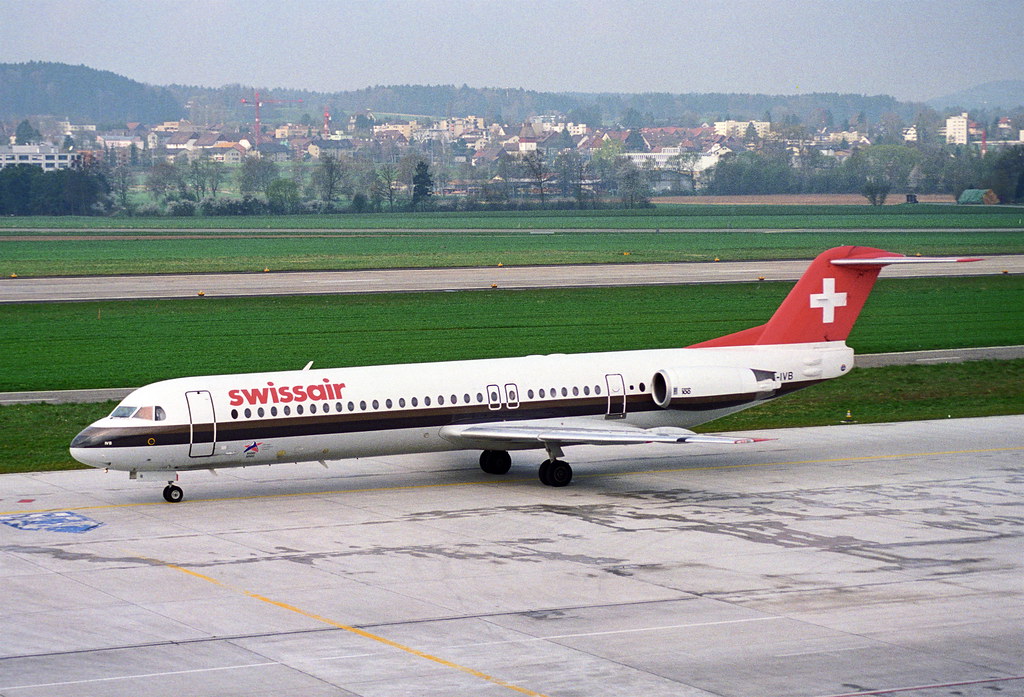
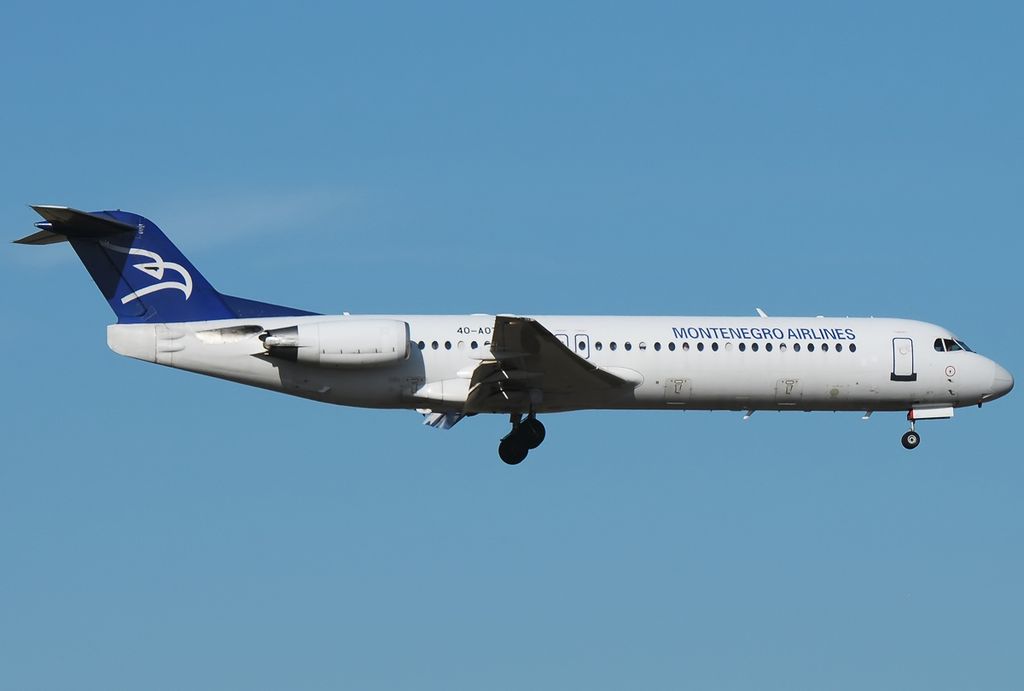
| Notable Operators | Swissair, American Airlines, USAir, TAM, KLM Cityhopper, Carpatair, Montenegro Airlines | |

Development Timeline
The development of the Fokker F100 was driven by the company’s desire to build on the success of the F28 Fellowship and meet growing demand for a modern 100‑seat regional jet. The timeline below outlines the major milestones from concept to production.
| Year | Milestone |
|---|---|
| 1983 | Fokker announces the Fokker 100 program and applies for approval of the new airframe on 25 March. |
| 1986 | First prototype completed on 01 November, registered PH‑MKH. |
| 1987 | Second prototype completed on 25 February, registered PH‑MKC. Type receives certification on 20 November after extensive testing. |
| 1988 | First customer delivery to Swissair in February, powered by Rolls‑Royce Tay 620‑15 engines. |
| 1989 | American Airlines places the largest order in Fokker’s history: 75 aircraft powered by the Tay 650‑15. TAM and USAir also place major orders. |
| 1992 | Fokker introduces the shortened Fokker 70 (F70), a derivative of the F100 for lower‑capacity routes. |
| 1995 | Noise testing at John Wayne Airport shows the F100 is quieter than the BAe 146 Whisperjet. |
| 1996 | After several years of financial losses, Fokker declares bankruptcy. Production of the F100 winds down. |
| 1997 | Final Fokker 100 airframes completed; production officially ends. |
| 2019 | 101 Fokker 100s remain in service with 19 airlines worldwide. |
History
Fokker’s long history in aircraft manufacturing began with its founder, Anthony Fokker, who established his first aviation business in Germany in 1912 before returning to the Netherlands in 1919. The company thrived during the 1920s and 1930s, a period of rapid advancement in aviation, but ultimately ceased operations in 1996 after years of financial losses.
Building on the success of the F28 Fellowship, Fokker identified a growing market need for a regional jet in the 100‑seat category. In 1983, the company announced the Fokker 100 program and applied for approval of the new airframe on 25 March. The design was based on the F28 Fellowship Mark 4000, retaining its rear‑mounted twin engines and T‑tail configuration, but incorporating significant upgrades and a stretched fuselage.
Two prototypes were constructed to support certification. The first, PH‑MKH, was completed on 01 November 1986. The second, PH‑MKC, followed on 25 February 1987. After extensive testing, the Fokker 100 received certification on 20 November 1987.
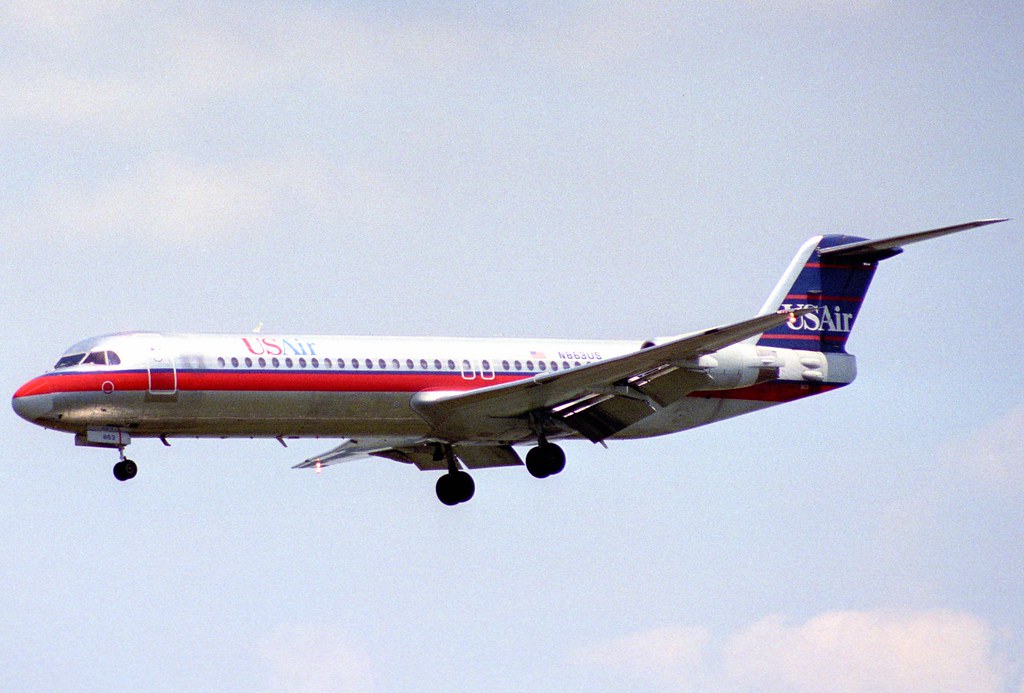
With certification secured, Fokker delivered the first production aircraft to Swissair in February 1988, powered by Rolls‑Royce Tay 620‑15 engines. The aircraft quickly attracted major interest from airlines. American Airlines placed a landmark order for 75 aircraft in March 1989, powered by the more powerful Tay 650‑15 engines. TAM Transportes Aéreos Regionais ordered 50 airframes, and USAir ordered 40. The American Airlines order, valued at US$3.1 billion, was the largest ever placed with a Dutch company at the time.
The Fokker 100 proved to be a quiet aircraft as well. Noise tests at John Wayne Airport in California showed it was even quieter than the famously low‑noise BAe 146 Whisperjet. The aircraft’s performance, comfort, and operating economics made it a strong competitor in the regional jet market.
However, the 1990s brought increasing competition from new regional jets, which gradually eroded the F100’s sales momentum. In 1992, Fokker introduced the shortened Fokker 70 (F70) to complement the F100, but financial pressures continued to mount. Even after being acquired by Deutsche Aerospace AG, Fokker’s financial situation did not improve.
By 1996, after several years of losses, Fokker declared bankruptcy. Production of the F100 ended in 1997, marking the conclusion of the company’s final commercial jet program. Although various proposals to revive the aircraft surfaced over the years, none came to fruition.
Despite the end of production, the Fokker 100 has enjoyed a long service life. A total of 283 airframes were built, and by mid‑2019, 101 aircraft remained in service with 19 airlines worldwide. Its durability, simplicity, and strong performance continue to make it a valued aircraft among operators.
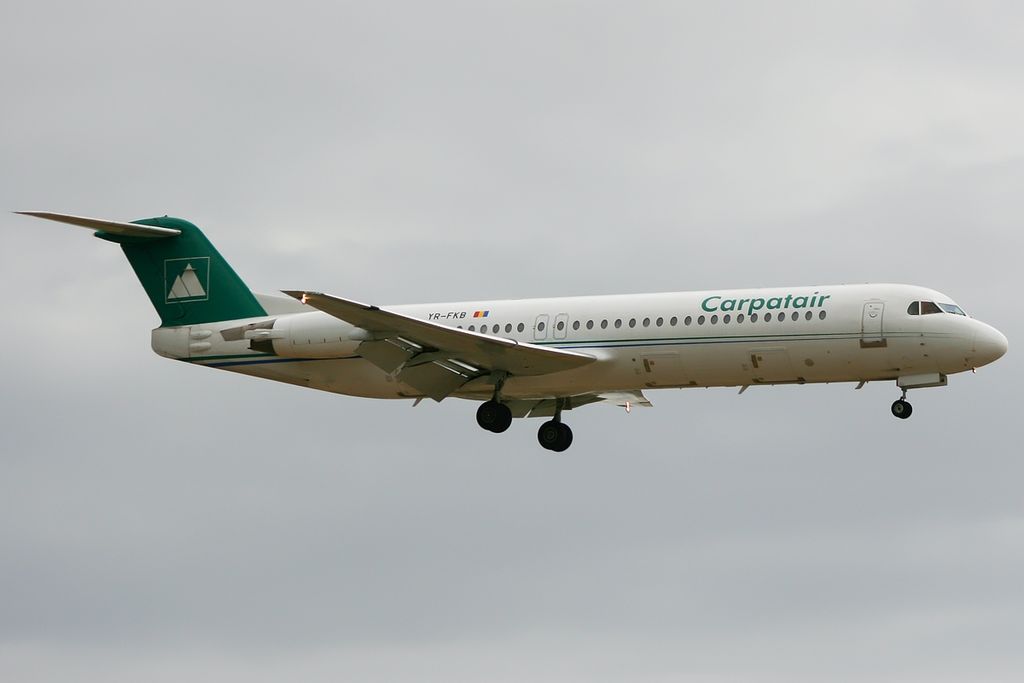
Specifications
| Type | Fokker 100 (Tay 620) | Fokker 100 (Tay 650) |
|---|---|---|
| First Flight | 28 November 1986 | 1989 |
| Crew | 2 | |
| Passengers | Max 122 (1‑class), Typical 107 (1‑class), Typical 97 (2‑class) | |
| Cabin Width (Internal) | 3.10 m (10 ft 2 in) | |
| Cabin Height (Internal) | 2.01 m (6 ft 7 in) | |
| Fuselage Width | 3.30 m (10 ft 10 in) | |
| Aircraft Length | 35.53 m (116 ft 7 in) | |
| Tail Height | 8.50 m (27 ft 11 in) | |
| Main Wing Span | 28.08 m (92 ft 2 in) | |
| Main Wing Area | 93.5 m² (1,006 ft²) | |
| Empty Weight | 24,375 kg (53,738 lb) | 24,541 kg (54,104 lb) |
| MTOW | 43,090 kg (95,000 lb) | 45,810 kg (100,900 lb) |
| Maximum Payload | 11,242 kg (24,784 lb) | 11,993 kg (26,440 lb) |
| Takeoff Distance (MTOW) | 1,520 m (4,988 ft) | 1,621 m (5,319 ft) |
| Fuel Capacity | 13,365 L (2,940 imp gal; 3,531 US gal) | |
| Engines (x2) | Rolls‑Royce Tay 620‑15 | Rolls‑Royce Tay 650‑15 |
| Thrust (each) | 61.6 kN (13,850 lbf) | 67.2 kN (15,100 lbf) |
| Max Cruise Speed | Mach 0.77 (456 kn / 525 mph / 845 km/h) | |
| Service Ceiling | 35,000 ft (11,000 m) | |
| Range (Fully Laden) | 2,450 km (1,323 nm / 1,522 mi) | 3,170 km (1,710 nm / 1,970 mi) |
Assembly
The Fokker 100 was developed as a modernised and enlarged evolution of the F28 Fellowship. While the aircraft retained the F28’s rear‑mounted twin‑engine layout and T‑tail configuration, almost every major structure was redesigned or upgraded to meet the performance, efficiency, and capacity requirements of a 100‑seat regional jet.
To support the program, Fokker worked with a network of international construction partners who supplied major components and systems. These collaborations allowed Fokker to scale production while incorporating advanced materials, improved aerodynamics, and updated manufacturing techniques.
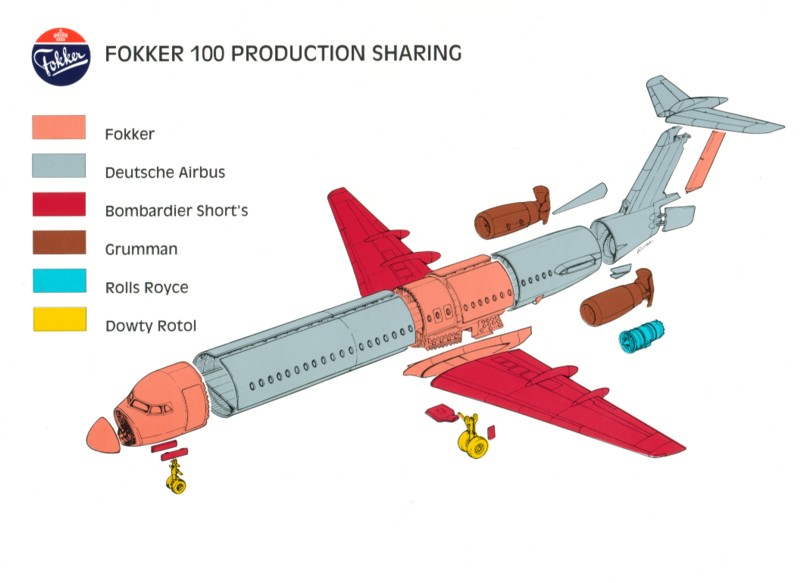
The upsizing of the F100 over the F28 included a fuselage stretch of 5.74 metres (18 ft 10 in), an increased wingspan of 3.0 metres (9 ft 10 in), and a horizontal stabiliser widened by 1.4 metres (4 ft 7 in). Passenger capacity increased from 85 seats to a maximum of 122 in a single‑class configuration.
The wing was completely redesigned with extended leading and trailing edges, providing improved aerodynamic efficiency. Fokker deliberately retained a simple wing structure without leading‑edge slats, reducing weight and maintenance complexity. The new wing was found to be approximately 30% more efficient in cruise compared to the F28.
Maximum weights were increased, requiring strengthened landing gear and improved braking systems. Despite these changes, fuel capacity, service ceiling, and maximum speed remained similar to the F28.
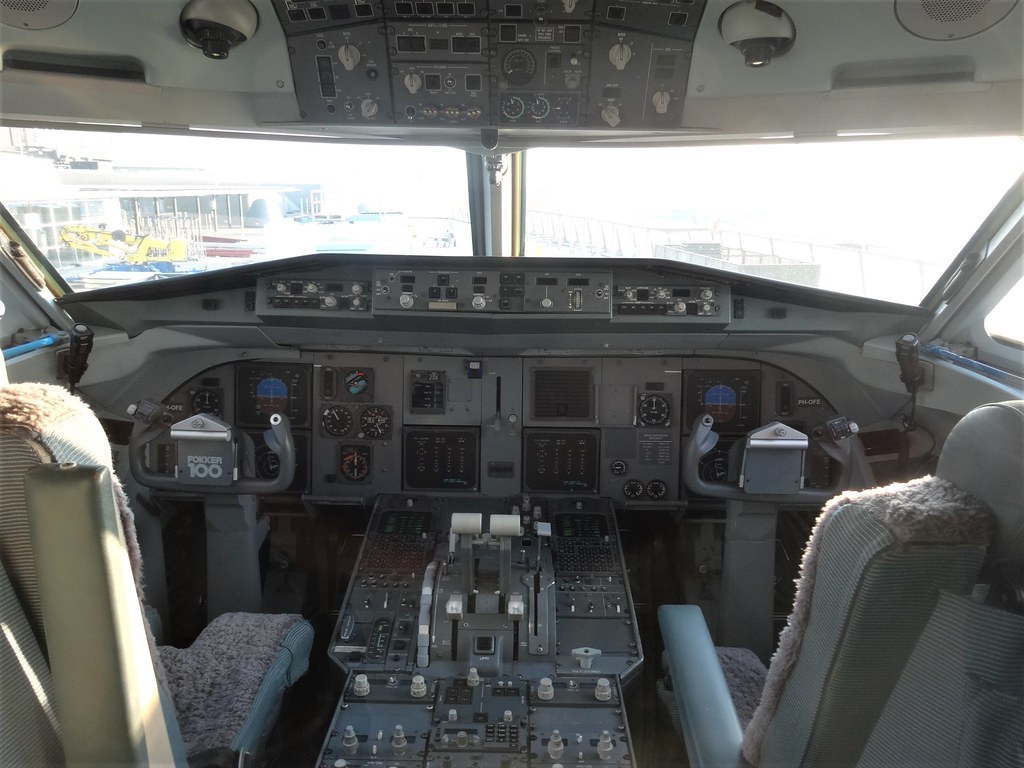
The cockpit received one of the most significant upgrades. The F100 introduced the Rockwell Collins DU‑1000 EFIS digital flight deck, replacing the analogue instrumentation of the F28. This system provided:
- Flight Management System (FMS)
- Autopilot and flight director
- Thrust management system
- Electronic flight instrument displays
- ARINC data communications
- Category III autoland capability
One notable design change was the removal of the F28’s distinctive cockpit eyebrow windows, giving the F100 a cleaner and more modern flight deck profile.
Overall, the F100’s assembly process combined proven F28 design principles with substantial structural, aerodynamic, and technological improvements. These enhancements allowed Fokker to deliver a competitive and efficient regional jet that met the evolving needs of airlines throughout the late 1980s and early 1990s.
Orders & Deliveries
The Fokker 100 entered the market with strong momentum, attracting major orders from airlines across Europe, the Americas, and South America. Its combination of modern systems, quiet operation, and efficient performance made it an appealing choice for regional carriers seeking a reliable 100‑seat jet.
The first customer delivery took place in February 1988, when Swissair received the initial production aircraft powered by Rolls‑Royce Tay 620‑15 engines. This marked the beginning of a successful early sales period for the type.
American Airlines placed the largest order in Fokker’s history in March 1989, committing to 75 aircraft equipped with the more powerful Tay 650‑15 engines. Valued at US$3.1 billion, it was the largest single order ever placed with a Dutch company at the time. TAM Transportes Aéreos Regionais followed with an order for 50 airframes, while USAir ordered 40, further strengthening the F100’s global presence.
Despite strong initial demand, competition from newer regional jets in the 1990s gradually slowed sales. Fokker’s financial difficulties ultimately overshadowed the aircraft’s commercial potential, and production ended in 1997 following the company’s bankruptcy the previous year.
In total, Fokker produced 283 F100 airframes. By mid‑2019, 101 aircraft remained in service with 19 airlines worldwide, demonstrating the type’s durability and continued relevance in regional aviation.
Legacy
The Fokker 100 occupies a significant place in regional aviation history. As the largest airliner ever produced by Fokker, it represented the company’s most ambitious commercial aircraft program and showcased its ability to modernise proven designs while meeting evolving market demands. The aircraft’s quiet operation, efficient performance, and comfortable cabin made it a favourite among both airlines and passengers during its peak years.
Despite strong early sales and major orders from airlines such as American Airlines, Swissair, TAM, and USAir, the F100’s long‑term success was ultimately constrained by external factors. Growing competition from newer regional jets in the 1990s, combined with Fokker’s mounting financial difficulties, overshadowed the aircraft’s strengths. The company’s bankruptcy in 1996 brought an abrupt end to production, leaving the F100 as the final chapter in Fokker’s long history of aircraft manufacturing.
Yet the Fokker 100’s legacy endures. Its robust design, straightforward maintenance, and reliable performance have allowed many airframes to remain in service decades after production ceased. By mid‑2019, 101 aircraft were still flying with 19 airlines worldwide, a testament to the type’s durability and the loyalty of operators who continue to value its capabilities.
Today, the Fokker 100 is remembered not only as a successful regional jet but also as a symbol of Fokker’s engineering heritage. It stands as a reminder of the company’s contributions to commercial aviation and its ability to innovate within a competitive and rapidly changing industry.