
Introduction
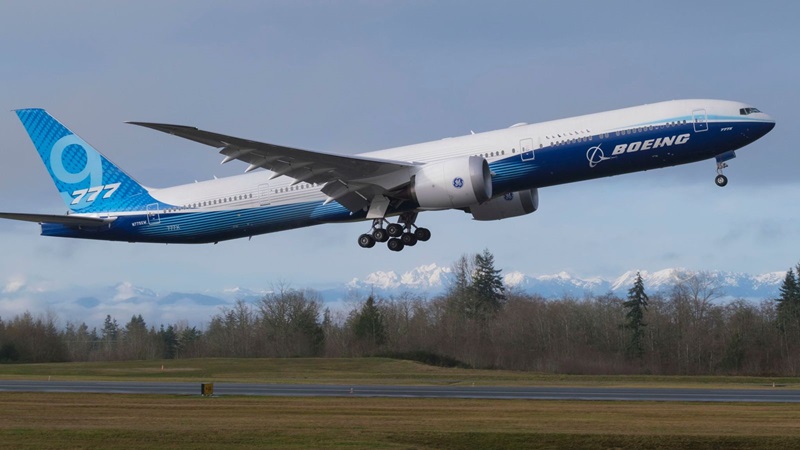
The Boeing 777X is Boeing’s next‑generation long‑range wide‑body airliner, designed to succeed the hugely successful 777‑300ER and compete directly with the Airbus A350. Built around a new composite wing with folding wingtips, the world‑leading GE9X engines, and a wider, more comfortable cabin, the 777X represents the most significant evolution of the 777 family since its launch in the early 1990s.
Boeing developed the 777X in response to changing market demands. Airlines wanted an aircraft that could match the 777‑300ER’s payload and reliability while delivering substantially lower fuel burn and operating costs. At the same time, the arrival of the A350 pushed Boeing to modernise its flagship twin‑engine wide‑body rather than pursue an entirely clean‑sheet design. The result was a new family — the 777‑8 and 777‑9 — combining proven 777 architecture with advanced materials, aerodynamics, and systems.
The most distinctive innovation is the 777X’s composite wing, the largest wing ever fitted to a Boeing commercial aircraft. Its long, raked design improves lift and efficiency, while the folding wingtips allow the aircraft to retain compatibility with existing airport gates. The aircraft also introduces the GE9X, the most efficient high‑thrust commercial turbofan ever built, along with a wider cabin, larger windows, improved lighting, and updated systems throughout.
The 777X program has experienced a complex development path. After its first flight in January 2020, the aircraft entered an extended certification campaign shaped by structural test issues, GE9X redesign work, and the global slowdown in aviation during COVID‑19. As of 2026, flight testing continues from Boeing’s Everett facilities, with entry into service now expected in the 2025–2026 timeframe. Major customers including Emirates, Lufthansa, Qatar Airways, and Singapore Airlines remain committed to the type, and Boeing has also launched the 777‑8F freighter variant to replace the 777F in the next decade.

Boeing 777X At‑a‑Glance
| Summary | Boeing 777X Family Overview |
|---|---|
| Aircraft Family | Boeing 777X |
| Variants | 777‑8, 777‑9, 777‑8F (Freighter) |
| Role | Long‑range wide‑body twin‑jet |
| Launch Year | 2013 |
| First Flight | 25 January 2020 (WH‑001, What WH‑001 means. W = Widebody test program, H = 777X program code, 001 = First airframe built for testing) |
| Entry Into Service | Expected 2025–2026 |
| Engines | GE Aviation GE9X |
| Wingspan | 71.8 m extended / 64.8 m folded |
| Range | 777‑8: ~16,000 km / 777‑9: ~13,900 km |
| Passengers (Typical 2‑Class) | 777‑8: ~384 / 777‑9: ~414 |
| Major Customers | Emirates, Lufthansa, Qatar Airways, Singapore Airlines, Etihad |
| Assembly Location | Boeing Everett Factory, Washington |
| Key Features | Composite wing, folding wingtips, GE9X engines, wider cabin, larger windows, improved lighting |
History
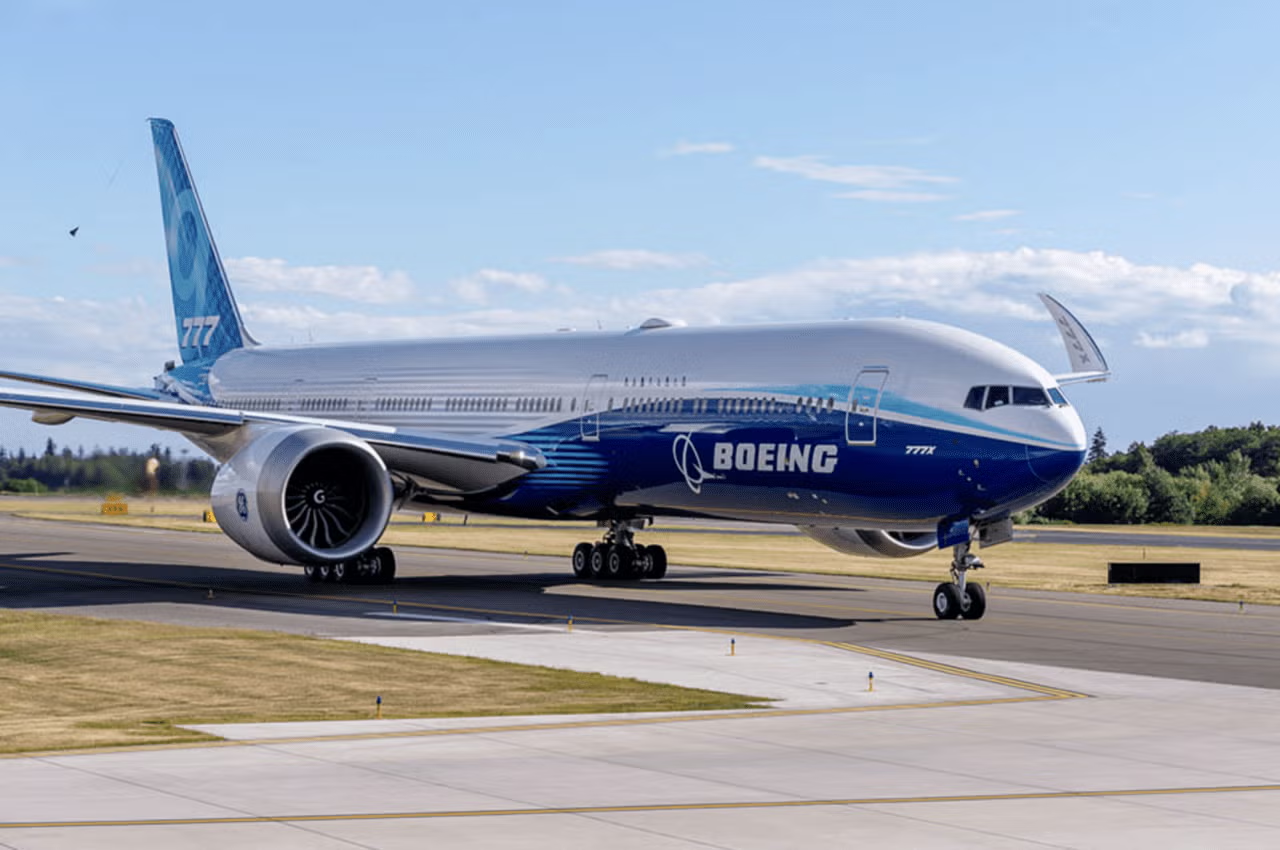
The Boeing 777X program began in the early 2010s as airlines started looking for a successor to the hugely successful 777‑300ER. Although the 300ER had dominated the long‑haul market for more than a decade, rising fuel prices and the arrival of the Airbus A350 pushed Boeing to develop a more efficient, modernised wide‑body aircraft. Rather than design a clean‑sheet replacement, Boeing chose to evolve the proven 777 platform with new materials, new aerodynamics, and the most advanced high‑thrust engines ever built.
Boeing formally launched the 777X family — the 777‑8 and 777‑9 — at the 2013 Dubai Airshow with record‑breaking orders. The design centred on a new composite wing, the largest ever fitted to a Boeing airliner, featuring long raked tips and a unique folding mechanism to maintain compatibility with existing airport gates. The aircraft would also introduce the GE9X, a next‑generation turbofan offering significant improvements in fuel burn and emissions. By 2015 the 777‑9 design was frozen, and major structural components began arriving from partners in Japan and the United States.
A major part of the 777X’s development challenges centred on the GE9X, the most advanced high‑thrust commercial turbofan ever built. With a fan diameter of 134 inches and an overall pressure ratio approaching 60:1, the GE9X incorporates extensive use of ceramic matrix composites (CMCs), allowing hotter core temperatures and improved efficiency. Early testing revealed durability issues in the compressor section, prompting GE to redesign several stages and adjust clearances to improve long‑term reliability. These changes required additional certification cycles and contributed to delays in the 777X flight‑test program. Despite the setbacks, the GE9X ultimately demonstrated significant improvements in fuel burn, emissions, and noise performance compared with the GE90‑115B used on the 777‑300ER.
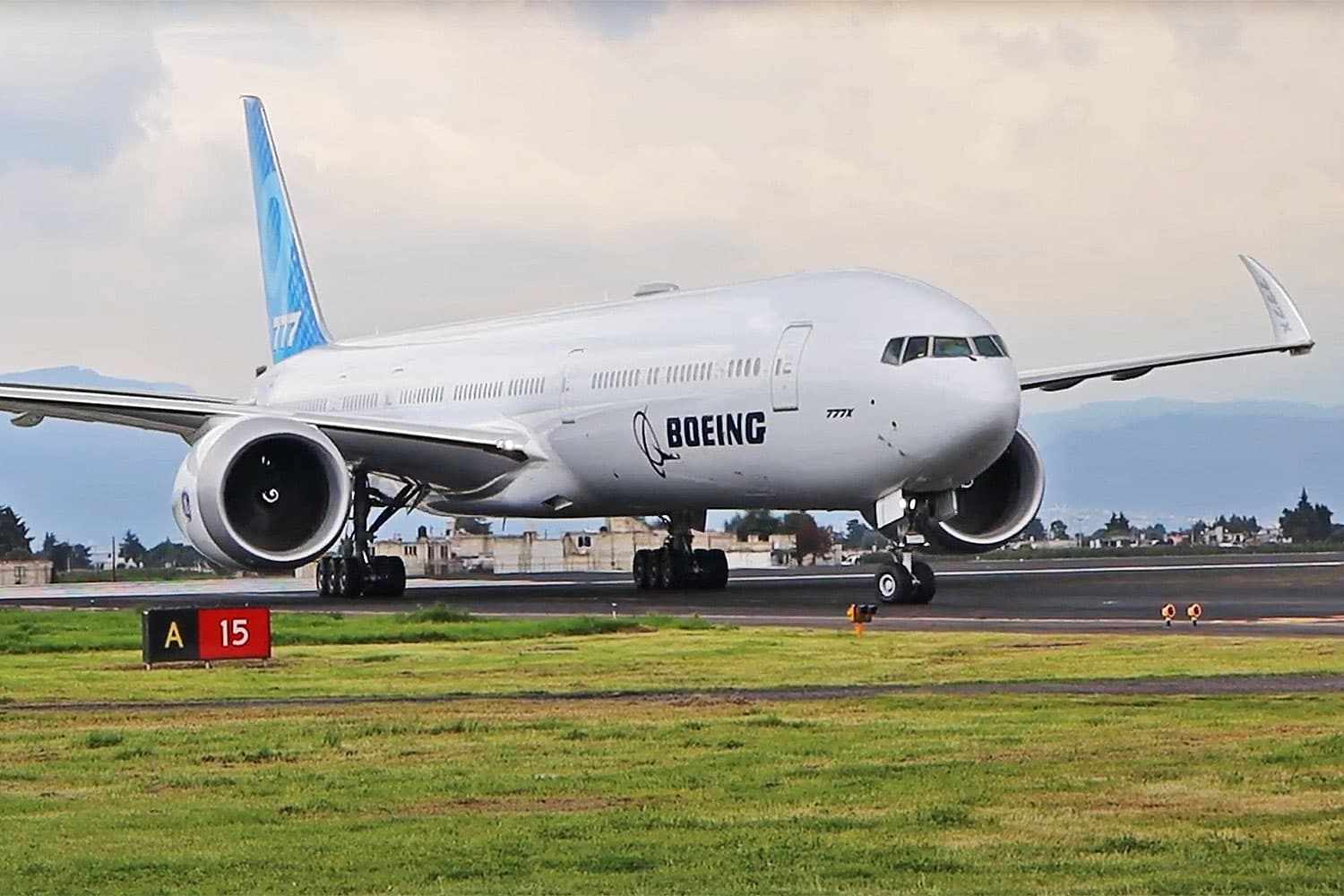
Assembly of the first test aircraft progressed through 2018 and 2019, although the program encountered early challenges. A GE9X compressor durability issue delayed engine certification, and a structural over‑pressurisation test caused a cargo door failure on a static airframe. Despite these setbacks, Boeing rolled out the first flying prototype, WH‑001, and on 25 January 2020 the 777‑9 completed its maiden flight from Paine Field.
Certification of the 777X became substantially more complex following the regulatory environment that emerged after the 737 MAX investigations. The FAA required Boeing to provide far more detailed documentation for the aircraft’s flight‑control software, including the updated fly‑by‑wire architecture and the logic governing the folding wingtips. Regulators also mandated additional structural testing, repeated load‑case analysis, and expanded simulation data to validate the aircraft’s behaviour under abnormal conditions. The folding wingtip mechanism itself required a new certification pathway, ensuring that the tips could not inadvertently deploy or retract during critical phases of flight. These heightened requirements extended the certification timeline and forced Boeing to revise internal processes, but they also resulted in a more thoroughly validated aircraft that meets the FAA’s strengthened post‑MAX standards.
The timing of the first flight coincided with the global aviation downturn caused by COVID‑19. Airlines deferred deliveries, Boeing slowed production, and certification work became more complex as regulators increased scrutiny. From 2021 through 2024 the 777X continued an extended flight‑test campaign, including high‑altitude trials, cold‑weather operations, ETOPS evaluations, and repeated wing‑load testing. Boeing also revealed the updated cabin interior, featuring larger windows, improved lighting, and a wider cabin than previous 777 models.
In 2022 Boeing paused development of the passenger 777‑8 to prioritise the newly launched 777‑8F freighter, which quickly attracted interest from major cargo operators. By 2025 the program had entered its final certification phase, with route‑proving flights and customer aircraft beginning assembly in Everett.
Boeing now targets entry into service in the 2025–2026 timeframe, with Emirates and Lufthansa expected to receive the first deliveries. Despite the delays, airline commitment to the 777X remains strong, and the aircraft is positioned to become Boeing’s flagship long‑range twin‑engine wide‑body for the next generation.
Boeing 777X Development Timeline
| Date | Event |
|---|---|
| 2010–2011 | Boeing responds to Airbus A350 with three 777X concepts, targeting design freeze by 2015 and entry into service in 2019. |
| March 2013 | GE9X selected as the exclusive engine for the 777X. |
| 01 May 2013 | Boeing board approves selling the 777X family. |
| 18 September 2013 | Lufthansa becomes launch customer for the 777‑9. |
| November 2013 | 777‑8 and 777‑9 formally launched at Dubai Airshow with record order value. |
| December 2014 | Boeing begins construction of composite wing facility in St. Louis. |
| August 2015 | Final 777‑9 design locked down. |
| 2017–2018 | Wing box assembly, fuselage sections shipped, and major structural components completed by Japanese partners. |
| March 2018 | Assembly begins on first 777‑9 fuselage. |
| May 2018 | FAA approves folding wingtip design. |
| November 2018 | First test aircraft body join completed. |
| January 2019 | GE9X engines installed on WH‑001. |
| 29 May 2019 | Engine compressor issue delays first flight. |
| 05 September 2019 | Static test over‑pressurisation causes cargo door failure. |
| 25 January 2020 | WH‑001 performs first flight from Paine Field. |
| November 2021 | 777X displays at Dubai Airshow; visits Doha and Frankfurt. |
| 2022 | Boeing revises entry‑into‑service target to 2025; GE9X certification work continues; 777‑8 passenger variant paused in favour of 777‑8F freighter. |
| 2023 | Boeing launches the 777‑8F. FAA requests additional documentation for flight‑control software; structural test improvements implemented. |
| 2024 | Extended flight testing continues. Boeing reveals updated cabin interior. Emirates adjusts delivery expectations; Boeing confirms 2025–2026 EIS window. |
| 2025 | Final certification testing underway, including ETOPS trials and route‑proving flights. First customer aircraft enters assembly. |
| 2026 | Expected entry into service. First deliveries planned for Emirates and Lufthansa. Freighter program milestones achieved for 777‑8F. |
Specifications
| Specification | 777‑8 | 777‑9 |
|---|---|---|
| Manufacturer | Boeing Commercial Airplanes | |
| Role | Long‑range wide‑body twin‑jet | |
| First Flight | TBD | 25 January 2020 (WH‑001) |
| Entry Into Service | Expected 2027+ | Expected 2025–2026 |
| Length | 69.8 m | 76.7 m |
| Wingspan (Extended) | 71.8 m | |
| Wingspan (Folded) | 64.8 m | |
| Height | 19.5 m | |
| Wing Area | ~516 m² | |
| Maximum Takeoff Weight (MTOW) | ~351,500 kg | ~364,000 kg |
| Operating Empty Weight (Approx) | ~220,000 kg | ~230,000 kg |
| Range | ~16,000 km | ~13,900 km |
| Cruise Speed | Mach 0.84 | |
| Maximum Speed | Mach 0.89 | |
| Engines | 2 × GE Aviation GE9X | |
| Thrust | 105,000 lbf (470 kN) | |
| Typical Seating (2‑Class) | ~384 | ~414 |
| Maximum Seating | ~440 | ~475 |
| Cargo Volume | ~200 m³ | ~220 m³ |
| Flight Deck Crew | 2 | |
| Cabin Crew (Typical) | 10–13 | |
Design & Features
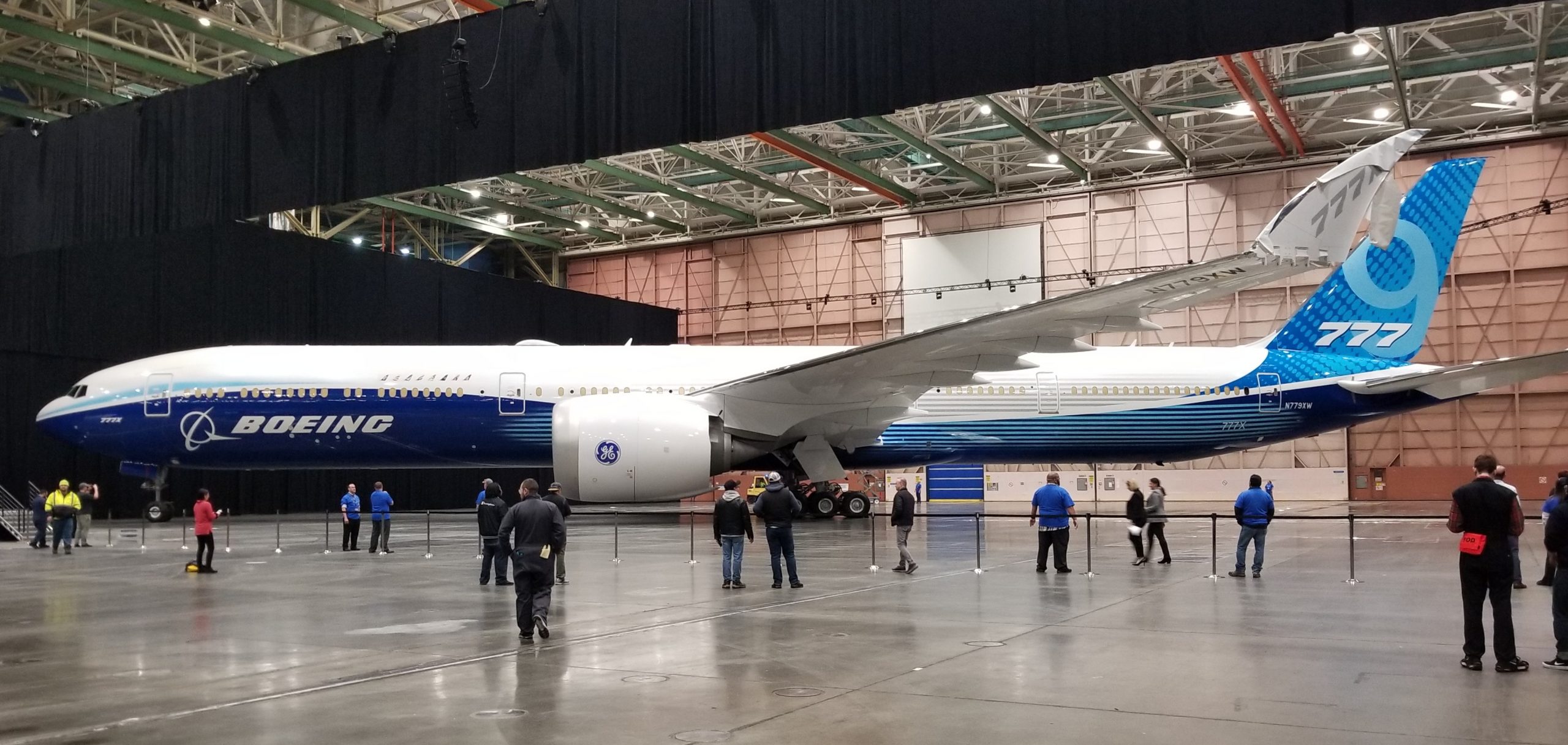
The Boeing 777X represents the most extensive redesign of the 777 family since its introduction in the 1990s. While retaining the proven fuselage cross‑section and overall architecture of the earlier 777 models, the 777X incorporates new materials, new aerodynamics, and advanced systems that significantly improve efficiency and performance. Boeing’s approach was evolutionary rather than revolutionary: build on the strengths of the 777‑300ER while introducing next‑generation technology where it delivers the greatest benefit.
The most distinctive feature of the 777X is its composite wing, the largest ever fitted to a Boeing airliner. Constructed from carbon‑fibre reinforced plastic, the wing has a high aspect ratio and long raked tips that improve lift‑to‑drag efficiency. To maintain compatibility with existing airport gates, Boeing designed a unique folding wingtip mechanism. When extended, the wingspan reaches 71.8 metres; when folded, it reduces to 64.8 metres, allowing the aircraft to use the same Code E gates as the 777‑300ER. The folding tips lock in place with multiple redundant systems and are certified to prevent inadvertent movement during critical phases of flight.
The fuselage of the 777X is based on the earlier 777 design but incorporates structural improvements and a wider cabin that allows airlines to offer more spacious seating layouts. Larger windows, improved LED lighting, and redesigned sidewalls give the interior a more modern and open feel. The cabin architecture supports lower cabin altitude, better humidity control, and quieter operation, enhancing passenger comfort on long‑haul flights.
Aerodynamically, the 777X benefits from refinements to the nose profile, tailcone, and engine nacelles. The GE9X engines feature a slim composite fan case, serrated chevrons for noise reduction, and advanced materials that allow higher operating temperatures. These improvements contribute to a significant reduction in fuel burn compared with the GE90‑115B on the 777‑300ER.
The aircraft’s flight‑control system has been updated with enhanced fly‑by‑wire logic, including software governing the folding wingtips and new control laws for the larger wing. The 777X also incorporates improved spoilers, advanced high‑lift devices, and a redesigned trailing‑edge flap system that provides better performance during takeoff and landing. These aerodynamic and control‑system upgrades allow the 777X to achieve strong short‑field performance despite its increased size.
The landing gear has been strengthened to support the higher maximum takeoff weight of the 777‑9, and the aircraft features new carbon brakes, updated hydraulic systems, and improved electrical architecture. The cockpit retains the familiar 777 layout but includes larger displays, updated avionics, and new systems integration derived from the 787.
Overall, the 777X combines the reliability and familiarity of the 777 platform with cutting‑edge materials, advanced aerodynamics, and next‑generation systems. These design improvements position the aircraft as Boeing’s flagship long‑range twin‑engine wide‑body for the coming decades.
Engines
Powering the Boeing 777X is the GE Aviation GE9X, the most advanced and highest‑bypass turbofan engine ever developed for commercial service. Designed specifically for the 777‑8 and 777‑9, the GE9X builds on the architecture of the GE90 family but incorporates new materials, new aerodynamics, and next‑generation manufacturing techniques that significantly improve efficiency and durability.
The GE9X features an enormous 134‑inch composite fan, surrounded by a lightweight carbon‑fibre fan case. With a bypass ratio of around 10:1 and an overall pressure ratio approaching 60:1, the engine delivers strong fuel efficiency while maintaining high thrust output. The fan blades are made from fourth‑generation carbon‑fibre composites, allowing a thinner, lighter design compared with earlier GE90 blades.
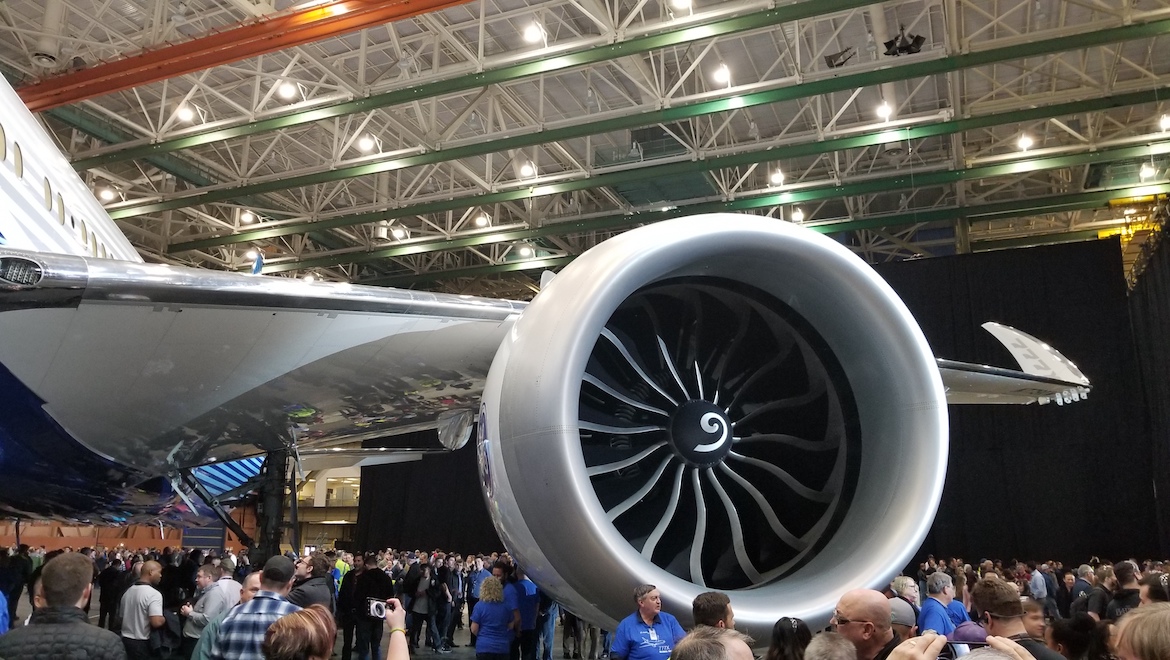
One of the most important innovations in the GE9X is the extensive use of ceramic matrix composites (CMCs) in the combustor and turbine sections. These materials can withstand far higher temperatures than traditional metal alloys, enabling hotter and more efficient core operation. The result is lower fuel burn, reduced emissions, and improved long‑term durability. Additive manufacturing (3D printing) is also used for several components, including fuel nozzles and structural brackets, reducing weight and simplifying production.
The GE9X incorporates lean‑burn combustor technology that reduces NOx emissions and improves environmental performance. Serrated chevrons on the exhaust nacelle help lower noise levels, making the 777X quieter than earlier 777 models despite its larger size and higher thrust capability.
During development, GE encountered durability issues in the compressor section, prompting a redesign of several stages and adjustments to blade clearances. These improvements required additional certification cycles and contributed to delays in the 777X program. Once resolved, the GE9X demonstrated strong performance in testing, meeting Boeing’s efficiency targets and delivering the reliability expected of a long‑haul wide‑body engine.
The GE9X is rated at 105,000 lbf (470 kN) of thrust, making it one of the most powerful commercial engines ever produced. Despite its size, the engine achieves a significant reduction in specific fuel consumption compared with the GE90‑115B used on the 777‑300ER. This improvement is a key contributor to the 777X’s lower operating costs and extended range capability.
Overall, the GE9X combines cutting‑edge materials, advanced aerodynamics, and modern manufacturing techniques to deliver a highly efficient and environmentally advanced powerplant. Its performance is central to the 777X’s role as Boeing’s next‑generation flagship twin‑engine wide‑body.
Cabin
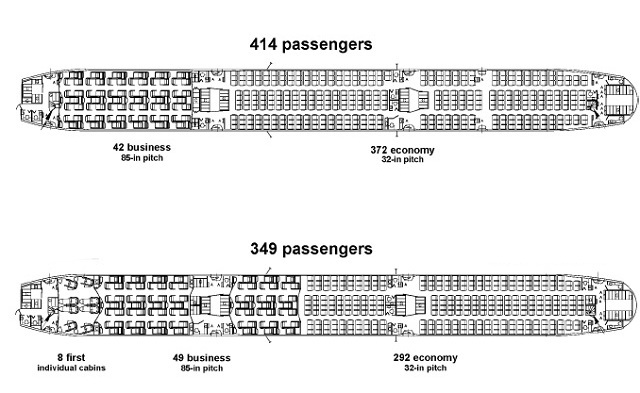
The Boeing 777X cabin builds on the strengths of the earlier 777 models while introducing a range of improvements inspired by the 787 Dreamliner. Airlines have considerable flexibility in configuring the interior, with options ranging from high‑density layouts to premium long‑haul cabins featuring enclosed suites and advanced seating products. The wider fuselage of the 777X allows more spacious seating arrangements, improved aisle width, and greater design freedom for airlines.
One of the most noticeable upgrades is the use of larger windows, similar in style to those on the 787 but adapted to the 777X’s fuselage structure. These windows are positioned higher on the cabin wall, improving outside visibility for passengers. Combined with new LED lighting and redesigned sidewalls, the cabin feels brighter, more open, and more modern than earlier 777 interiors.
The 777X supports a lower cabin altitude and improved humidity levels, reducing passenger fatigue on long‑haul flights. Air filtration and circulation systems have also been upgraded, providing cleaner air and more consistent temperature control throughout the cabin. These environmental improvements contribute to a noticeably more comfortable experience, especially on ultra‑long‑range routes.
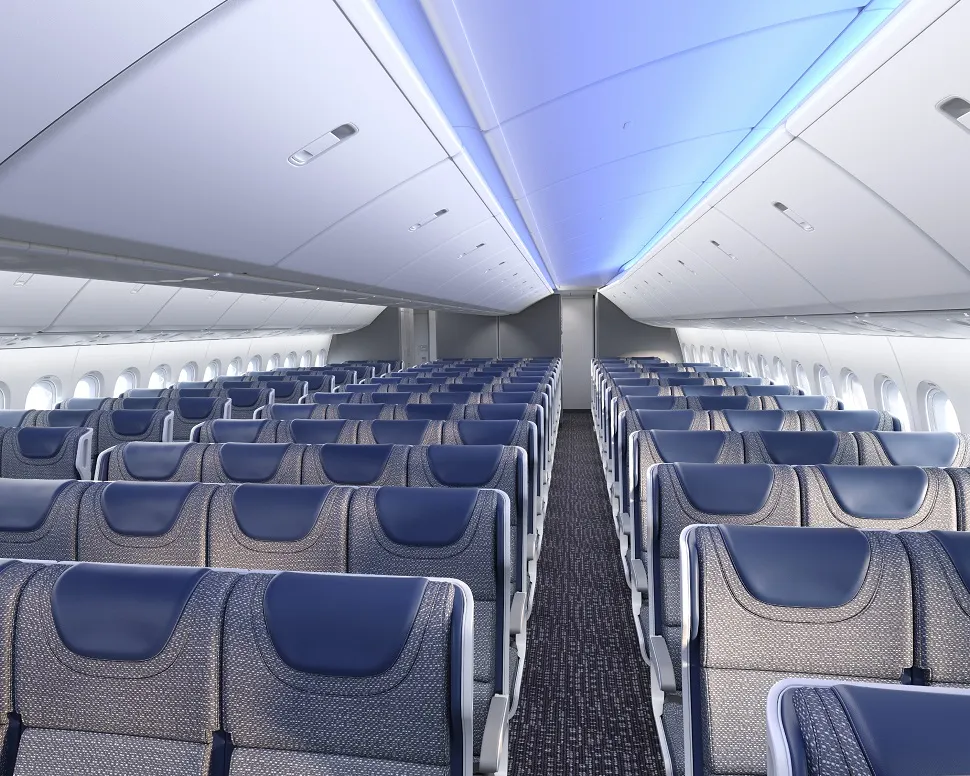
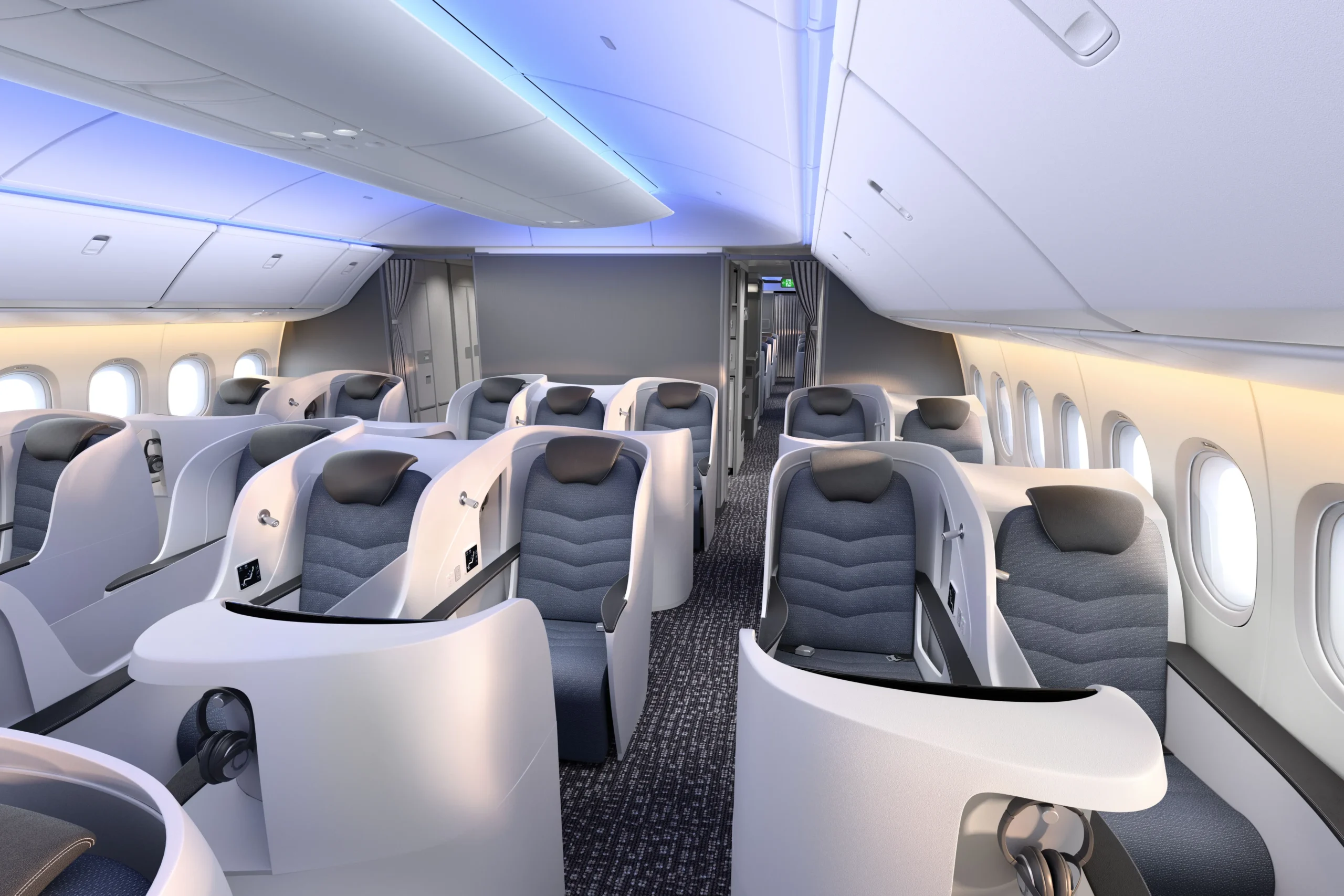
Seating layouts vary widely depending on airline preference. Most carriers are expected to adopt a 10‑abreast economy class configuration, similar to the 777‑300ER, but with slightly wider seats thanks to the 777X’s increased cabin width. Premium economy cabins benefit from improved pitch and seat width, while business class products increasingly feature fully enclosed suites with privacy doors, direct aisle access, and advanced inflight entertainment systems.
The 777X’s overhead bins have been redesigned to provide more storage space while maintaining easy access for passengers. Larger pivot‑style bins, similar to those on the 787, allow more carry‑on luggage to be stored efficiently. The aircraft also features quieter cabin acoustics, achieved through improved insulation, engine nacelle design, and aerodynamic refinements.
In the forward cabin, airlines can install spacious first‑class suites or enhanced business‑class zones, depending on their market strategy. The 777‑9, with its longer fuselage, offers more flexibility for premium cabin layouts, while the 777‑8 is expected to be popular for ultra‑long‑range missions where passenger comfort is a key priority.
Overall, the 777X cabin combines modern design, improved environmental controls, and flexible seating options to deliver a comfortable and adaptable interior for airlines and passengers alike. These enhancements position the 777X as one of the most advanced long‑haul cabins in Boeing’s lineup.
Orders & Deliveries
The Boeing 777X program launched with record demand at the 2013 Dubai Airshow, where several major carriers placed large orders for the 777‑8 and 777‑9. Since then, the order book has evolved as airlines adjusted fleet plans, deferred deliveries, or converted passenger aircraft orders to the newly launched 777‑8F freighter. As of 2026, the 777X family has accumulated more than 350 orders across passenger and freighter variants. Deliveries have not yet begun, with entry into service expected in the 2025–2026 timeframe.
Orders & Deliveries
The Boeing 777X program launched with record demand at the 2013 Dubai Airshow, where several major carriers placed large orders for the 777‑8 and 777‑9. Since then, the order book has evolved as airlines adjusted fleet plans, deferred deliveries, or converted passenger aircraft orders to the newly launched 777‑8F freighter. As of 2026, the 777X family has accumulated more than 350 orders across passenger and freighter variants. Deliveries have not yet begun, with entry into service expected in the 2025–2026 timeframe.
| Customer | Variant | Orders |
|---|---|---|
| Emirates | 777‑8 / 777‑9 | 115 |
| Qatar Airways | 777‑8F / 777‑9 | 74 |
| Singapore Airlines | 777‑9 | 31 |
| Cathay Pacific | 777‑9 | 21 |
| Lufthansa | 777‑9 | 20 |
| All Nippon Airways (ANA) | 777‑9 | 20 |
| British Airways | 777‑9 | 18 |
| Japan Airlines | 777‑8F | 10 |
| Etihad Airways | 777‑8 / 777‑9 | 8 |
| Other Customers | 777‑8F / 777‑9 | ~40 |
| Total Orders | ~357 | |
| Total Deliveries | 0 (Deliveries expected 2025–2026) |
Legacy
Although the Boeing 777X has yet to enter service, its impact on long‑haul aircraft design is already clear. The program represents Boeing’s most ambitious evolution of the 777 family, combining proven wide‑body architecture with next‑generation materials, advanced aerodynamics, and the highly efficient GE9X engines. The composite wing and folding wingtip system stand out as major engineering achievements, setting new benchmarks for wingspan management and aerodynamic performance.
The 777X has endured a longer and more complex development path than originally planned, shaped by engine redesigns, structural testing challenges, and a significantly more rigorous certification environment. Yet these hurdles have resulted in a more thoroughly validated aircraft, one that reflects the lessons learned across Boeing’s recent programs and the evolving expectations of global regulators.
As deliveries approach, the 777X is positioned to become Boeing’s flagship long‑range twin‑engine wide‑body, offering airlines a blend of capacity, efficiency, and modern cabin comfort. With strong commitments from major carriers and a freighter variant already attracting interest, the 777X is set to play a central role in Boeing’s wide‑body strategy for the coming decades. Its legacy will be defined not only by its technological advancements but by its role in shaping the next era of long‑haul travel.