
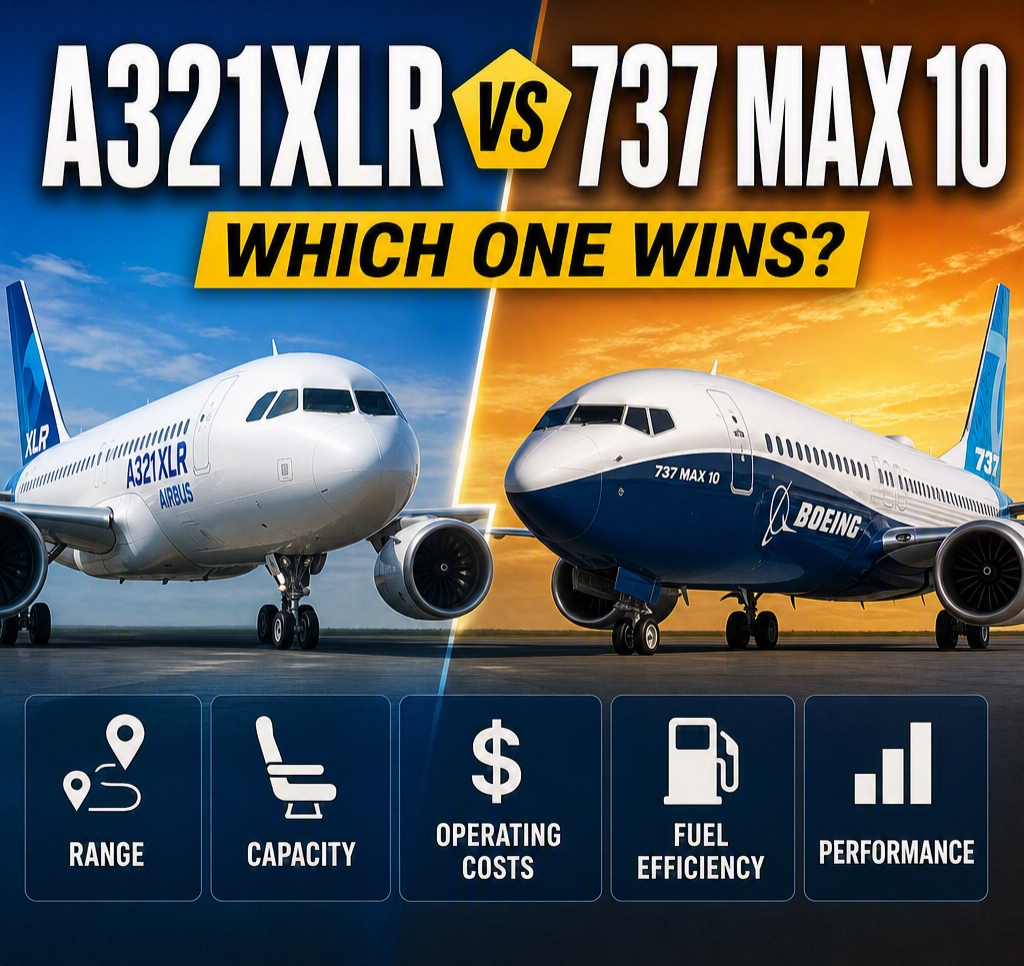

The narrow‑body market is shifting quickly in 2026. Airlines have spent years waiting for the next generation of large single‑aisle aircraft — jets capable of stretching short‑haul economics or pushing narrow‑body flying into long‑range territory. The A321XLR vs 737 MAX 10 comparison sits at the centre of that change, and both aircraft arrive at a moment when airlines are making fleet decisions that will shape their networks well into the 2030s.
Although they’re often positioned as direct competitors, the reality is more nuanced. The A321XLR and 737 MAX 10 represent two very different philosophies about what the future of narrow‑body flying should look like.
Why These Two Aircraft Matter in 2026
The timing is crucial. The A321XLR is entering service, giving airlines a narrow‑body capable of flying routes once reserved for wide‑bodies. Meanwhile, the 737 MAX 10 is finally approaching certification after years of delays, offering Boeing a much‑needed answer to the upper end of the A321neo family.
Airlines are also replacing aging 757s, A321ceos, and 737‑900ERs. As a result, the choices they make now will influence route development, fleet strategy, and long‑haul flexibility for decades.
Two Philosophies: Range vs Capacity
A321XLR — Range First
Airbus designed the A321XLR to push narrow‑body flying into long‑haul territory. With its additional fuel tank, strengthened landing gear, and long‑haul cabin options, it’s built for:
- transatlantic routes
- long leisure markets
- secondary‑city international links
- thinner long‑haul routes where wide‑bodies are too large
Consequently, the XLR behaves like a “small wide‑body” in terms of mission profile.
737 MAX 10 — Capacity First
Boeing built the MAX 10 to maximise seat count and short‑haul economics. It’s the largest 737 ever produced, aimed at:
- high‑density domestic routes
- intra‑Europe and intra‑Asia flying
- low‑cost carrier expansion
- replacing older 737‑900ER and A321ceo fleets
In contrast, the MAX 10 is a high‑volume workhorse rather than a long‑range experiment.
A321XLR vs 737 MAX 10: Key Differences
| Feature | A321XLR | 737 MAX 10 |
|---|---|---|
| Range | ~4,700 nmi | ~3,300 nmi |
| Typical Seats | 180–200 | 188–204 |
| Max Seats | 220 | 230 |
| Engines | PW1100G / LEAP‑1A | LEAP‑1B |
| MTOW | ~101 t | ~89 t |
| Entry Into Service | 2026 | Expected late 2026 |
| Key Buyers | American, United, Iberia, Air Canada | United, Delta, Ryanair |
The numbers highlight the core difference: the A321XLR prioritises reach, while the MAX 10 prioritises volume. Therefore, airlines will deploy them in very different ways.
How Airlines Will Use Each Aircraft
A321XLR
- Transatlantic Boeing 757 replacement
- Long‑range leisure routes
- Secondary‑city international connections
- Point‑to‑point long‑haul without wide‑body costs
Furthermore, the XLR allows airlines with smaller wide‑body fleets to open new long‑haul markets.
737 MAX 10
- High‑density domestic trunk routes
- Short‑haul operations where seat count drives revenue
- Low‑cost carrier growth
- Fleet commonality for existing MAX operators
As a consequence, the MAX 10 fits naturally into networks that prioritise frequency and volume.
Operational Advantages
A321XLR Advantages
- Unmatched range in the narrow‑body category
- Lower trip cost than wide‑bodies on long routes
- Opens new long‑haul markets
- Strong appeal for North American and European carriers
737 MAX 10 Advantages
- Commonality with existing 737 fleets
- Lower pilot training and maintenance costs
- Higher seating capacity for short‑haul optimisation
- Strong economics for airlines like United and Delta
Challenges and Real‑World Issues
A321XLR
- Regulatory scrutiny over the rear centre tank
- Cabin comfort concerns on long flights
- Competition from efficient wide‑bodies
737 MAX 10
- Certification delays
- Public perception of the MAX brand
- Pressure from airlines needing deliveries sooner
Nevertheless, both aircraft remain central to their manufacturers’ strategies.
So Which One Wins?
There’s no single winner. Ultimately, each aircraft excels in its intended mission:
- The A321XLR dominates long‑range flexibility.
- The 737 MAX 10 dominates short‑haul economics and fleet commonality.
In summary, airlines aren’t choosing between them — they’re choosing the aircraft that fits their network strategy.
Key Takeaways
- The Airbus A321XLR is designed for long‑range narrow‑body missions, including transatlantic routes.
- The Boeing 737 MAX 10 focuses on high‑capacity short‑haul efficiency and fleet commonality.
- Airlines choose between them based on mission profile, not direct competition.
- 2026 marks the first year both aircraft enter real‑world service, shaping networks into the 2030s.
Conclusion: The Future of Narrow‑Body Flying
The A321XLR and 737 MAX 10 illustrate how differently Airbus and Boeing view the future of narrow‑body aviation. Airbus is pushing single‑aisles into long‑haul territory, while Boeing is doubling down on high‑density short‑haul efficiency. Consequently, these aircraft will reshape passenger expectations and redefine profitable route structures throughout the 2020s and 2030s.
2026 is the year these two aircraft finally meet in real‑world service, and the decisions airlines make now will echo across global networks for years to come.
Frequently Asked Questions
Is the Airbus A321XLR a replacement for the Boeing 757?
Yes. Many airlines are using the A321XLR to replace aging 757 fleets, especially on transatlantic routes where its long range and lower operating costs make it ideal.
Is the Boeing 737 MAX 10 designed for long‑range flights?
No. The MAX 10 is optimised for high‑capacity short‑haul operations and is not intended for long‑range missions like the A321XLR.
Which aircraft has the longer range?
The A321XLR has a significantly longer range, capable of flying up to ~4,700 nautical miles, compared to the MAX 10’s ~3,300 nautical miles.
Why are airlines choosing the A321XLR?
Airlines value its ability to open new long‑haul routes, replace 757s, and operate thinner international markets without needing a wide‑body.
Why are airlines choosing the 737 MAX 10?
The MAX 10 offers strong short‑haul economics, high seating capacity, and fleet commonality for existing 737 operators.
United Airlines fleet announcements
Updated September 2026