
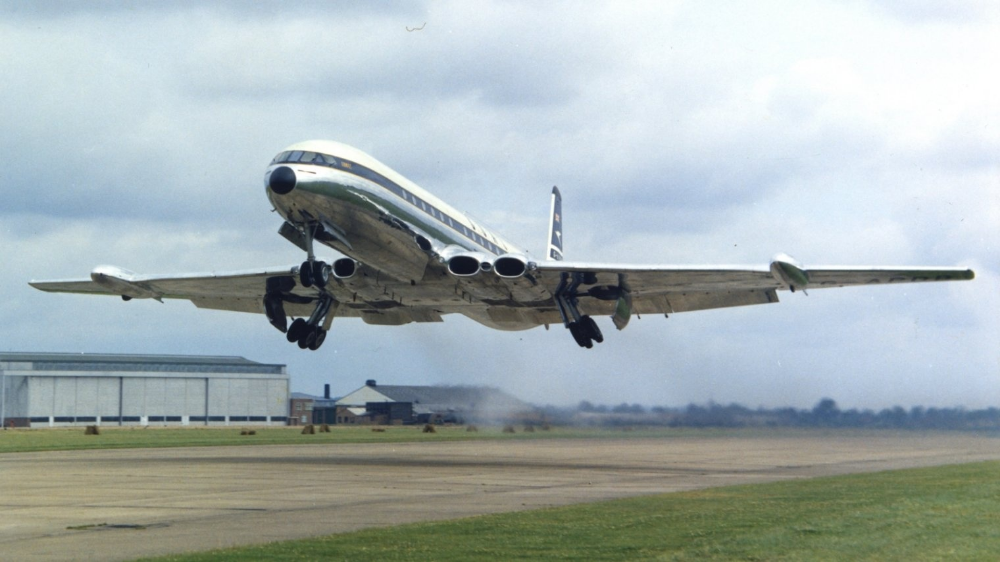
The de Havilland Comet holds an esteemed place in aviation history as the world’s first commercial jet airliner. Launched by the British manufacturer de Havilland Aircraft Company, the Comet made its maiden flight on July 27, 1949, revolutionising passenger aviation forever.
With its sleek design and powerful jet engines, the Comet shattered the boundaries of traditional air travel. When it entered service with British Overseas Airways Corporation (BOAC) in May 1952, the world witnessed an unprecedented era of fast, efficient, and comfortable air journeys.
The impact of the Comet was immense, propelling the aviation industry into a new age of jet propulsion. It drastically reduced travel times on long-haul routes, making international travel accessible to a broader audience. The success of the Comet inspired the development of numerous jet airliners, ushering in a new era of global airline networks.
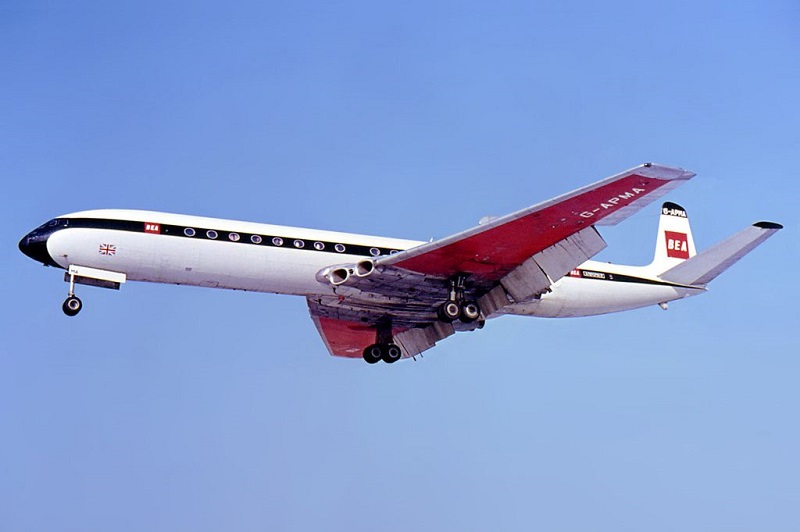
Despite encountering setbacks and safety challenges, the Comet’s legacy lives on. Although it is no longer a common sight in the skies, the de Havilland Comet remains a pioneering symbol of innovation and exploration in the world of aviation.
In the following sections, we will delve deeper into the captivating history, technical specifications, notable orders, and luxurious interiors of the trailblazing de Havilland Comet, providing a comprehensive tribute to its enduring impact on passenger aviation.

At‑a‑Glance Summary
| Aircraft | de Havilland DH-106 Comet |
| Manufacturer | de Havilland Aircraft Company |
| First Flight | 27 July 1949 |
| Entered Service | 2 May 1952 (BOAC) |
| Engines | 4 × Rolls-Royce Avon turbojets |
| Variants | Comet 1, 1A, 2, 3, 4, 4B, 4C |
| Passengers | 36–81 depending on variant |
| Total Built | 112 |
| Notable Operators | BOAC, BEA, Dan-Air, Aerolíneas Argentinas, JAL, RAF |
Development Timeline
| Year | Milestone |
| 1946–1948 | The British government issues a requirement for a pressurised jet airliner. de Havilland begins design work on DH-106. |
| 27 July 1949 | First flight of the Comet prototype from Hatfield Aerodrome. |
| 1952 | BOAC launches the world’s first jet-powered commercial airline service using the Comet 1. |
| 1953–1954 | Three fatal accidents (G-ALYP, G-ALYY, G-ALYZ) lead to grounding and a full structural investigation. |
| 1954–1957 | Major redesign including rounded windows, strengthened structure, and improved pressurisation cycles. |
| 1958 | Comet 4 enters service, restoring confidence and enabling long-range jet operations. |
| 1960s | Comet variants continue in commercial and military service; the RAF adopts Comet C2 and C4. |
| 1970s–1990s | Comet airframes evolve into the Hawker Siddeley Nimrod maritime patrol aircraft. |

History
Commercial Service and Global Recognition
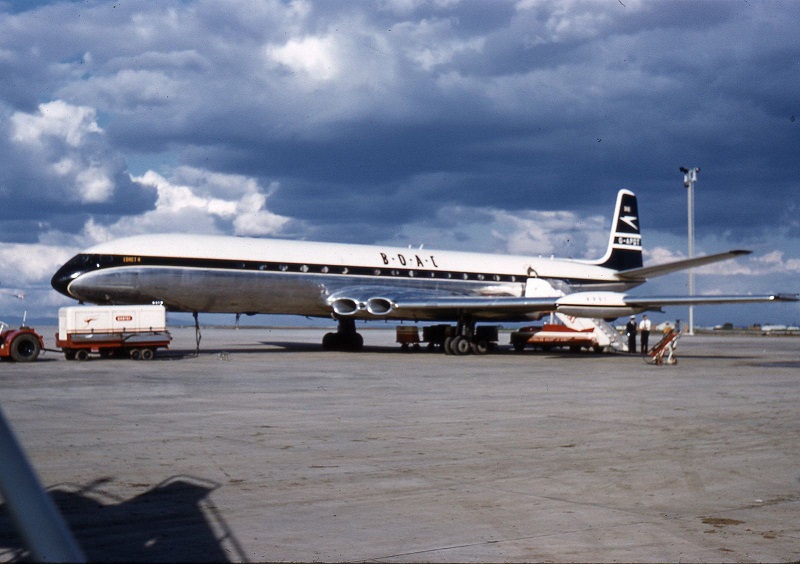
With its striking appearance, unmatched speed, and luxurious interiors, the Comet quickly captured the world’s imagination. British Overseas Airways Corporation (BOAC) launched the Comet into commercial service on May 2, 1952, operating its inaugural route between London and Johannesburg.
The Comet’s success was immediate, offering passengers never-before-seen levels of comfort and significantly reducing travel times. It quickly became a symbol of prestige and modernity, solidifying the UK’s position as a leader in commercial aviation.
G‑ALYP Accident (Elba)
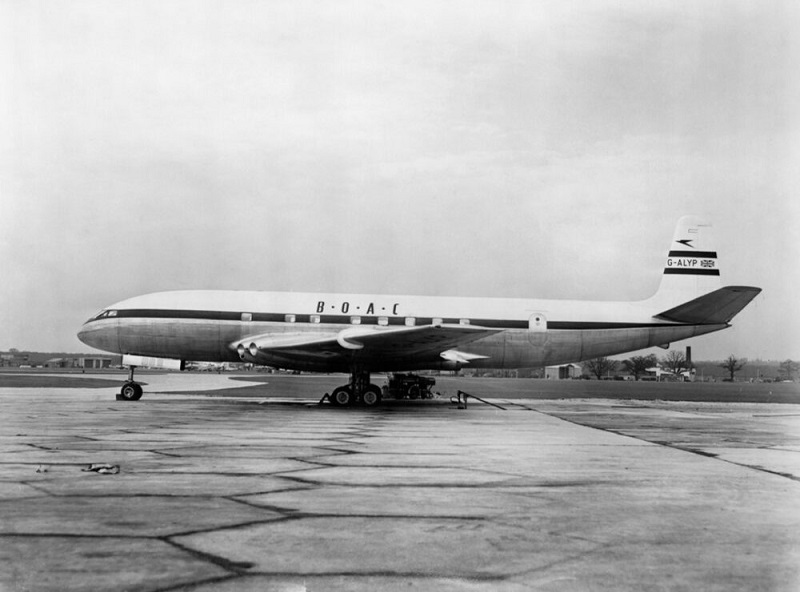
Italian island of Elba. Metal fatigue around the square windows led to explosive decompression.
The first major incident occurred on 10 January 1954, when BOAC Comet G‑ALYP suffered an explosive decompression shortly after departing Rome. The aircraft broke apart in mid‑air near the island of Elba, and all 35 people on board were lost. Investigators later determined that metal fatigue around the square cabin windows had caused catastrophic structural failure.
G‑ALYY Accident (Mediterranean)
Just three months later, on 8 April 1954, BOAC Comet G‑ALYY was lost under similar circumstances while flying from Rome to London. The aircraft suffered an explosive decompression over the Mediterranean Sea and disintegrated in flight, killing all 21 passengers and crew. Although G‑ALYY featured slightly revised window framing, investigators found that stress concentrations still existed around the window corners, again leading to metal fatigue and structural failure.
These two accidents — along with the earlier loss of G‑ALYZ in 1953 — resulted in the entire Comet fleet being grounded while a full structural investigation was undertaken.
Redesign and Reinvention
In response to the findings, de Havilland engineers embarked on a comprehensive redesign of the aircraft. The Comet 4 series, introduced in 1958, incorporated rounded windows, reinforced fuselage structure, and improved pressurisation cycle tolerance. These changes directly addressed the fatigue issues that had plagued the early models.
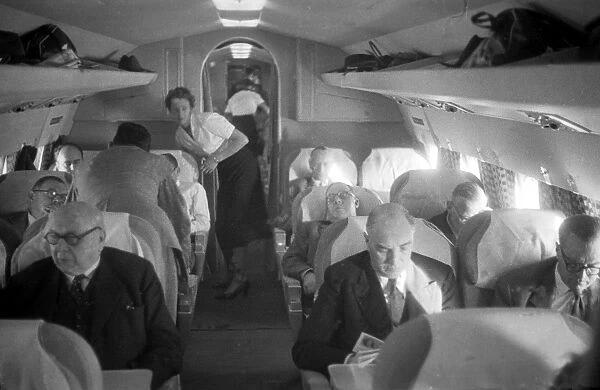
before by being able to fly above most weather.
Resumption of Service and Further Achievements
The Comet 4 entered service in 1958, regaining the trust of airlines and passengers alike. BOAC and other operators resumed commercial operations with the aircraft, and the Comet once again graced the skies.
The Comet continued to make significant contributions to aviation during the 1960s, with various military variants and special mission versions deployed by air forces worldwide. However, with the arrival of more advanced jet airliners, the Comet’s commercial presence gradually declined.
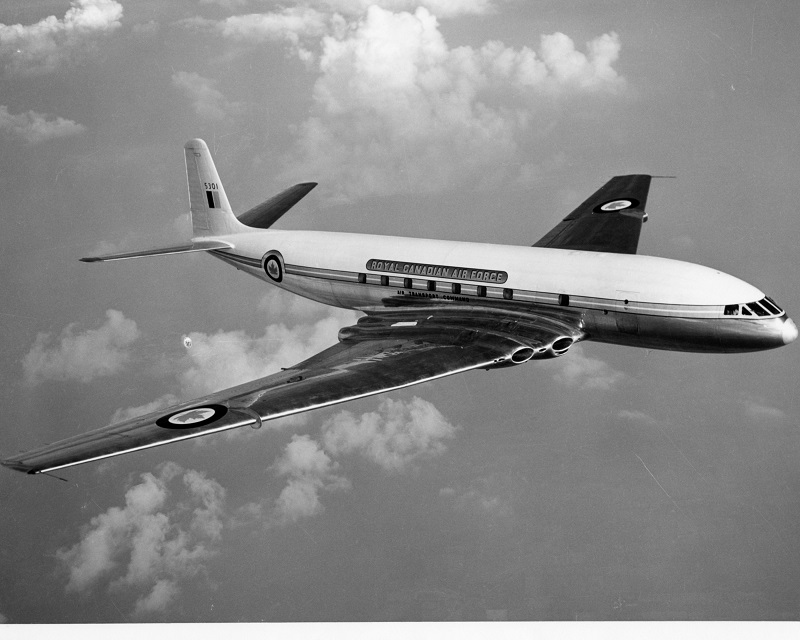
Development and Evolution
The history of the de Havilland Comet traces back to the post‑World War II era, when the aviation industry was abuzz with possibilities. The de Havilland Aircraft Company, led by visionary designer Sir Geoffrey de Havilland, embarked on a bold mission to create a cutting‑edge aircraft that would revolutionise air travel.
Early Development and First Flight
In response to a British government request for a pressurised airliner, de Havilland began work on the Comet in the late 1940s. The team focused on two groundbreaking features: jet propulsion and a pressurised cabin, which would allow the aircraft to fly above turbulent weather and at higher altitudes.
On July 27, 1949, the de Havilland Comet took to the skies for the first time, piloted by John Cunningham. The flight from Hatfield Aerodrome was a pivotal moment in aviation history, marking the introduction of the world’s first jet‑powered commercial airliner.
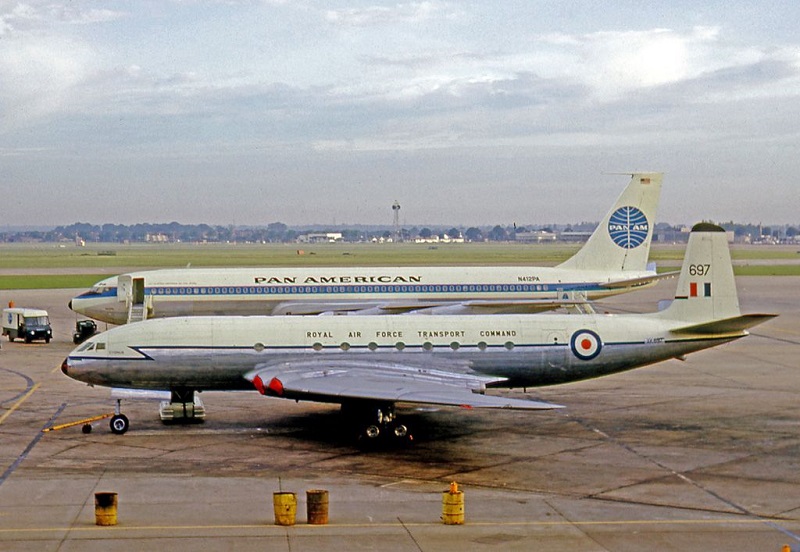
Whilst the de Havilland Comet pioneered jet airliner transport, aircraft like the Boeing 707 built on the new technology and successfully ran with it.
Structural Improvements
One of the primary changes was the implementation of rounded windows instead of the earlier square‑shaped windows. The stress concentrations at the corners of square windows had contributed to metal fatigue. By adopting rounded windows, the new design mitigated these issues, ensuring the structural integrity of the fuselage.
Additionally, the Comet 4 featured strengthened structural components to withstand the rigours of high‑altitude flight and frequent pressurisation cycles. These modifications, along with advancements in engineering techniques, contributed to a safer and more reliable aircraft.
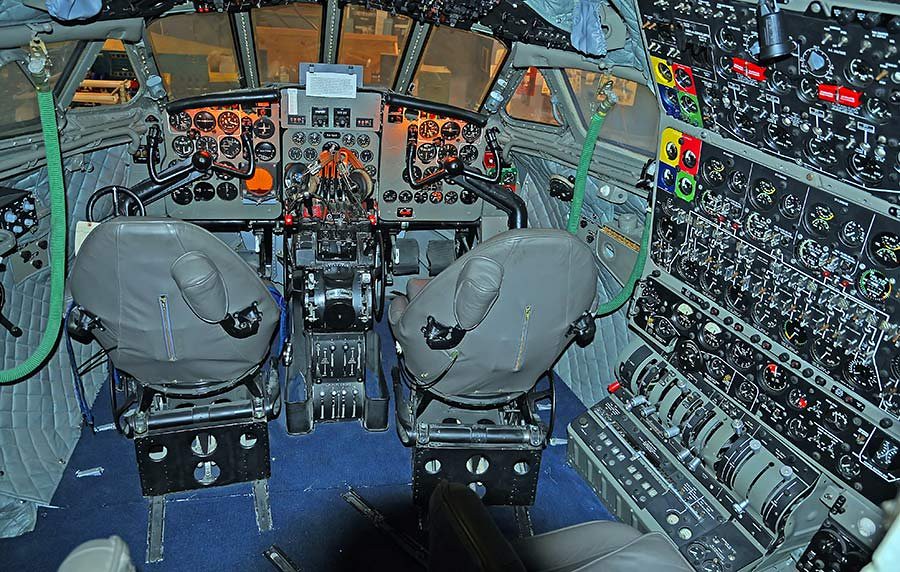
the Comet cockpit required an engineer as well as two pilots to operate.
Specifications
Airframe Configuration
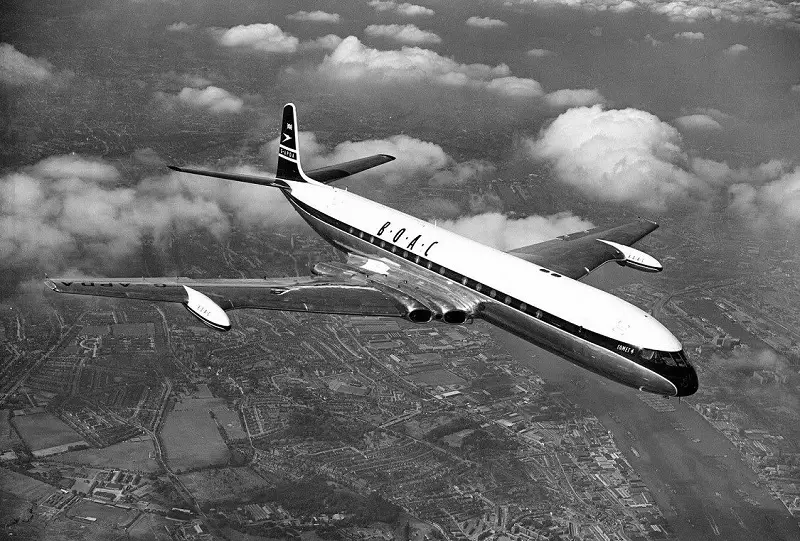
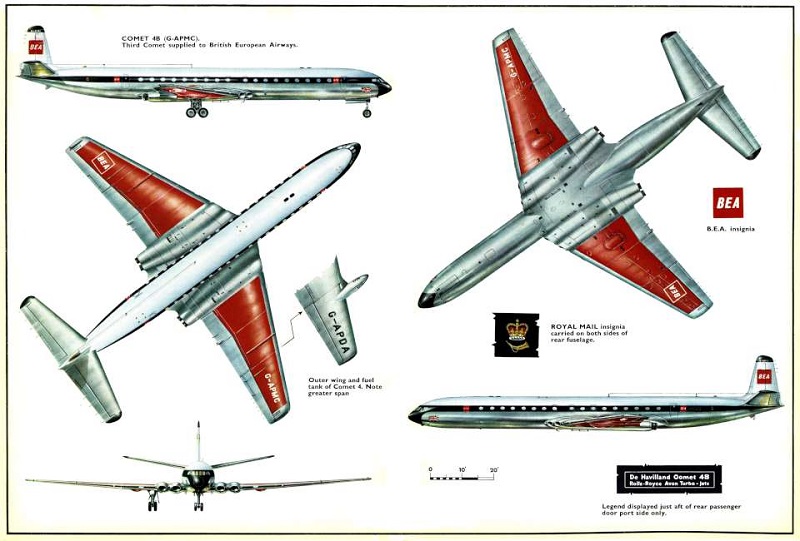
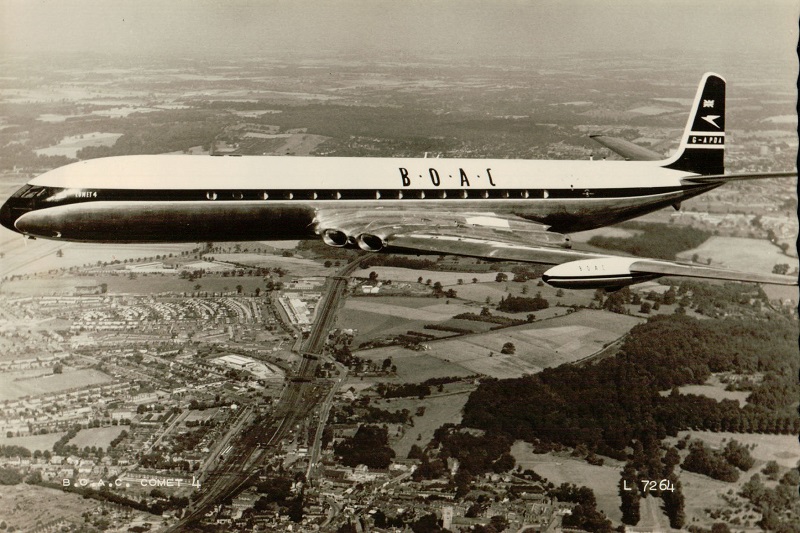
The de Havilland Comet featured a sleek and elegant airframe configuration, designed to maximise aerodynamic efficiency. Its fuselage had a slender and streamlined shape, reducing drag and allowing the aircraft to achieve higher speeds with reduced fuel consumption. The wings swept back at an angle, enhancing lift and stability during flight.
Engine Location
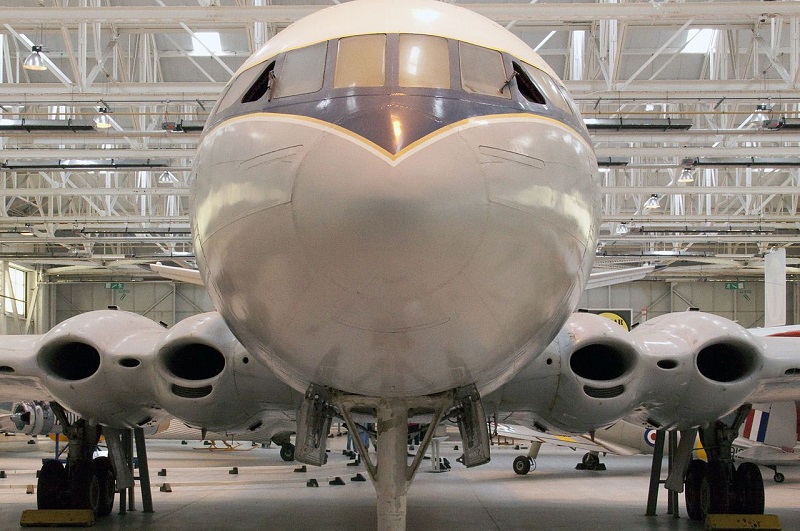
The Comet’s engines were housed within the main wings. The positioning of the engines, along with advanced engine design, contributed to the Comet’s exceptional performance and comfort during flight.
The de Havilland Comet’s groundbreaking design, with its advanced airframe configuration and powerful jet engines, revolutionised the world of aviation. This extraordinary aircraft, with its ability to fly faster, higher, and more efficiently than its propeller-driven counterparts, marked the beginning of a new era in passenger air travel.
Engines
The Comet was equipped with four turbojet engines, a breakthrough innovation that set it apart from traditional propeller-driven aircraft. The jet engines were far more powerful, providing greater thrust and significantly higher speeds. The engine placement was on the wings, with two engines mounted within each wing, close to the fuselage.
Engine Type and Power
The original de Havilland Comet 1 and 1A models were powered by Rolls-Royce Avon 502 engines. Each Avon 502 engine generated approximately 10,000 pounds of thrust, propelling the aircraft at impressive speeds. Subsequent variants, including the Comet 2, 3, 4, and 4B, featured improved versions of the Avon engine series, increasing both power and efficiency.
Variants and Performance
Comet Specifications Table
| Comet 1 | Comet 2 | Comet 3 | Comet 4 | |
|---|---|---|---|---|
| First Flight | 27 July 1949 | UNK | 19 July 1954 | UNK |
| Flight Crew | 4 (2 Pilots, 1 Flight Engineer, 1 Navigator/Radio Operator) | |||
| Range (fully laden) | 1,300 nm | 2,300 nm | 2,802 nm | |
| Seating (Typical) | 36–44 | 58–76 | 56–81 | |
| Length | 28.3 m | 29.29 m | 33.99 m | |
| Wingspan | 35 m | |||
| Wing Area | 187.2 m² | 197 m² | ||
| Wing Sweep | 20° | |||
| Height | 8.99 m | |||
| Undercarriage | 12 wheels (2 nose, 4×2 main) | |||
| Operating Empty Weight | UNK | UNK | UNK | 34,201 kg |
| Cruising Speed | Mach 0.62 | Mach 0.67 | Mach 0.70 | |
| MTOW | 50,000 kg | 54,000 kg | 68,000 kg | 71,000 kg |
| Service Ceiling | 42,000 ft | 45,000 ft | 42,000 ft | |
| Engines | Ghost 50 | Avon 503/504 | Avon 502/521 | Avon 524 |
| Thrust | 5,000 lbf | 7,000 lbf | 10,000 lbf | 10,500 lbf |
Assembly
Manufacturing and Production
The de Havilland Comet was assembled at the company’s Hatfield facility in Hertfordshire, England. This site had long been the centre of de Havilland’s aircraft development, and the Comet programme brought together some of the most advanced engineering and manufacturing techniques of the era.
The assembly process involved precision metalwork, particularly around the pressurised fuselage — a key innovation of the Comet. Engineers and technicians worked meticulously to ensure the aircraft’s structural integrity, especially given the high-altitude pressurisation cycles that were new to commercial aviation.
Fuselage Construction
The Comet’s fuselage was built using a semi-monocoque design, with aluminium alloy skin panels riveted to an internal frame. This construction method provided strength while keeping weight to a minimum. The fuselage was assembled in sections, which were then joined together with reinforced frames and bulkheads.
Special attention was given to the cabin windows and door surrounds, as these areas were subject to significant stress during pressurisation. After the early accidents, redesigned, rounded windows and strengthened structural members became a critical part of the assembly process.
Wing and Engine Integration
The Comet’s wings were manufactured as large, single-piece structures with integrated engine nacelles. Unlike later jetliners, the Comet’s engines were buried within the wings rather than suspended beneath them. This required precise alignment and careful installation of the Rolls‑Royce Avon turbojets.
The wing assembly included the installation of fuel tanks, hydraulic systems, and control surfaces. Once complete, the wings were mated to the fuselage using heavy-duty attachment points designed to distribute aerodynamic loads evenly.
Systems Installation
Once the major structural components were assembled, technicians installed the aircraft’s electrical, hydraulic, and avionics systems. The Comet featured advanced instrumentation for its time, including pressurisation controls, early autopilot systems, and radio navigation equipment.
The cockpit required extensive wiring and panel integration, as the Comet was operated by a crew of four — two pilots, a flight engineer, and a navigator/radio operator. Each station had dedicated instrumentation and controls.
Interior Fit-Out
The Comet’s interior was designed to reflect the luxury of early jet travel. Craftsmen installed comfortable seating, decorative paneling, and soundproofing materials to create a quiet and refined cabin environment. The pressurised cabin allowed passengers to fly above most weather, resulting in smoother and more comfortable journeys.
Testing and Quality Assurance
Before delivery, each Comet underwent rigorous ground and flight testing. Engineers checked pressurisation cycles, engine performance, control responses, and structural integrity. The aircraft was subjected to repeated pressurisation tests to simulate years of service.
Flight testing ensured that each aircraft met performance specifications and safety standards. Only after passing all inspections was the aircraft handed over to the customer airline.
Orders and Deliveries
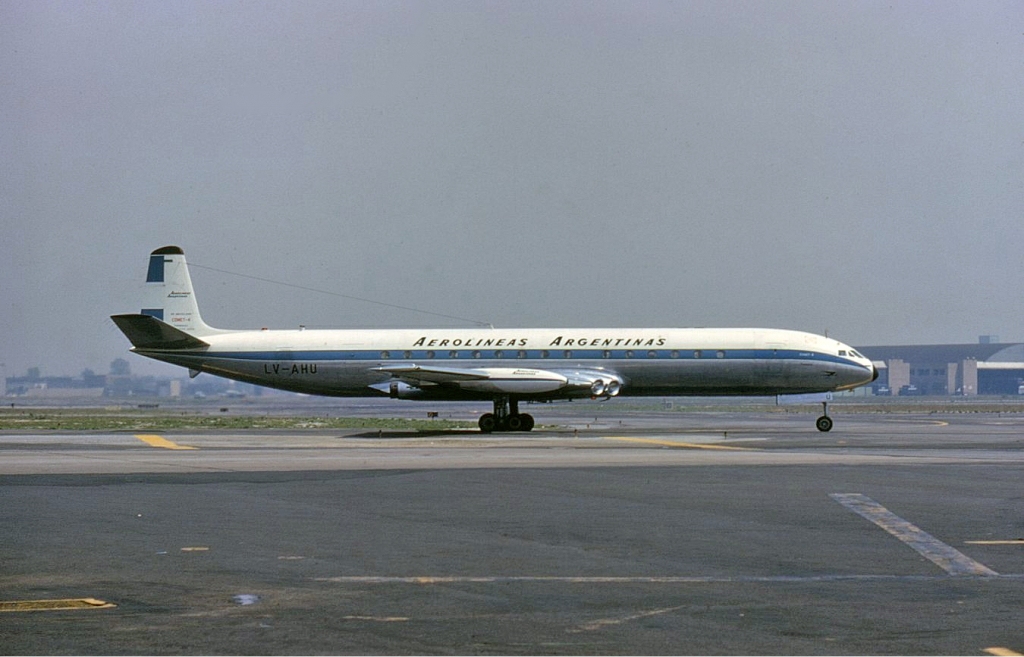
The de Havilland Comet captured the attention of airlines worldwide, leading to significant orders and deployments on various routes. Let’s explore the airlines that ordered and received the Comet, along with the routes they operated, broken down by the variants used when available. 112 Comets were built; however, the table below hints at more, as it shows airliners that operated the type, which may have been purchased from other operators.
| Airline | Variant | Orders | Deliveries | Routes |
|---|---|---|---|---|
| Aerolíneas Argentinas | Comet 4 | 6 | 6 | Buenos Aires to New York and Madrid |
| Air France | Comet 1 / 1A | 12 | 12 | Various European Routes |
| Bahamasair | Comet 4C | 2 | 2 | Bahamas to Miami |
| British Island Airways (B.I.A.) | Comet 4C | 1 | 1 | Southend to Europe charters |
| BKS Air Transport | Comet 4C | 5 | 5 | Manchester to European destinations |
| B.E.A. British European Airways | Comet 4 | 19 | 19 | London to Various European Destinations |
| B.O.A.C. British Overseas Airways Corporation | Comet 1 / 1A | 11 | 11 | London to Johannesburg, Tokyo and Colombo |
| Canadian Pacific Air Lines | Comet 1A | 9 | 9 | Vancouver to London |
| Channel Airways | Comet 4C | 1 | 1 | Southend to Europe charters |
| Court Line | Comet 4C | 2 | 2 | Luton to European holiday spots |
| Dan-Air | Comet 4C | 8 | 8 | Various European Charter Services |
| Danish Air Lines (DDL) | Comet 4 | 3 | 3 | Copenhagen to Tokyo and New York |
| East African Airways | Comet 1 Comet 4 Comet 4C |
3 1 2 |
3 1 2 |
Nairobi to London and Johannesburg Nairobi to London, Dar es Salaam and Aden Nairobi to London, Jeddah and Bombay |
| Iran Air | Comet 4C | 1 | 1 | Tehran to London |
| Iraqi Airways | Comet 4C | 6 | 6 | Middle East Routes |
| Japan Airlines (JAL) | Comet 4B | 20 | 20 | Tokyo to Honolulu, San Francisco and Sydney |
| Kuwait Airways | Comet 4C | 4 | 4 | Kuwait to London |
| Linee Aeree Italiane (LAI) | Comet 4C | 3 | 3 | Rome to Tokyo and Johannesburg |
| Malaysia–Singapore Airlines (MSA) | Comet 4C | 4 | 4 | Singapore to London |
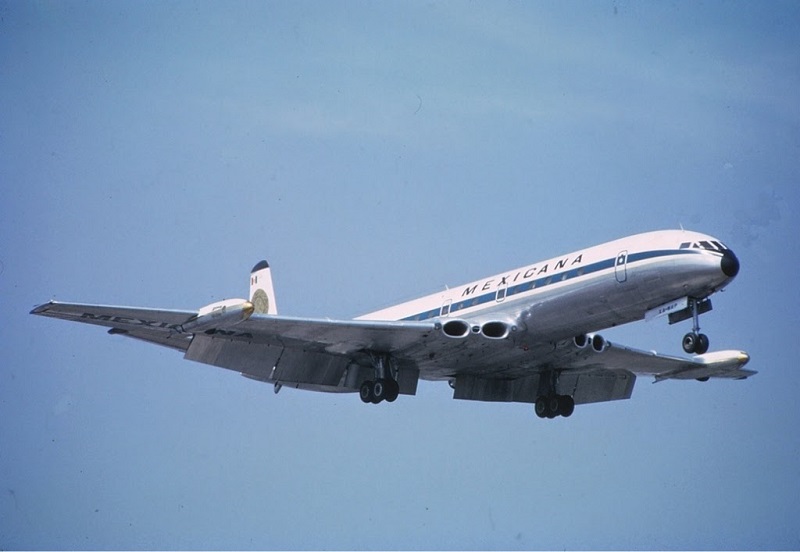
| Mexicana | Comet 4C | 4 | 4 | Mexico City to New York and Los Angeles |
| Middle East Airlines (MEA) | Comet 4 | 6 | 6 | Beirut to London and Paris |
| Monarch Airlines | Comet 4C | 5 | 5 | Luton to Europe |
| Olympic Airways | Comet 4C | 5 | 5 | Athens to New York and London |
| Philippine Air Lines (PAL) | Comet 4 | 5 | 5 | Manila to San Francisco and Los Angeles |
| Royal Air Force (RAF) | Comet C2 | 14 | 14 | Military Transport |
| Royal Jordanian Airlines | Comet 4C | 3 | 3 | Middle East Routes |
| Starways | Comet 4C | 1 | 1 | London to Europe charters |
| Union de Transports Aériens (UTA) | Comet 1A | 6 | 6 | Paris to North and West Africa |
Legacy and Lasting Impact:
Legacy and Lasting Impact:
Despite its eventual fade from commercial service, the de Havilland Comet’s legacy endured. It had paved the way for a new era of jet travel, leaving an indelible mark on the aviation industry. The lessons learned from the Comet’s early challenges contributed to the development of stringent safety standards, ensuring the well‑being of future generations of passengers.
Closing Reflections
Today, the Comet stands as an iconic symbol of innovation, bravery, and determination. While no longer a regular sight in the skies, its significance as the world’s first commercial jet airliner remains etched in history, forever remembered as a pioneering force that transformed air travel and brought the world closer together.
In the subsequent sections, we will delve into the technical specifications, notable orders, and the luxurious interiors that made the de Havilland Comet a truly exceptional aircraft of its time.
If you or someone you know has ever flown on a Comet, we’d love to hear about it. Be sure to leave comments below and share.