
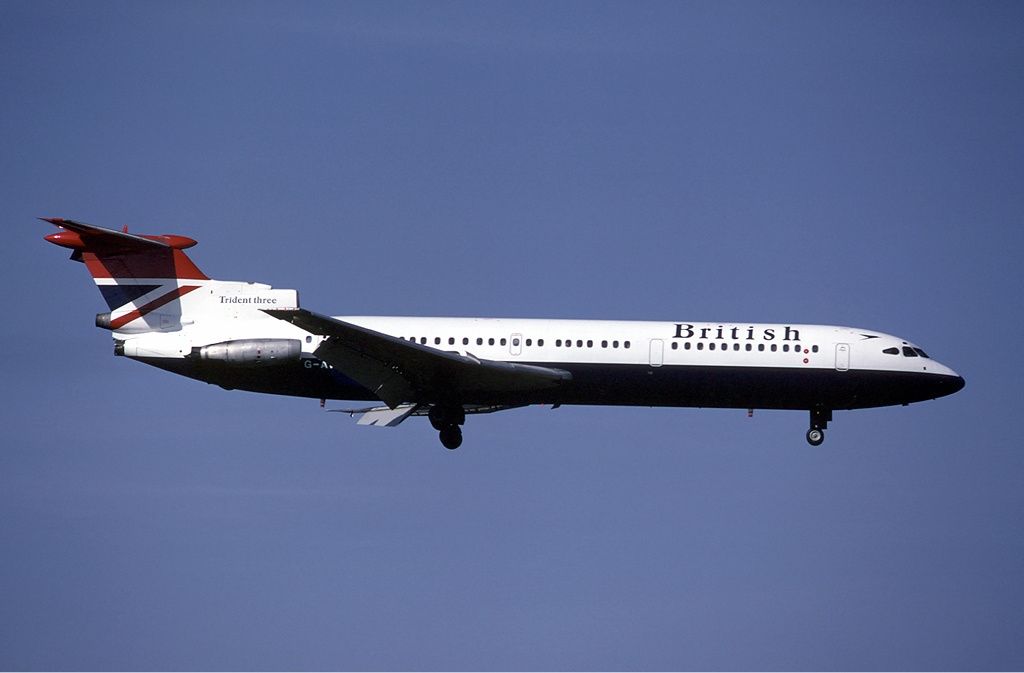
Hawker Siddeley DH121 Trident
The Hawker Siddeley Trident was a pioneering British short‑ to medium‑haul tri‑jet airliner, developed originally by de Havilland and later produced by Hawker Siddeley Aviation. It became the first commercial airliner capable of fully automatic landings and introduced advanced avionics that influenced future generations of aircraft design.

At‑a‑Glance
| Manufacturer | Hawker Siddeley Aviation |
| First Flight | 1962 |
| Entered Service | 1964 (BEA) |
| Engines | 3 × Rolls‑Royce Spey turbofans |
| Variants | Trident 1 / 1C / 1E / 2E / 3B |
| Total Built | 117 |
| Year | Milestone |
|---|---|
| 1953 | British European Airways (BEA) begins looking for a modern jet successor to the Vickers Viscount, issuing requirements for a short‑ to medium‑haul airliner with around 100 seats and higher cruise speeds. |
| 1957 | de Havilland responds with the DH.121 trijet concept, laying the foundations for what will become the Trident programme and starting detailed design studies around a three‑engine rear‑mounted layout. |
| 1958–1959 | BEA requests a smaller, lighter aircraft tailored to European routes, prompting a major redesign of the DH.121. On 24 August 1959 BEA places a launch order for 24 aircraft with options on a further 12. |
| 1960 | de Havilland is absorbed into the Hawker Siddeley group and the project is redesignated HS.121. The name “Trident” is announced, reflecting the aircraft’s three engines and triple‑redundant hydraulic systems. |
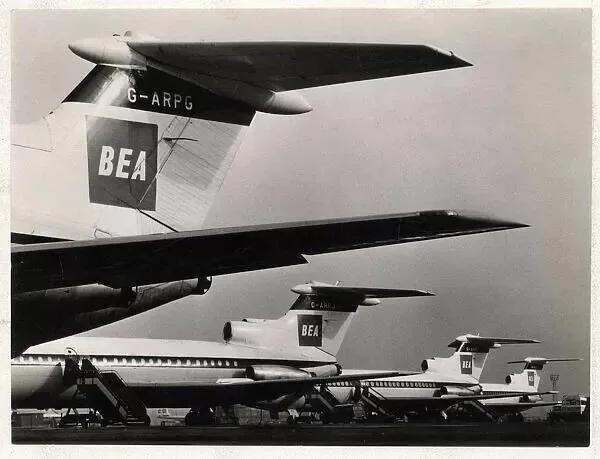
| 9 January 1962 | Prototype Trident 1C G‑ARPA makes its maiden flight from Hatfield Aerodrome, beginning the flight‑test and certification campaign for the new British trijet. |
| 1 April 1964 | The Trident enters revenue service with BEA, offering passengers a fast, comfortable jet replacement for turboprop services and introducing advanced automatic landing capability to commercial operations. |
| 1964–1966 | Trident development aircraft pioneer fully automatic “blind landing” systems. The type achieves the world’s first fully automatic landing in test service and later in normal commercial service, setting new standards for low‑visibility operations. |
| 1962–1978 | Production of Trident variants (1C, 1E, 2E and 3B) continues, with a total of 117 aircraft built for BEA, British Airways and a range of international customers including Cyprus Airways and Kuwait Airways. |
| 1995 | The last Tridents are retired from commercial service, closing more than three decades of operations and leaving a legacy as one of the pioneers of automatic landing and advanced avionics in civil aviation. |
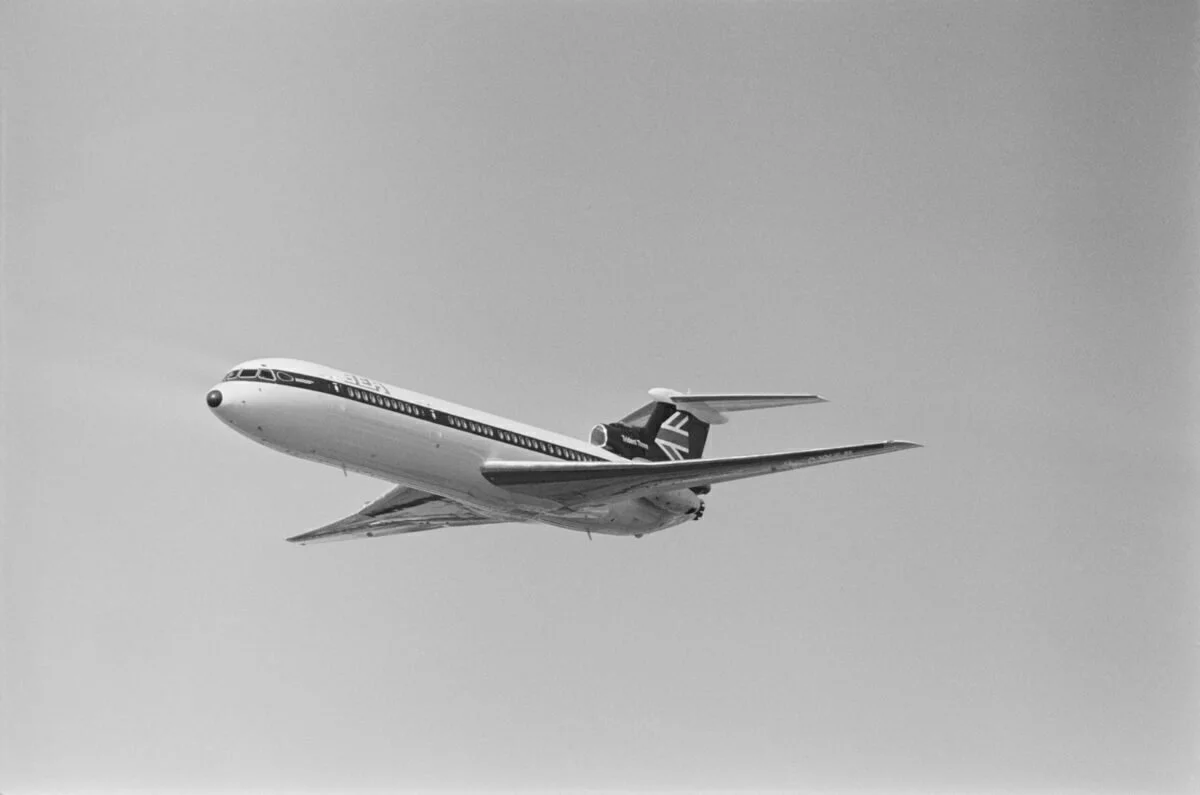
History
Inception and Development
The origins of the Trident can be traced back to the early 1950s when British European Airways (BEA) began looking for a replacement for its aging fleet of Vickers Viscount turboprop aircraft. BEA wanted a faster, more efficient jet that could offer greater comfort and reliability to passengers.
To meet this requirement, de Havilland began work on a new jet design that evolved from the DH118 research aircraft. The DH118 had been used to test new materials and aerodynamic concepts, forming the basis of what would become the DH121 Trident.
A major turning point came in 1957 when Rolls‑Royce introduced the Spey turbofan engine. Its performance and efficiency aligned perfectly with BEA’s needs, and the engine became central to the Trident programme.
Design and Technological Innovations
The Trident was a groundbreaking aircraft in many respects. It became the world’s first commercial airliner capable of performing a fully automatic landing, a capability that revolutionised low‑visibility operations and set new industry standards.
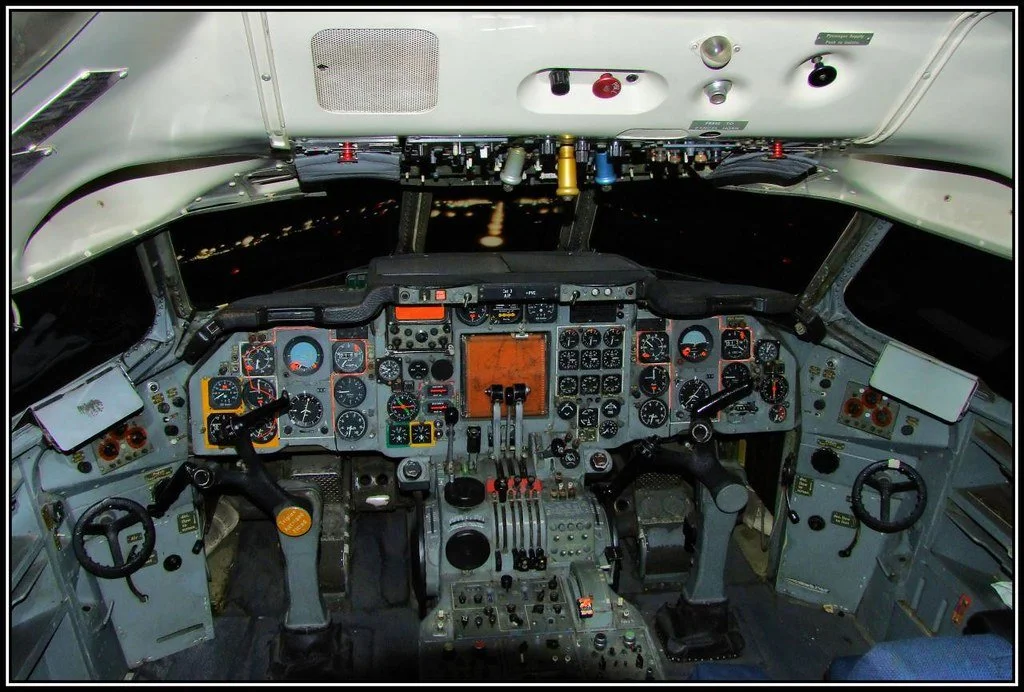
It also introduced one of the earliest digital flight decks, giving pilots improved situational awareness and reducing workload. The aircraft’s sleek fuselage, swept wings, and three‑engine tail configuration helped reduce noise and vibration, improving passenger comfort.
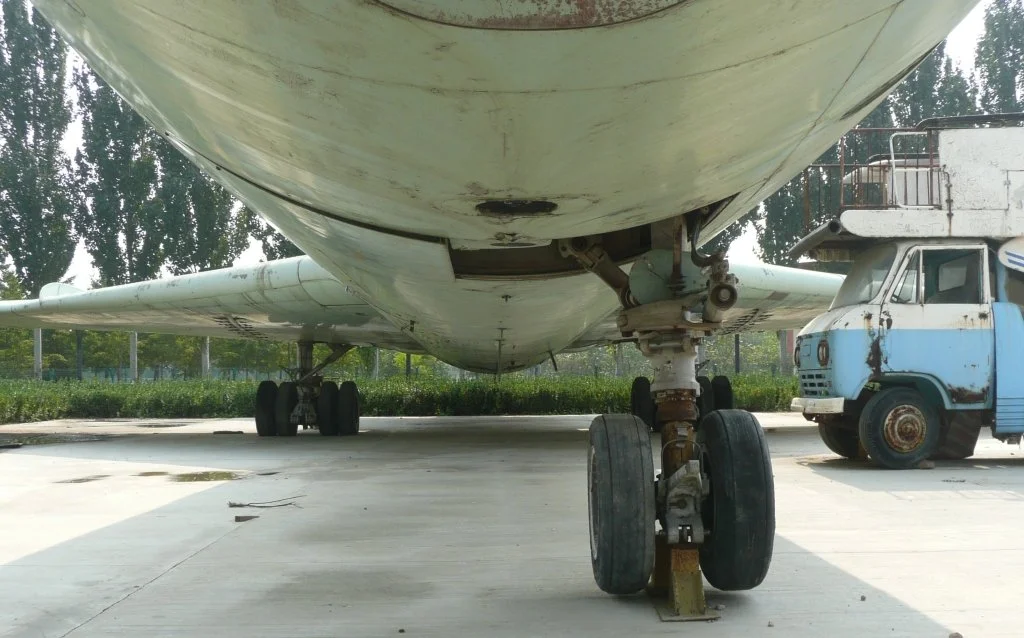
The offset nose landing gear was another distinctive feature. Positioned to the left and retracting to the right, it freed space for a large avionics bay and increased forward hold capacity. This unusual arrangement became one of the Trident’s most recognisable design traits.
Service and Legacy
The Trident entered service with BEA in April 1964 and quickly established a reputation for speed, comfort, and reliability. Over the next decade, it served with airlines including British Airways, Cyprus Airways, Kuwait Airways, Channel Airways, and Pakistan International Airlines.
Although technologically advanced, the Trident was eventually overtaken by newer aircraft such as the Boeing 737 and Airbus A300. Production ended in 1978 after 117 aircraft were built.
Despite this, the Trident’s legacy is significant. Its pioneering automatic landing system and advanced avionics directly influenced later designs, including the Airbus A300 and Boeing 757. The aircraft set new standards for European jet operations and remains an important milestone in commercial aviation history.
Specifications
Trident 1
The first production variant, powered by three Rolls‑Royce RB.163 Spey turbofan engines delivering 11,400 lbf (50.7 kN) each. It carried up to 119 passengers and had a maximum range of 1,800 nm (3,333 km).
Trident 2
An improved version featuring RB.163‑25 engines rated at 12,550 lbf (55.8 kN). Range increased to 2,400 nm (4,444 km) with seating for up to 115 passengers.
Trident 3 / 3B
The final and largest variant, powered by RB.167 engines producing 20,000 lbf (89 kN). It carried up to 180 passengers and had a range of 2,700 nm (5,000 km). The 3B added a fourth RB162 booster engine for additional takeoff thrust.
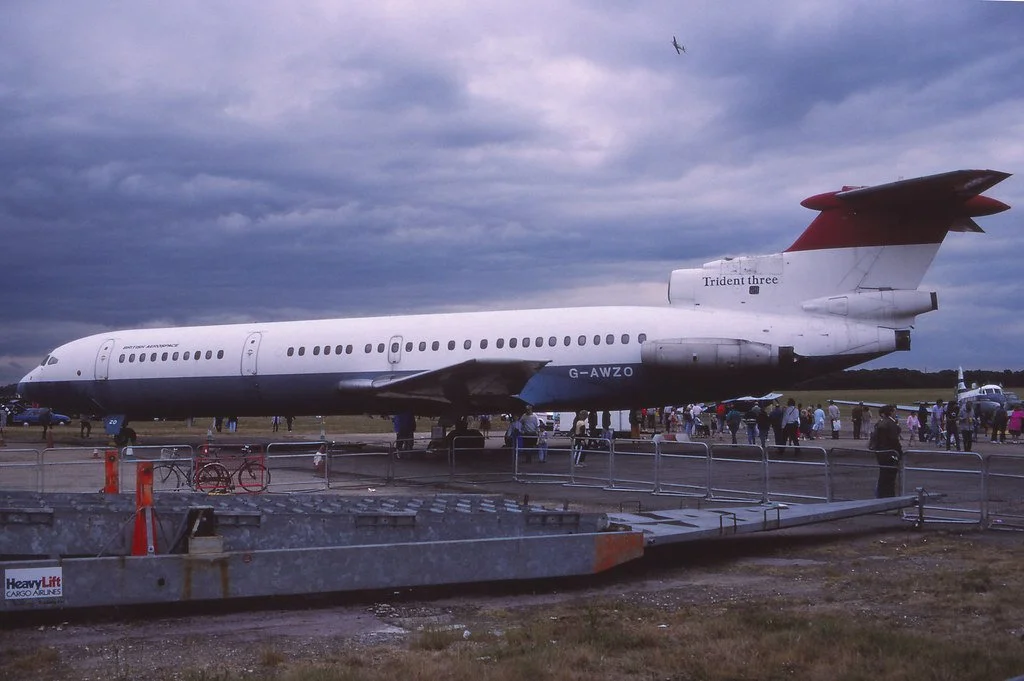
| Trident 1/1C | Trident 1E | Trident 2E | Trident 3B | |
|---|---|---|---|---|
| Flight Crew | 3 (2 pilots + 1 flight engineer) | |||
| Typical 1‑Class Seating | 101 | 108 | 115 | 180 |
| Year Entered Service | 1964 | – | 1968 | 1971 |
| Airframe Dimensions | ||||
| Length | 34.98 m (114 ft 9 in) | 39.98 m (131 ft 2 in) | ||
| Tail Height | 8.23 m (27 ft) | 8.61 m (28 ft 3 in) | ||
| Cabin Width | 3.4 m (11 ft 3.5 in) | |||
| Wing Span | 27.38 m (89 ft 10 in) | 29 m (95 ft) | 30 m (98 ft) | |
| Wing Sweep | 35° | |||
| Wing Area | 126.2 m² | 131.5 m² | 135.8 m² | |
| Performance | ||||
| Engines | 3 × Spey RB163‑1 Mk505‑5 | 3 × Spey RB163‑25 Mk511‑5 | 3 × Spey RB163‑25 Mk512‑5 | 3 × Spey RB163‑25 Mk512‑5 + RB162‑86 |
| Thrust | 3 × 46 kN | 3 × 51 kN | 3 × 53.2 kN | 3 × 53.2 kN + 23.4 kN booster |
| Cruise Speed (FL300) | Mach 0.86 (506 kt / 937 km/h) | Mach 0.84 (495 kt / 917 km/h) | ||
| Max Operating Altitude | 35,000 ft (11,000 m) | |||
| Range | 1,170–1,760 nm | 1,910 nm | 2,350 nm | 1,940 nm |
| Parameters | ||||
| Fuel Capacity | 17,500–22,000 L | 24,700 L | 26,250 L | 24,700 L |
| Max Takeoff Weight | 30,300–30,500 kg | 31,800 kg | 33,200 kg | 37,600 kg |
| Empty Operating Weight | 48,500–52,200 kg | 58,100 kg | 64,600 kg | 68,000 kg |
Assembly
Production of the Hawker Siddeley Trident took place at Hatfield Aerodrome in Hertfordshire, one of Britain’s most important post‑war aircraft manufacturing centres. The assembly process combined traditional hand‑built craftsmanship with emerging automated techniques, reflecting the transitional era of 1960s jetliner production.
Large prefabricated fuselage sections arrived at Hatfield from subcontractors and were aligned on precision jigs before being riveted together. The centre fuselage carried the wing box, which was bolted and braced to the main structure. The Trident’s distinctive swept wings were assembled separately, with fuel tanks, hydraulic lines and control surfaces installed before final attachment.
The aircraft’s three Rolls‑Royce Spey turbofan engines were mounted at the rear of the fuselage. Rolls‑Royce also supplied the fuel systems, plumbing, and engine instrumentation. Smiths Industries provided navigation, communication and flight‑control avionics, while Sperry Gyroscope supplied instrumentation and cockpit gauges. These systems were installed in the large electronics bay beneath the flight deck — made possible by the Trident’s offset nose‑wheel design.
Once the major assemblies were complete, the aircraft moved to the final assembly line for interior installation, systems integration, and ground testing. Each Trident underwent extensive checks, including hydraulic tests, electrical integration, engine runs and low‑speed taxi trials. Flight testing was conducted from Hatfield’s runway before delivery to BEA or international customers.

Orders & Deliveries
A total of 117 Tridents were produced between 1962 and 1978. BEA and British Airways were the largest operators, with additional aircraft delivered to Cyprus Airways, Kuwait Airways, Channel Airways, Pakistan International Airlines, Singapore Airlines, Ghana Airways, and Iraqi Airways.
| Airline / Customer | Country | Variant | Number |
|---|---|---|---|
| BEA British European Airways | United Kingdom | Trident 1C | 35 |
| BEA British European Airways | United Kingdom | Trident 2E | 15 |
| BEA British European Airways | United Kingdom | Trident 3B | 9 |
| British Airways | United Kingdom | Trident 1C | 28 |
| British Airways | United Kingdom | Trident 2E | 7 |
| Cyprus Airways | Cyprus | Trident 1C | 1 |
| Ghana Airways | Ghana | Trident 1E | 1 |
| Iraqi Airways | Iraq | Trident 1E | 1 |
| Kuwait Airways | Kuwait | Trident 1E | 5 |
| Pakistan International Airlines | Pakistan | Trident 1E | 1 |
| Singapore Airlines | Singapore | Trident 1E | 2 |
| Channel Airways | United Kingdom | Trident 1B | 2 |
| Channel Airways | United Kingdom | Trident 1E | 2 |
| Channel Airways | United Kingdom | Trident 3B | 1 |
| Total | 117 | ||
Legacy
The Hawker Siddeley Trident occupies a unique place in commercial aviation history. Although produced in relatively small numbers, it introduced technologies that would become standard across the industry. Its fully automatic landing system was decades ahead of its time, enabling safe operations in low‑visibility conditions and paving the way for modern autoland procedures used worldwide.
The Trident’s early adoption of digital avionics and triple‑redundant hydraulic systems influenced later aircraft including the Airbus A300 and Boeing 757. Its sleek aerodynamic profile and quiet three‑engine configuration set new standards for passenger comfort on short‑ to medium‑haul routes.
While ultimately overshadowed by more commercially successful competitors such as the Boeing 727 and 737, the Trident remains a landmark achievement in British engineering. Its innovations helped shape the future of jet transport design and cemented its reputation as one of the most technologically advanced airliners of its era.