
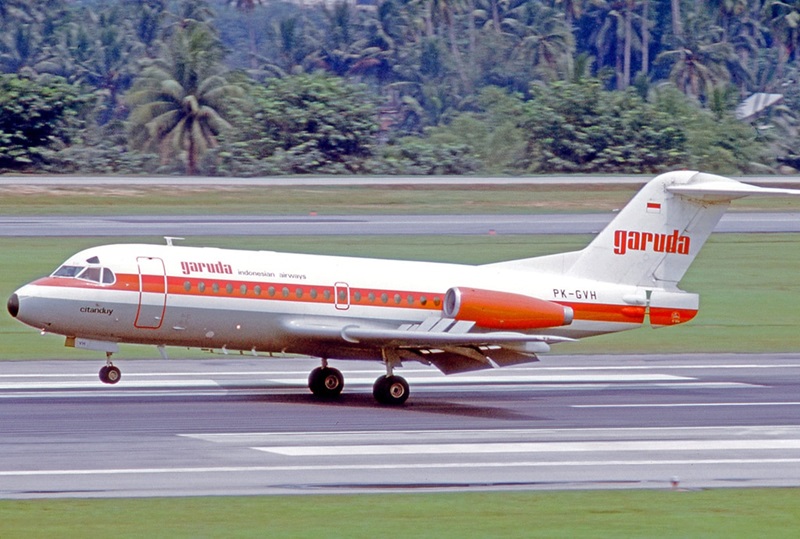
The Fokker F28 Fellowship was Fokker’s first jet-powered regional airliner, designed to complement the highly successful turboprop F27 Friendship. Introduced during the late 1960s, the F28 offered airlines a modern, reliable short‑haul jet that could operate from the same demanding airfields as the F27 and even the Douglas DC‑3. With its low‑mounted crescent‑sweep wing, rear‑mounted Rolls‑Royce Spey engines, and distinctive T‑tail, the Fellowship brought jet performance to routes traditionally served by turboprops.
Fokker intended the F28 to be simple, rugged, and versatile. Although smaller and slower than contemporary jets such as the BAC One‑Eleven and Douglas DC‑9, the Fellowship was engineered to access around 85% of the airfields used by the F27. This capability made it ideal for regional carriers operating from short or unprepared runways, particularly in South America, Scandinavia, and Southeast Asia.
The aircraft’s design emphasised operational practicality. The F28 lacked thrust reversers to avoid debris ingestion on rough strips, instead relying on effective lift‑dumping spoilers and anti‑skid brakes. Its hydraulically operated tail air brake—later seen on the BAe 146—allowed rapid descents and improved engine responsiveness during approach. These features, combined with robust landing gear and large low‑pressure tyres, made the Fellowship uniquely suited to challenging environments.
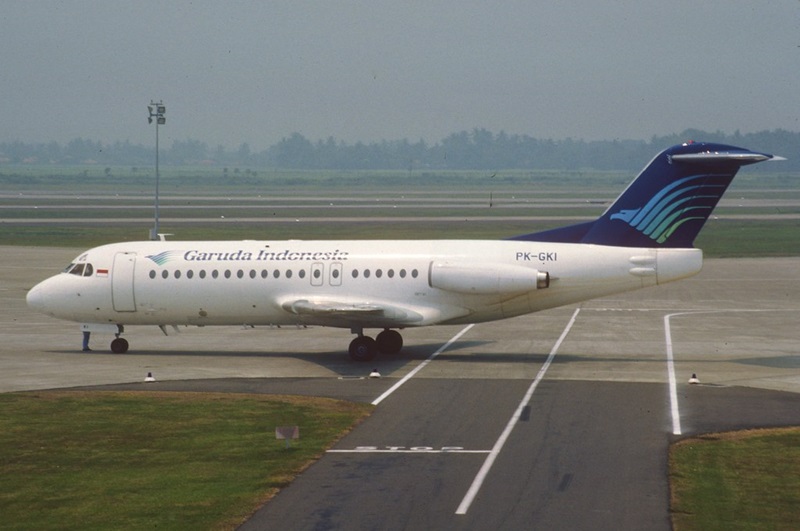
Over its 20‑year production run, the F28 evolved into several variants, including the stretched F28‑2000 and F28‑4000, as well as the improved but commercially unsuccessful F28‑5000 and F28‑6000. In total, 241 airframes were produced between 1967 and 1987, with Garuda Indonesia becoming the largest operator. The Fellowship ultimately paved the way for Fokker’s next‑generation jets—the Fokker 100 and Fokker 70.
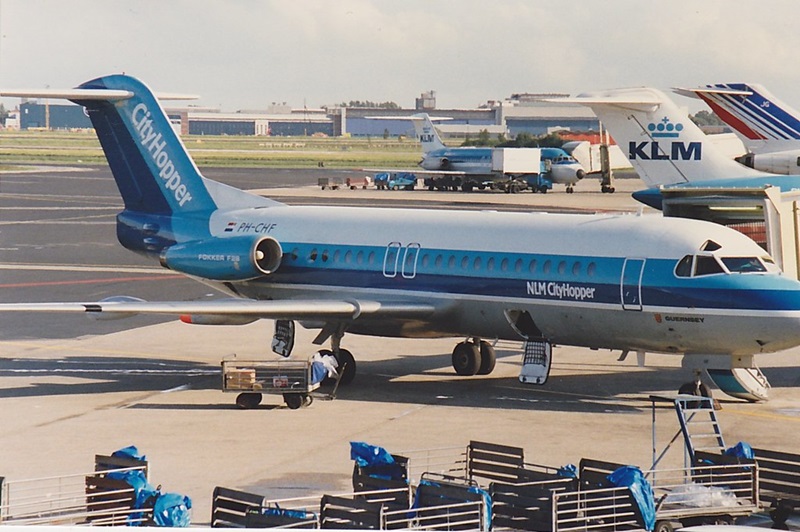

Fokker F28 Fellowship — At a Glance
| Category | Details |
|---|---|
| Manufacturer | Fokker (Netherlands) |
| First Flight | 9 May 1967 (F28‑1000 prototype) |
| Production Years | 1967–1987 |
| Total Built | 241 aircraft |
| Engines | 2 × Rolls‑Royce Spey turbofans |
| Typical Seating | 65–85 passengers (variant dependent) |
| Range | 1,668–2,872 km (900–1,550 nm) |
| Cruise Speed | 436–458 knots (502–527 mph) |
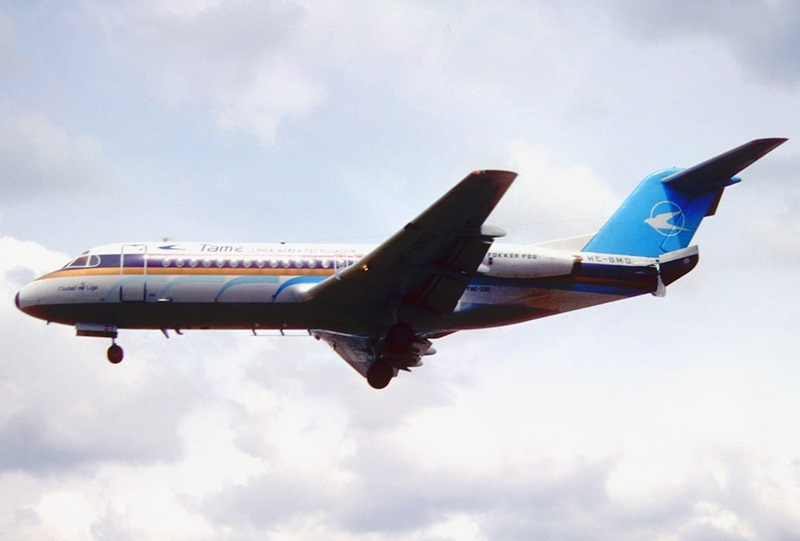
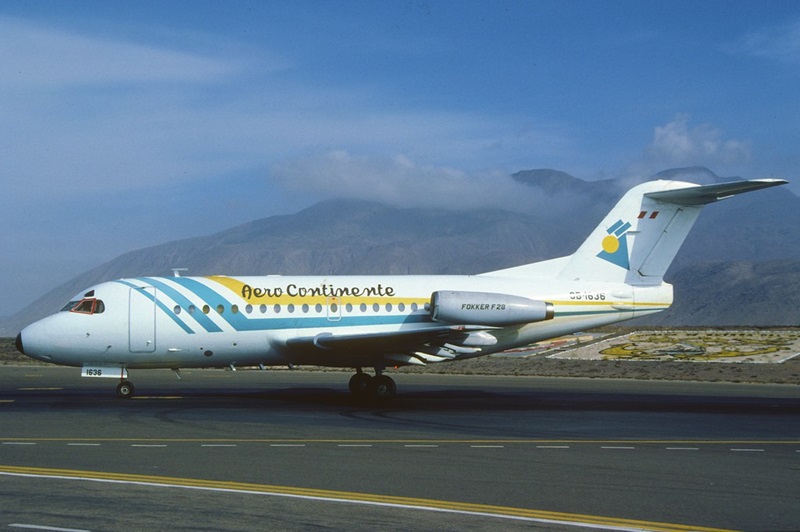
| Notable Operators | Garuda Indonesia (largest operator), Linjeflyg, Braathens SAFE, LTU, NLM CityHopper, TAME, Flight West Airlines, Aero Continente. |
Development Timeline
| Year | Milestone |
|---|---|
| April 1962 | Fokker formally announces the F28 Fellowship project after extensive market research and customer feedback. |
| 9 May 1967 | First flight of the F28‑1000 prototype, flown by Chief Test Pilot Jas Moll, Co‑Test Pilot Abe van der Schraaf, and flight engineer Cees Dik. |
| 24 Feb 1969 | West German certification granted for the F28‑1000. |
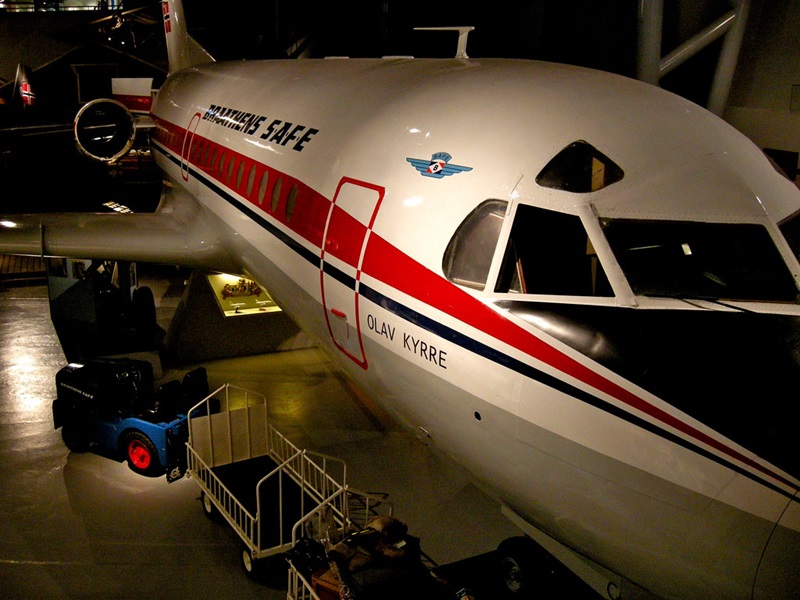
| 28 Mar 1969 | First commercial service operated by Braathens SAFE, despite LTU being the initial customer. |
| 28 Apr 1971 | First flight of the stretched F28‑2000 variant. The original 1000 prototype was converted to 2000 configuration for certification. |
| 20 Oct 1976 | First flight of the F28‑4000, the most successful variant, featuring increased seating (85), larger wingspan, and Spey 555‑15H engines. |
| 1978 | First flight of the F28‑3000, a shorter‑body variant with updated systems. |
| Late 1970s |
Development of the improved F28‑5000 and F28‑6000 variants featuring wing slats, greater wingspan, and quieter engines. Neither achieved commercial success; two 6000s built, no 5000s. |
| Early 1980s | Fairchild develops the Fairchild 228 for the U.S. market, based on the F28. Only two built due to certification delays linked to the Rolls‑Royce Trent RB203 engine. |
| 1987 | Production of the F28 ends after 241 aircraft built. The Fellowship is succeeded by the Fokker 100 and later the Fokker 70. |
History
By the early 1960s, Fokker had already achieved major success with the F27 Friendship, a rugged and reliable turboprop that became a favourite among regional airlines worldwide. Confident in their ability to design practical and versatile aircraft, Fokker began exploring the idea of a small jet airliner that could serve the same demanding routes as the F27 while offering higher speed and improved passenger comfort.
In 1960, British European Airways (BEA) issued a requirement for a high‑speed regional jet, signalling a shift in the market. Fokker responded by conducting extensive research, including consultations with North American operators to ensure the new aircraft would meet international expectations. Initially planned as a 50‑seat jet, customer feedback led Fokker to increase capacity to 65 seats, resulting in the design that became the F28 Fellowship.
The prototype F28‑1000 made its maiden flight on 9 May 1967, piloted by Chief Test Pilot Jas Moll, Co‑Test Pilot Abe van der Schraaf, and flight engineer Cees Dik. After a successful test programme, West German certification was granted on 24 February 1969. Although LTU placed the first order, the first commercial service was flown by Braathens SAFE on 28 March 1969.
The F28‑2000, a stretched version of the original 1000 series, first flew on 28 April 1971. Fokker converted the original prototype to 2000 configuration for certification. Later, the company developed the F28‑5000 and F28‑6000, featuring wing slats, increased wingspan, and quieter engines. However, these improved variants failed to attract customers—two 6000s were built, and none of the 5000.
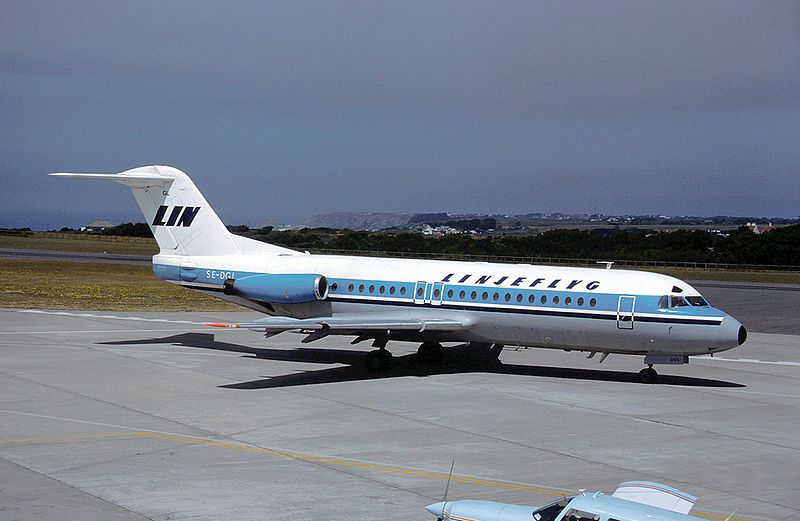
The most successful variant was the F28‑4000, which first flew on 20 October 1976. With seating for up to 85 passengers, a larger reinforced wingspan, and more powerful Rolls‑Royce Spey 555‑15H engines, the 4000 became the backbone of many regional fleets. Swedish carrier Linjeflyg introduced the type into service, and it quickly gained popularity across Europe and Asia.
Production of the F28 Fellowship spanned two decades, from 1967 to 1987, with a total of 241 aircraft built. The type was eventually succeeded by the larger Fokker 100 and the smaller Fokker 70, both of which carried forward the design philosophy established by the Fellowship.
In the United States, Fairchild Aircraft developed the Fairchild 228, a derivative of the F28 intended for the U.S. market. Only two were built due to certification delays caused by uncertainty surrounding the Rolls‑Royce Trent RB203 engine. The programme was cancelled, and Fairchild wrote off US$30 million in development costs.
Specifications
Fokker F28 Fellowship Specs Table
| Fokker F28 | ‑1000 | ‑2000 | ‑3000 | ‑4000 |
|---|---|---|---|---|
| Crew | 2 | |||
| First Flight | 24 February 1969 | 28 April 1971 | 19 July 1978 | 20 October 1976 |
| Number Produced | 97 | 10 | 22 | 112 |
| Passengers | 65 | 79 | 65 | 85 |
| Cabin Width (Internal) | 3.1 m (11 ft 1 in) | |||
| Aircraft Length | 27.4 m (89 ft 10 in) | 29.6 m (97 ft 2 in) | 27.4 m (89 ft 10 in) | 29.6 m (97 ft 2 in) |
| Tail Height | 8.47 m (27 ft 9.5 in) | |||
| Main Wing Span | 23.6 m (77 ft 4 in) | 23.6 m (77 ft 4 in) | 25.7 m (82 ft 3 in) | 25.7 m (82 ft 3 in) |
| Main Wing Area |
76.4 m² (822 ft²) 16° sweep, Aspect Ratio (AR) 7.3:1 |
79 m² (850 ft²) 16° sweep, Aspect Ratio (AR) 8:1 |
||
| Empty Weight | 16,144 kg (35,517 lb) | 16,707 kg (36,953 lb) | 16,846 kg (37,139 lb) | 17,611 kg (38,825 lb) |
| MTOW | 29,480 kg (65,000 lb) | 33,110 kg (73,000 lb) | ||
| Maximum Payload | 8,629 kg (18,983 lb) | 7,976 kg (17,547 lb) | 8,620 kg (19,003 lb) | 10,556 kg (23,307 lb) |
| Takeoff Distance (MTOW) | 1,676 m (5,500 ft) | |||
| Landing Distance | 1,079 m (3,540 ft) | 967 m (3,173 ft) | 1,065 m (3,495 ft) | |
| Fuel Capacity | 13,040 L (2,869 imp gal; 3,445 US gal) | |||
| Engines × 2 | Rolls‑Royce Spey Mk 555‑15 | Rolls‑Royce Spey Mk 555‑15H | ||
| Engine Thrust × 2 | 43.9 kN (9,850 lbf) | |||
| Speed (Max Cruise) | 458 kn, 527 mph, 848 km/h | 436 kn, 502 mph, 808 km/h | ||
| Service Ceiling | 35,000 ft (10,670 m) | |||
| Range (Fully Laden) | 1,705 km, 920 nm | 2,872 km, 1,550 nm | 1,668 km, 900 nm | |
Variants
| Variant | Description |
|---|---|
| F28‑1000 |
Original production model seating 65 passengers. First flew on 9 May 1967. Powered by Rolls‑Royce Spey Mk 555‑15 engines. 97 aircraft produced. |
| F28‑2000 |
Stretched version of the 1000 series, seating 79 passengers. First flew on 28 April 1971. Only 10 produced. The original 1000 prototype was converted to 2000 configuration for certification. |
| F28‑3000 |
Short‑body variant with updated systems. First flew on 19 July 1978. 22 aircraft produced. |
| F28‑4000 |
Most successful variant, seating 85 passengers. First flew on 20 October 1976. Featured larger reinforced wings and Spey 555‑15H engines. 112 aircraft produced. |
| F28‑5000 |
Updated version of the 1000 featuring wing slats, increased wingspan, and quieter engines. No aircraft were produced. |
| F28‑6000 |
Updated version of the 2000 with wing slats, greater wingspan, and quieter engines. Only two aircraft were built. |
| Fairchild 228 |
U.S.‑developed derivative of the F28. Only two built due to certification delays linked to the Rolls‑Royce Trent RB203 engine. Programme cancelled; US$30M development cost written off. |
Assembly
The Fokker F28 Fellowship was the product of an international collaboration involving four major aerospace manufacturers. Fokker led the programme, but significant portions of the aircraft were built by West German companies Messerschmitt‑Bölkow‑Blohm (MBB) and VFW‑Fokker, as well as Short Brothers in Northern Ireland. This multinational approach allowed Fokker to distribute production efficiently while ensuring the aircraft met the structural and performance standards required for global operations.
Fokker was responsible for the nose section, centre fuselage, and inner wing structure. These components formed the core of the aircraft’s aerodynamic and structural integrity. MBB/VFW‑Fokker produced the forward fuselage, rear fuselage, and tail assembly, including the distinctive T‑tail that defined the F28’s silhouette. Short Brothers manufactured the outer wing panels, completing the aircraft’s crescent‑sweep wing design.
Government support played a key role in the programme’s development. The Netherlands government funded 50% of Fokker’s share of production, while the West German government funded 65% of the West German contribution. This financial backing ensured the F28 could be developed to meet international market demands and compete with other emerging regional jets of the era.
Final assembly of the F28 took place at Amsterdam’s Schiphol Airport. Here, the major components were brought together, systems were integrated, and aircraft were prepared for testing and delivery. The assembly process emphasised simplicity and reliability—core design principles of the Fellowship. This included the installation of the hydraulically operated tail air brake, a unique feature that allowed rapid descents and improved engine responsiveness during approach.
The result was a regional jet that combined modern performance with rugged practicality. The F28’s straightforward systems, robust landing gear, and ability to operate from short or unprepared airstrips made it a favourite among airlines in challenging environments across South America, Scandinavia, and Southeast Asia.
Interior
The interior of the Fokker F28 Fellowship was designed around the same principles that made the F27 successful: simplicity, reliability, and practicality. Although the F28 introduced jet performance to regional routes, Fokker deliberately avoided unnecessary complexity in the cabin and systems, ensuring the aircraft remained easy to operate and maintain for airlines serving short‑haul and remote destinations.
The cabin typically seated between 65 and 85 passengers depending on the variant. Seating layouts were straightforward, with a clean two‑abreast arrangement on each side of the aisle. The cabin width of 3.1 metres provided a comfortable environment for regional travel, and operators often praised the F28 for its efficient use of space and ease of turnaround at busy airports.
Large oval windows offered excellent outside visibility, a feature carried over from the F27. Passengers enjoyed bright natural light and unobstructed views thanks to the aircraft’s low‑mounted wing and rear‑mounted engines, which kept the cabin quiet and free from wing‑root obstruction.
The F28’s systems were designed to be robust and uncomplicated. Leading‑edge slats were omitted to reduce mechanical complexity, and de‑icing was achieved using engine bleed air. The aircraft also lacked thrust reversers, relying instead on effective lift‑dumping spoilers and anti‑skid brakes. These choices not only simplified maintenance but also reduced the risk of debris ingestion on unprepared airstrips.
The flight deck followed the same philosophy. Straightforward instrumentation and familiar layouts made the F28 easy for crews transitioning from turboprops such as the F27. The cockpit offered good visibility and a logical arrangement of controls, contributing to the type’s reputation as a pilot‑friendly aircraft.
Overall, the F28’s interior reflected Fokker’s commitment to building a regional jet that was comfortable for passengers, practical for airlines, and capable of operating in environments where larger or more complex jets could not. Its simplicity and reliability became defining characteristics throughout its service life.
Legacy
The Fokker F28 Fellowship occupies a unique place in regional aviation history. As one of the earliest short‑haul twin‑jets, it bridged the gap between the rugged turboprop era of the 1950s and the modern regional jets that followed in the 1980s and 1990s. Designed to operate from the same demanding airfields as the F27 and even the Douglas DC‑3, the F28 proved that jet aircraft could be both practical and versatile in environments far removed from major airports.
Its simplicity was one of its greatest strengths. The absence of thrust reversers, the use of bleed‑air de‑icing, and the straightforward wing design made the Fellowship easy to maintain and reliable in service. The hydraulically operated tail air brake—an innovative feature decades ahead of its time—allowed rapid descents and improved responsiveness during approach, later inspiring similar systems on aircraft such as the BAe 146.
The Fellowship became a workhorse for airlines operating in challenging conditions. Garuda Indonesia, the largest operator, relied heavily on the type to connect remote communities across the Indonesian archipelago. In Scandinavia, carriers such as Linjeflyg and Braathens SAFE used the F28 to serve short, weather‑affected routes where reliability was essential. Across South America, operators like TAME and Aero Continente valued the aircraft’s ability to handle high‑altitude airports and unprepared strips.
Although the improved F28‑5000 and F28‑6000 variants failed to gain traction, the core design philosophy of the Fellowship lived on. The aircraft’s operational lessons directly influenced the development of the Fokker 100 and later the Fokker 70, both of which became successful regional jets in their own right. Many pilots who flew the F28 later transitioned to these newer types, often noting the familiar handling characteristics and practical cockpit layout.
The F28’s longevity is a testament to its robust engineering. Even decades after production ended in 1987, the Fellowship continued flying with smaller operators, government agencies, and military units. Its ability to operate from short runways, high‑altitude airports, and remote locations ensured that it remained relevant long after more advanced jets entered the market.
Today, the Fokker F28 Fellowship is remembered as a pioneering regional jet—an aircraft that brought jet performance to routes once dominated by turboprops, without sacrificing the practicality and ruggedness that made Fokker aircraft so respected. Its legacy lives on in museums, in the fleets it helped shape, and in the generations of regional jets that followed its example.