
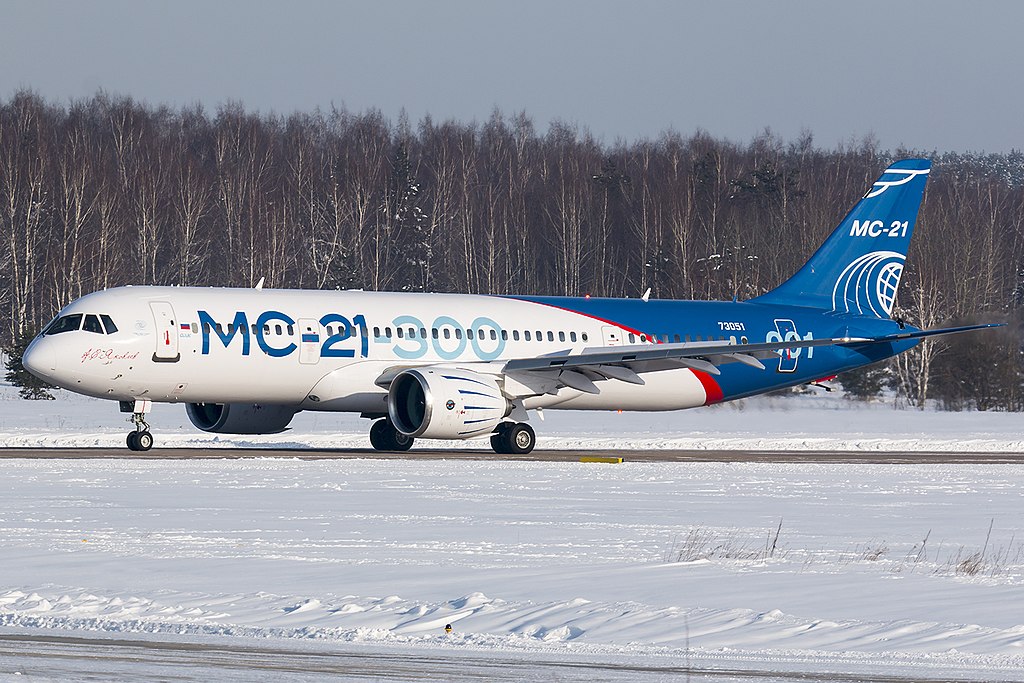
There is a new player on the block in the single‑aisle market long dominated by the Boeing 737 and the Airbus A320. The Irkut MC‑21 (Иркут МС‑21), now officially rebranded as the Yakovlev MC‑21 under Russia’s United Aircraft Corporation (UAC), represents a major step forward for Russian‑built airliners.
Sporting an advanced composite wing and offering both Western and Russian powerplant options, the MC‑21 was designed to reduce reliance on imported technologies. Early prototypes flew with Pratt & Whitney PW1400G engines, but due to sanctions, the production aircraft will exclusively use the Russian‑built Aviadvigatel PD‑14 turbofan.
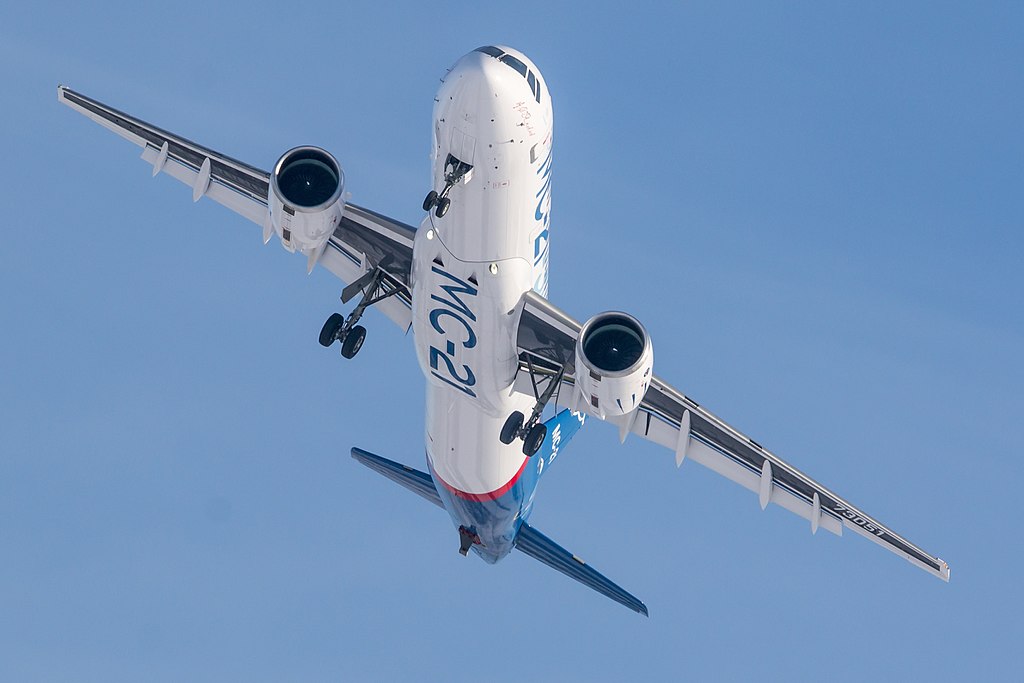
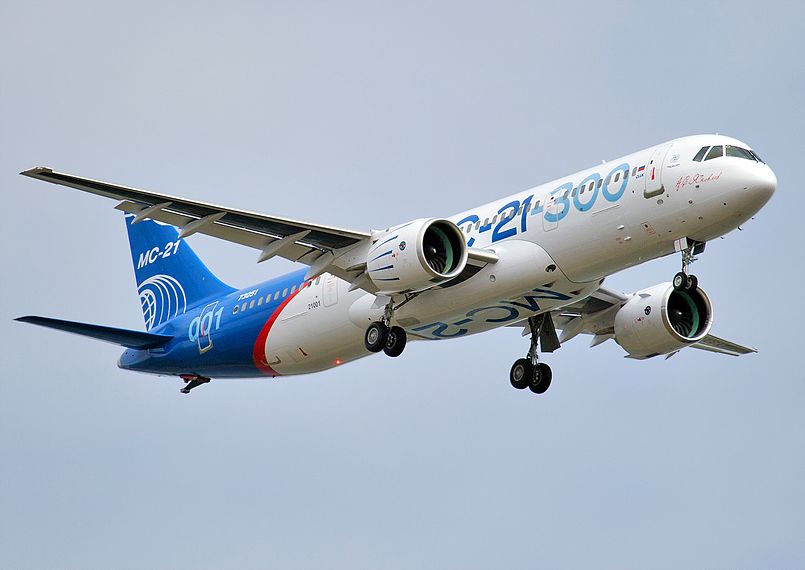
The MC‑21 wing is made of composites, as are many of today’s modern airliners. Interestingly, Irkut chose not to include winglets or wingtip devices on the initial prototypes — an unusual decision in an era where wingtip treatments are standard for reducing drag and improving fuel burn. Whether future variants adopt winglets remains to be seen.
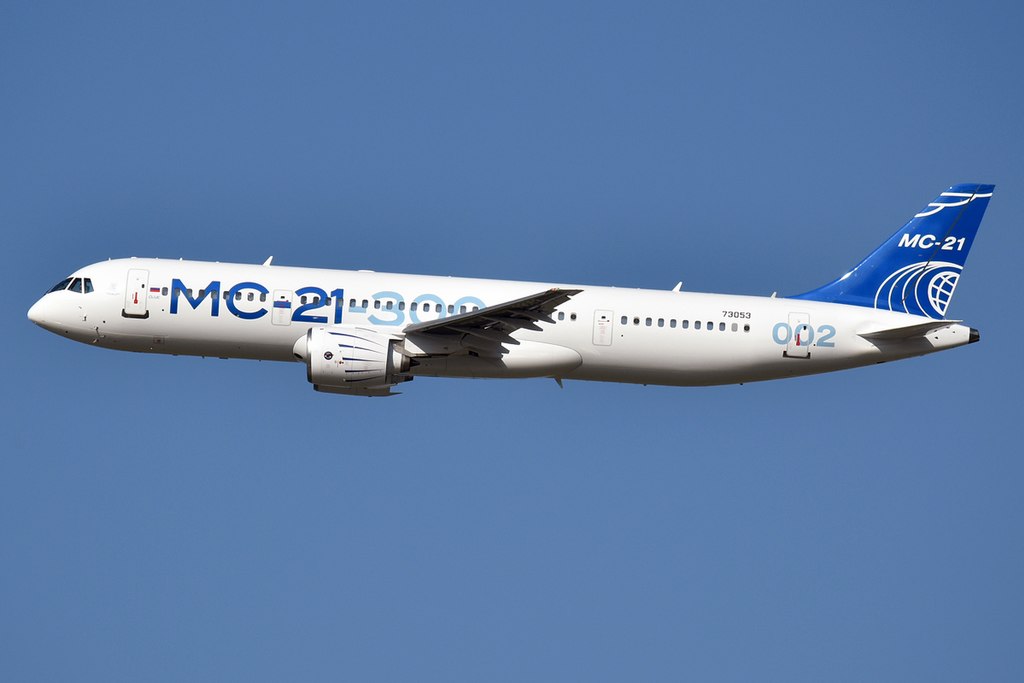
The aircraft is aimed initially at the domestic Russian market, where ageing types such as the TU‑134, TU‑154, TU‑204 and Yak‑42 are overdue for replacement. The first variant is the larger MC‑21‑300, followed later by the shorter MC‑21‑200.

At a Glance.
| Category | Details |
|---|---|
| Aircraft | Irkut MC‑21 (now Yakovlev MC‑21) |
| Manufacturer | United Aircraft Corporation (UAC) |
| Design Bureau | Yakovlev Design Bureau (formerly Irkut) |
| Role | Single‑aisle short‑ to medium‑haul airliner |
| Variants | MC‑21‑300 (baseline), MC‑21‑200 (shorter), MC‑21‑310 (PD‑14 powered) |
| Engines | Aviadvigatel PD‑14 (production); PW1400G (cancelled) |
| First Flight | 28 May 2017 |
| Certification | Initial Russian certification granted December 2021 (PW1400G version) |
| Status | PD‑14 version certification expected 2024–2025 |
| Launch Operator | Rossiya Airlines (Aeroflot Group) |
| Expected Entry Into Service | 2025–2026 |
| Market Focus | Russian domestic carriers; replacement for TU‑134, TU‑154, TU‑204, Yak‑42 |
| Key Feature | Advanced composite wing produced entirely in Russia |
Development Timeline.
| Year | Milestone |
|---|---|
| 2007 | MC‑21 project officially launched by Irkut Corporation. |
| 2016 | First prototype rolled out of the Irkutsk facility on 08 June. Ground testing began shortly after, including APU runs, taxi trials and runway roll tests. |
| February 2017 | Wing box static testing reached 90% of ultimate load before failing — common in early structural tuning. Reinforced with an additional 25 kg of composite material, the wing subsequently passed the full 100% test. |
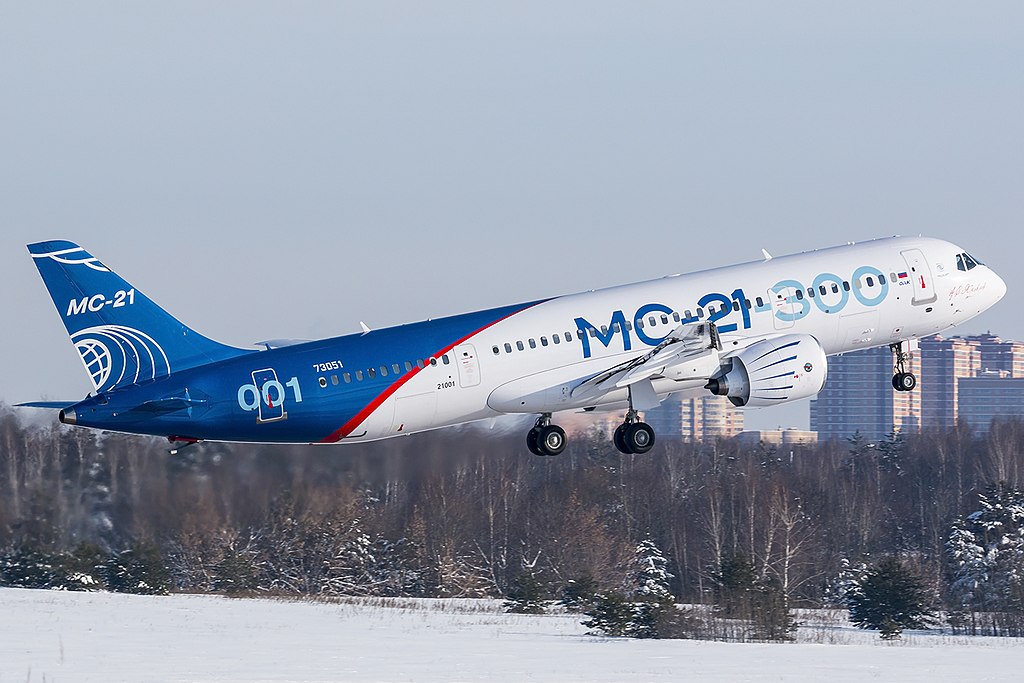
| 28 May 2017 | Maiden flight: a short 30‑minute sortie, climbing to 1,000 m (3,280 ft) and limited to 162 knots (300 km/h). Russian industry minister Denis Manturov claimed operating costs would be 12–15% lower than contemporary airliners. |
| August 2017 | First prototype completed nine test flights focusing on controllability and stability. Over 500 strain sensors monitored structural loads throughout the airframe. |
| 17 October 2017 | First long‑range flight: Irkutsk to Ramenskoye Airport, Moscow — 4,500 km (2,400 nmi) at 10,000 m (32,800 ft). High‑altitude testing continued up to 12,000 m (39,370 ft). |
| 2018 | Firm orders reached 175 aircraft. Initial production plan: 20 aircraft per year, ramping to 70 annually. |
| December 2021 | MC‑21 received initial type certification from Rosaviatsia for the PW1400G‑powered version. Certification for the PD‑14 version was scheduled to follow. |
| 2022–2023 | Western sanctions halted PW1400G deliveries. MC‑21‑310 (PD‑14 powered) became the sole production variant. Composite wing production transitioned fully to Russian suppliers. |
| 2023 | Irkut brand consolidated under Yakovlev — aircraft officially renamed “Yakovlev MC‑21”. |
| 2024–2025 | PD‑14 version certification expected. First deliveries planned for Rossiya Airlines once domestic component substitution is complete. |
| 2025–2026 | Expected entry into service for the MC‑21‑310. Production rate revised downward due to supply chain constraints. |
History.
The Irkut MC‑21 programme began in the mid‑2000s as Russia sought a modern, competitive single‑aisle airliner to challenge the Boeing 737 and Airbus A320 families. The country’s existing narrow‑body fleet — TU‑134s, TU‑154s, TU‑204s and Yak‑42s — was ageing, inefficient, and increasingly difficult to support. A clean‑sheet design was required, and Irkut Corporation was tasked with delivering it.
The MC‑21 was conceived as a technologically advanced aircraft featuring a composite wing, fly‑by‑wire controls, modern avionics, and Western engines. The Pratt & Whitney PW1400G geared turbofan was selected as the launch engine, giving the aircraft competitive fuel burn and performance. A Russian alternative, the Aviadvigatel PD‑14, was developed in parallel.
The first prototype rolled out in June 2016, followed by a series of ground tests including APU runs, taxi trials, and runway roll tests. Structural testing of the composite wing box initially resulted in a failure at 90% of ultimate load — not unusual for early composite development. After reinforcement, the wing passed the full 100% test, clearing the way for flight trials.
The MC‑21’s maiden flight took place on 28 May 2017 from Irkutsk. The initial sortie was limited to 30 minutes, reaching 1,000 m (3,280 ft) and 162 knots (300 km/h). Subsequent flights expanded the envelope, with the aircraft later climbing to 12,000 m (39,370 ft). The first long‑range flight occurred on 17 October 2017, covering 4,500 km (2,400 nmi) to Ramenskoye Airport near Moscow.
By 2018, firm orders had reached 175 aircraft, primarily from Russian carriers. Irkut planned to produce 20 aircraft per year initially, ramping up to 70 annually. The MC‑21‑300 was the first variant to enter testing, with the shorter MC‑21‑200 to follow.
In December 2021, the MC‑21 received initial type certification from Rosaviatsia for the PW1400G‑powered version. However, geopolitical developments in 2022 dramatically altered the programme. Western sanctions halted deliveries of Pratt & Whitney engines and composite materials, forcing Irkut to accelerate domestic substitution.
The PD‑14‑powered MC‑21‑310 became the sole production variant. Composite wing production transitioned entirely to Russian suppliers, and numerous imported systems were replaced with locally manufactured alternatives. These changes required additional testing and certification, delaying entry into service.
In 2023, the Irkut brand was consolidated under the Yakovlev Design Bureau as part of a United Aircraft Corporation restructuring. The aircraft was officially renamed the “Yakovlev MC‑21”, though the Irkut name remains widely used in industry references.
As of 2024–2025, certification of the PD‑14 version is expected to be completed, with Rossiya Airlines (Aeroflot Group) slated as the launch operator. Entry into service is anticipated in 2025–2026, though production rates have been revised downward due to supply chain constraints and the need for domestic component substitution.
Despite delays, the MC‑21 remains one of the most ambitious civil aviation projects in modern Russian history. Its composite wing, advanced aerodynamics, and modern systems place it among the most technologically sophisticated aircraft ever produced in the country. The programme’s future will depend heavily on domestic demand and the continued development of Russian aerospace manufacturing capabilities.
Specifications.
| Category | MC‑21‑200 | MC‑21‑300 / MC‑21‑310 |
|---|---|---|
| Manufacturer | Irkut / Yakovlev (UAC) | Irkut / Yakovlev (UAC) |
| Role | Single‑aisle airliner | Single‑aisle airliner |
| Engines | Pratt & Whitney PW1400G (prototype, cancelled) Aviadvigatel PD‑14 (planned option) |
MC‑21‑300: Pratt & Whitney PW1400G (prototype, cancelled) MC‑21‑310: Aviadvigatel PD‑14 (production) |
| Length | 36.8 m (120 ft 7 in) | 42.2 m (138 ft 5 in) |
| Wingspan | 35.9 m (117 ft 9 in) | 35.9 m (117 ft 9 in) |
| Height | 11.5 m (37 ft 9 in) | 11.5 m (37 ft 9 in) |
| Wing Area | 122.5 m² (1,319 ft²) | 122.5 m² (1,319 ft²) |
| Max Takeoff Weight | 72,000 kg (158,700 lb) | 79,250 kg (174,700 lb) |
| Max Landing Weight | 64,000 kg (141,100 lb) | 67,600 kg (149,000 lb) |
| Range | 5,500 km (2,970 nmi) | 6,000 km (3,240 nmi) |
| Cruise Speed | Mach 0.80 | Mach 0.80 |
| Max Speed | Mach 0.82 | Mach 0.82 |
| Service Ceiling | 12,000 m (39,370 ft) | 12,000 m (39,370 ft) |
| Takeoff Distance | 1,700 m (5,577 ft) | 1,800 m (5,900 ft) |
| Landing Distance | 1,450 m (4,757 ft) | 1,500 m (4,900 ft) |
| Passengers | 132 (two‑class typical) Up to 165 (maximum) |
163 (two‑class typical) Up to 211 (maximum) |
| Cargo Volume | 45.0 m³ (1,589 ft³) | 51.2 m³ (1,808 ft³) |
Assembly.
Final assembly of the MC‑21 takes place at the Irkutsk Aviation Plant in Siberia, one of Russia’s largest and most established aircraft manufacturing facilities. The plant has been modernised extensively for the MC‑21 programme, including new tooling, automated drilling systems, composite processing equipment, and digital production control systems.
One of the most significant aspects of MC‑21 assembly is the aircraft’s advanced composite wing. Originally produced using imported materials and foreign equipment, the wing is now manufactured entirely in Russia following the transition to domestic suppliers. This required substantial re‑engineering of production processes, including new resin systems, automated fibre placement equipment, and updated quality‑control procedures.
The fuselage is built in large sections that are transported to the final assembly line, where they are joined using automated alignment rigs. The nose section, centre fuselage, and tail components are mated before the composite wing is attached. The wing‑to‑body join is one of the most complex steps in the assembly process, requiring precision alignment and extensive structural testing.
Systems installation includes Russian‑built avionics, hydraulics, and electrical components, replacing many of the imported systems originally planned for the aircraft. The transition to domestic systems has required additional integration testing and certification work, contributing to programme delays.
The PD‑14 engines are installed late in the assembly process, followed by landing gear, interior fittings, and final cabin configuration. Each aircraft undergoes a series of ground tests, including fuel system checks, electrical power‑up, flight control calibration, and pressurisation tests, before being moved to the flight test station.
Despite the challenges posed by supply‑chain restructuring, the assembly process continues to mature. Production rates remain lower than originally planned, but the Irkutsk facility is expected to increase output gradually as domestic component manufacturing stabilises.
Orders & Deliveries.
The MC‑21 programme initially attracted strong interest from Russian carriers, with early commitments reaching 175 aircraft by 2018. These orders were primarily from Aeroflot Group subsidiaries, leasing companies, and smaller domestic operators. The aircraft was intended to become Russia’s primary single‑aisle replacement for ageing TU‑134, TU‑154, TU‑204 and Yak‑42 fleets.
However, geopolitical developments beginning in 2022 significantly affected the programme. Western sanctions halted deliveries of Pratt & Whitney PW1400G engines and restricted access to imported composite materials and avionics. As a result, Irkut (now Yakovlev) shifted production entirely to the PD‑14‑powered MC‑21‑310 and began replacing imported components with domestically produced alternatives.
These changes required additional testing and certification work, delaying the aircraft’s entry into service. Several early commitments were restructured or deferred, and no international orders remain active. The MC‑21 is now focused exclusively on the Russian domestic market.
Rossiya Airlines, part of the Aeroflot Group, is expected to be the launch operator once certification of the PD‑14 version is complete. Deliveries were originally planned for 2024–2025 but have since been pushed to the 2025–2026 timeframe due to supply‑chain restructuring and the need for full domestic component substitution.
As of 2026, no MC‑21 aircraft have been delivered to customers. Production continues at a reduced rate while Yakovlev finalises certification and stabilises domestic manufacturing of key components. The programme’s future delivery schedule will depend heavily on the pace of Russian industrial adaptation and the ability to maintain consistent output at the Irkutsk assembly plant.
Legacy.
The MC‑21 represents one of the most ambitious civil aviation projects undertaken by Russia since the fall of the Soviet Union. Conceived as a modern, competitive narrow‑body airliner capable of challenging the Boeing 737 and Airbus A320 families, it introduced technologies never before seen in a Russian commercial aircraft — most notably its advanced composite wing and geared turbofan engines.
Although the programme has faced significant delays, structural challenges, and geopolitical disruptions, the MC‑21 has demonstrated that Russia can design and produce an airliner that meets modern aerodynamic and performance standards. Its composite wing, produced domestically after sanctions halted foreign supply, is a major technological achievement and a milestone for the Russian aerospace industry.
The transition from the PW1400G to the PD‑14 engine marked a turning point in the programme. While originally intended to offer Western and Russian engine options, the aircraft ultimately became a symbol of industrial independence, relying entirely on domestic powerplants and systems. This shift required extensive redesign and certification work, but it also strengthened Russia’s long‑term ability to support the aircraft without reliance on foreign suppliers.
The MC‑21’s legacy will likely be defined by its role in revitalising Russia’s civil aviation manufacturing capability. It has driven investment in composite technologies, modernised the Irkutsk assembly plant, and accelerated the development of new avionics, hydraulics, and electrical systems produced within Russia. Even with reduced production rates, the programme has created a foundation for future aircraft development.
Operationally, the MC‑21 is expected to serve primarily within Russia and neighbouring regions, replacing ageing Soviet‑era airliners and providing a modern alternative for domestic carriers. Its entry into service, anticipated in the mid‑2020s, will mark the first time in decades that a Russian‑built narrow‑body airliner enters commercial operation with performance comparable to its Western counterparts.
While the MC‑21 may never achieve the global market penetration originally envisioned, its impact on Russian aerospace engineering is undeniable. It stands as a testament to the country’s ability to design, test, and certify a technologically advanced airliner under challenging circumstances. The aircraft’s long‑term legacy will be measured not only by the number produced, but by the industrial capability it helped create.