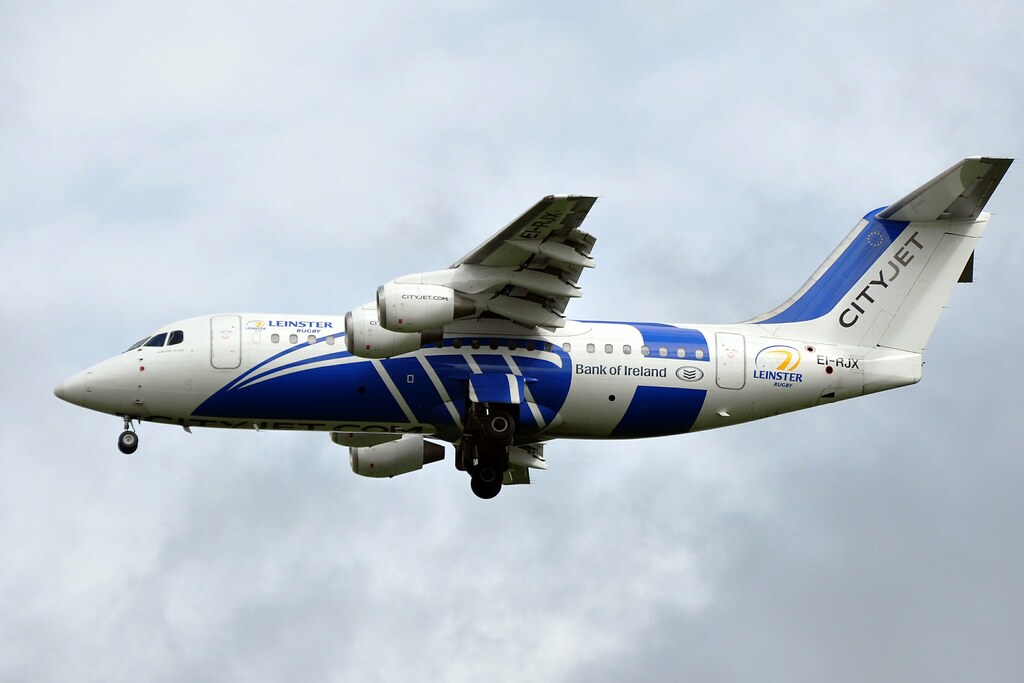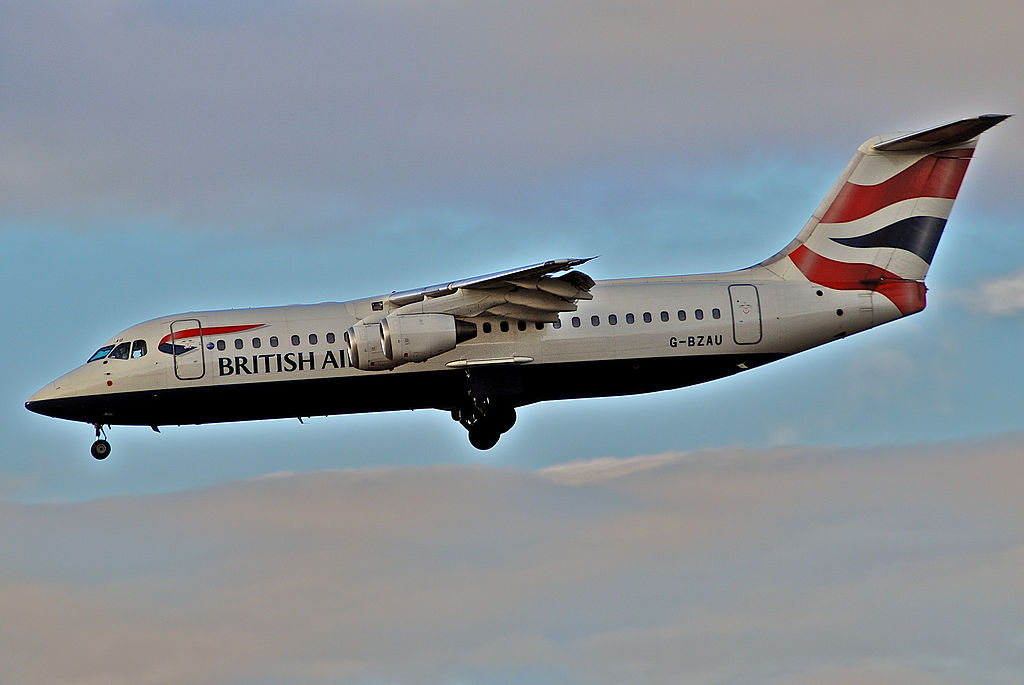
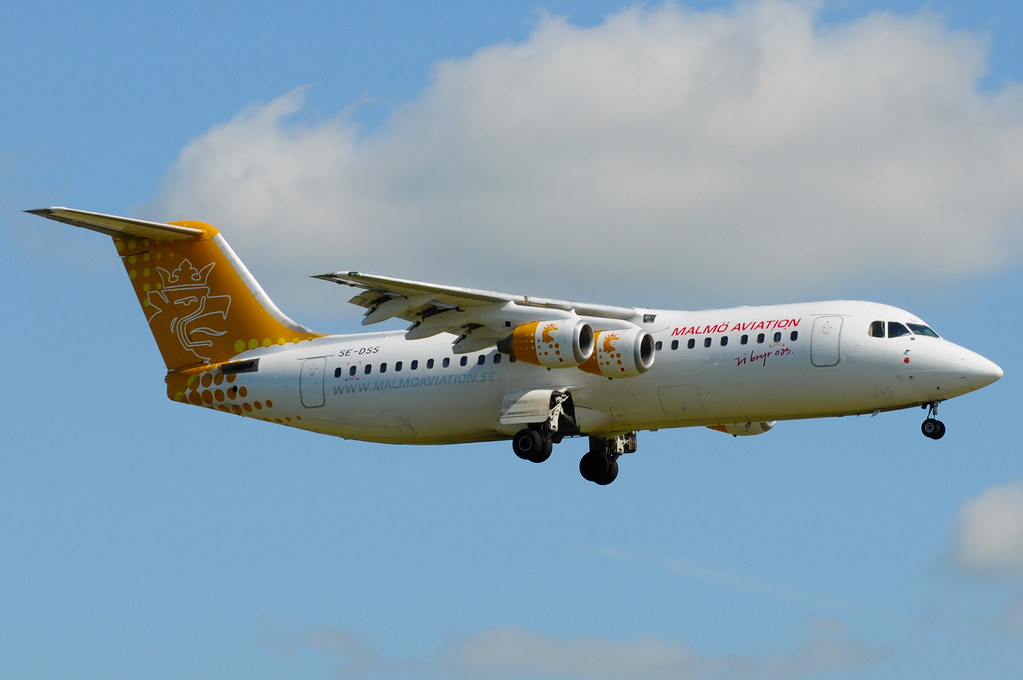
The BAe 146 and its later Avro RJ development form one of the most distinctive regional jet families ever built.
With four engines, a high wing, and a T‑tail, the “Whisperjet” carved out a unique niche: quiet, short‑field operations
into noise‑sensitive and constrained airports such as London City. Built in the UK, the BAe 146 / Avro RJ became
Britain’s most successful jet airliner, serving airlines, cargo operators, VIP fleets and, later, aerial firefighting
organisations around the world.

Development and history
Work on what would become the BAe 146 began in the late 1970s as British Aerospace sought to create a quiet,
short‑haul jet capable of operating from short runways and into airports with strict noise limits. The prototype
BAe 146‑100 first flew in September 1981, with certification following in 1983. The initial 146‑100 was soon joined
by the stretched 146‑200 and 146‑300, offering increased capacity and range.
In the early 1990s, British Aerospace launched an improved family under the Avro RJ name. The RJ70, RJ85 and RJ100
featured updated interiors, avionics and systems, along with aerodynamic refinements. The RJ series became particularly
successful in Europe, where airlines such as Crossair, Swiss and Lufthansa CityLine used the type extensively on
regional networks and into challenging airports.
Production of the BAe 146 / Avro RJ family ended in the early 2000s, but the aircraft continued to find new roles.
Many airframes were converted to cargo “Quiet Trader” (QT) configuration, while others were adapted as aerial
firefighting tankers. The type’s combination of low noise, good short‑field performance and robust design has kept
it in service long after passenger production ceased.
Design and features
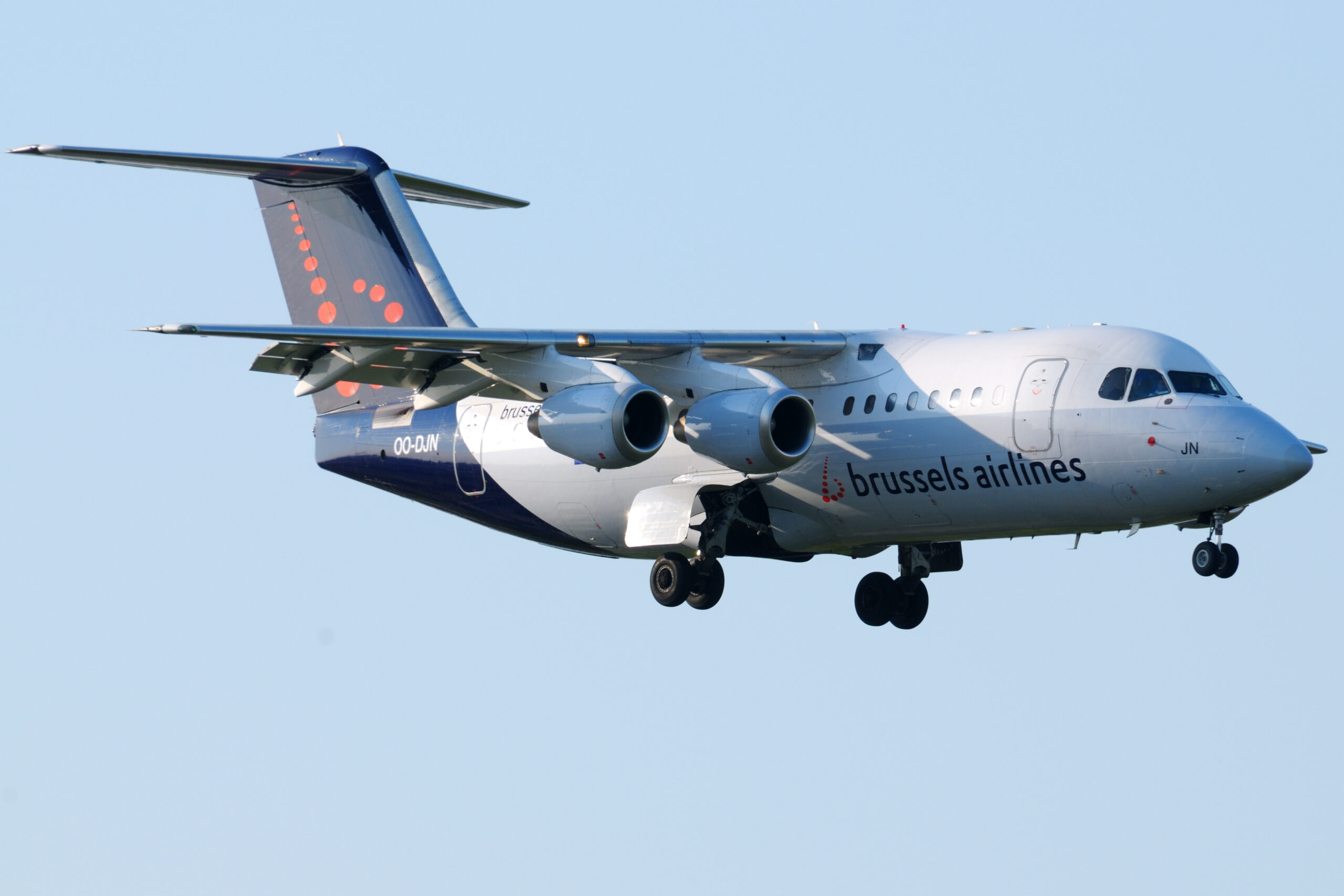
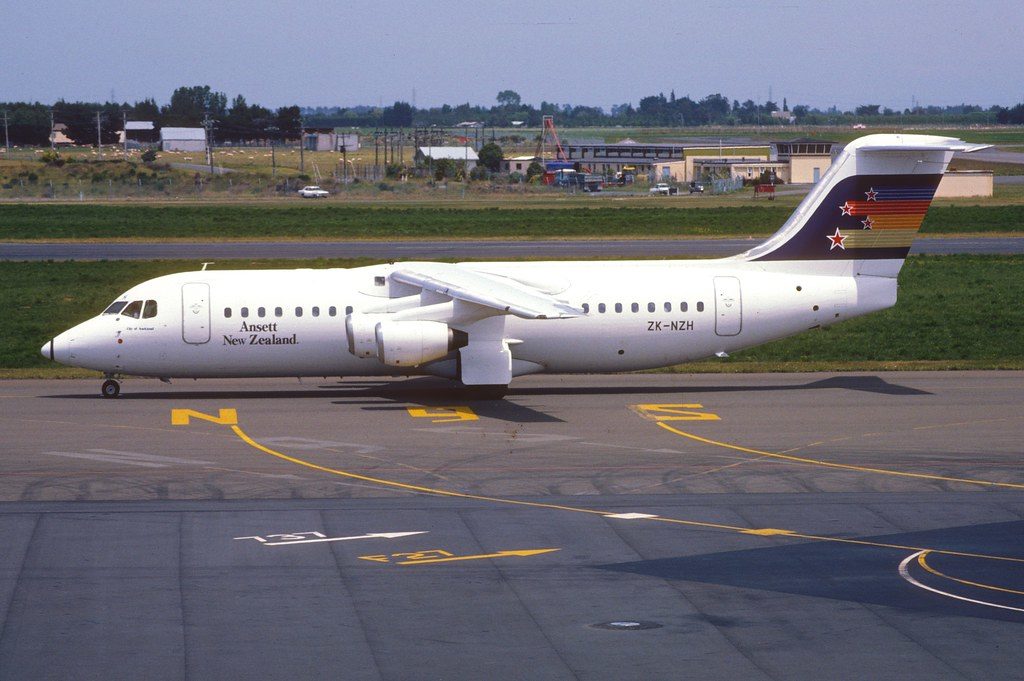
The BAe 146 / Avro RJ is instantly recognisable. A high wing sits atop a relatively short fuselage, with a T‑tail
and four turbofan engines mounted on short pylons. This configuration was chosen to maximise lift at low speeds,
keep the engines clear of debris on rough or contaminated runways, and provide good handling at steep approach angles.
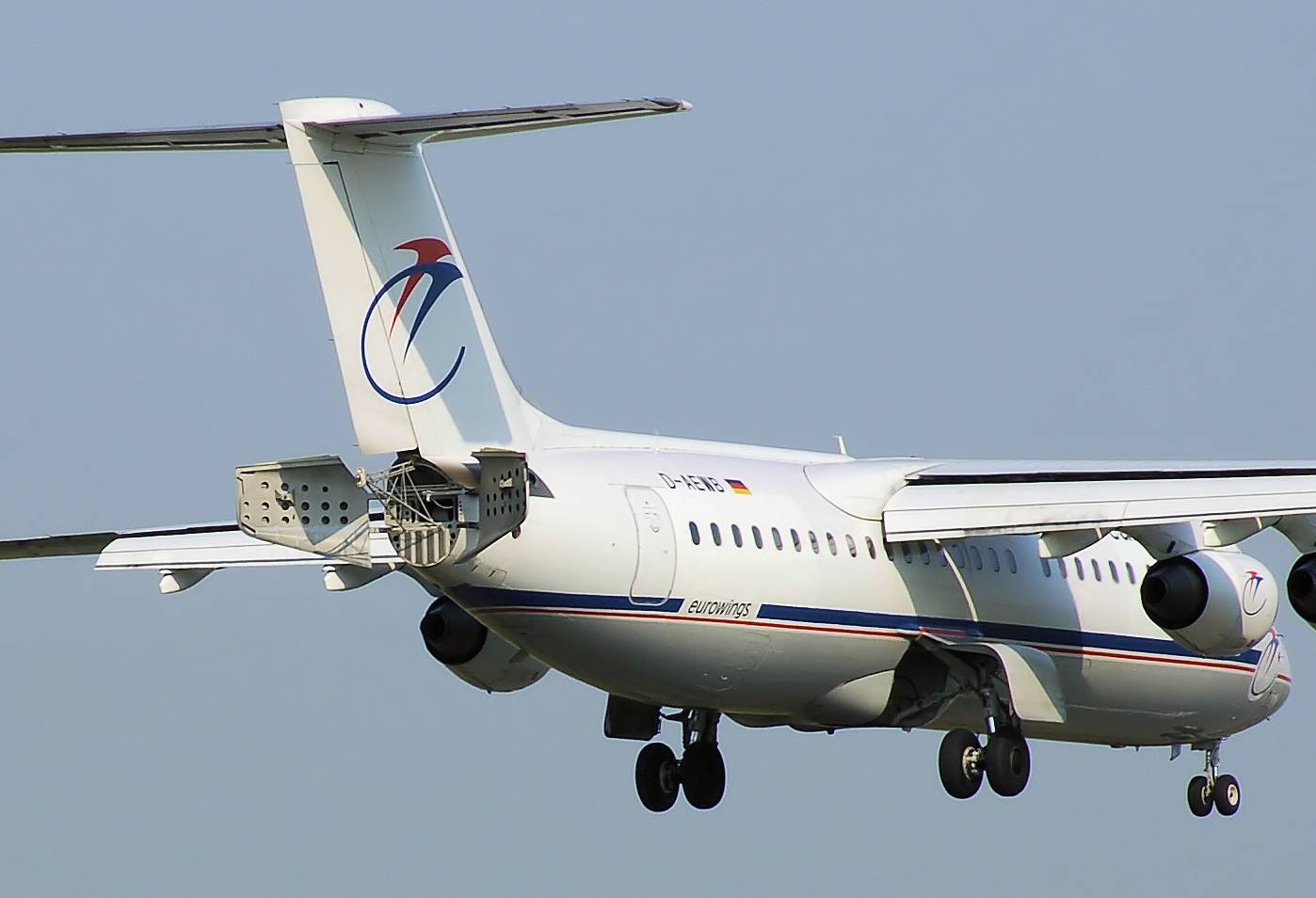
One of the aircraft’s signature features is its low noise. The “Whisperjet” branding reflects the quiet operation
of the Lycoming ALF 502 and later Honeywell LF 507 engines, combined with careful aerodynamic design. The type also
incorporates a large, clamshell‑style airbrake at the rear fuselage, allowing steep descents and short‑field landings
without excessive use of wheel brakes.
The high‑lift wing, powerful flaps and robust landing gear give the BAe 146 / Avro RJ excellent short‑field performance.
This made it ideal for airports with short runways, obstacles, or strict noise regulations. The aircraft was certified
for steep approaches, enabling operations into London City and similar challenging airports.
Assembly and production
Final assembly of the BAe 146 took place at British Aerospace’s Hatfield and later Woodford facilities in the UK.
Major components, including wings and fuselage sections, were produced at various British Aerospace sites and brought
together for final assembly. As the Avro RJ series entered production, assembly continued at Woodford, with the RJ70,
RJ85 and RJ100 sharing much of the BAe 146’s structure but incorporating updated systems and interiors.
In total, just under 400 BAe 146 and Avro RJ aircraft were built across all variants. While this is modest compared
with some larger jet families, it represents a significant achievement for a specialised regional jet designed for
niche operations. Many airframes have since been converted for cargo or firefighting roles, extending the type’s
service life well beyond its original passenger career.
Specifications
The BAe 146 / Avro RJ family covers several variants with differing capacities and performance. Typical figures for
the BAe 146‑200 and Avro RJ85 are shown in the specifications table below, with ranges and capacities varying slightly
between models and operator configurations.

| British Aerospace/Avro | BAe 146-100/RJ70 | BAe 146-200/RJ85 | BAe 146-300/RJ100 |
|---|---|---|---|
| First Flight | 03 September 1981 | August 1982 | 01 May 1987 |
| Crew | 2 | ||
| Passengers | 70-82 | 85-100 | 97-112 |
| Width(Internal) | 3.42 Metres (11 Feet 2 Inches) | ||
| Aircraft Length | 26.19 Metres (85 Ft 11 In) | 28.55 Metres (93 Ft 8 In) | 31 Metres (102 Ft) |
| Tail Height | 8.61 Metres (28 Feet 2 Inches) | ||
| Main Wing Span | 26.34 Metres (86 Feet 5 Inches) | ||
| Main Wing Area | 77.3 Metres2 (832 Feet2) | ||
| Main Wing Aspect Ratio | 8.98 | ||
| MTOW | 38,101 Kg (84,000 lb) | 42,184 Kg (93,000 lb) | 44,225 Kg (97,500 lb) |
| OEW | 23,820 Kg (52,510 lb) | 24,600 Kg (54,230 lb) | 25,640 Kg (56,530 lb) |
| Maximum Payload | 8,612 Kg (18,990 lb) | 11,233 Kg (24,760 lb) | 11,781 Kg (25,970 lb) |
| Takeoff Dist. | 1,195 M (3,921 ft) | 1,390 M (4,560 ft) | 1,535 M (5,036 ft) |
| Landing Dist. | 1,180 M (3,870 ft) | 1,190 M (3,900 ft) | 1,270 M (4,170 ft) |
| Fuel Capacity | 11,728 Litres (3,098 US Gallons) Longer range option (12,901 Litres (3,408 US Gallons)) | ||
| Engines x 4 | BAe 146: Lycoming ALF 502R-5, Avro RJ: Honeywell LF 507-1F | ||
| Engine Thrust x 4 | 31.1 kN (6,990 lbf) | ||
| Speed (Cruise) | Mach 0.7 (404 kn / 747 km/h) | ||
| Speed (Maximum) | Mach 0.739 (426 kn / 789 km/h) | ||
| Service Ceiling | 35,000 Feet (11,000 Metres) | ||
| Range | 3,870 Km(2,090 nm) | 3,650 Km(1,970 nm) | 3,340 Km(1,800 nm) |
| Variant | Length | Wingspan | MTOW | Typical seats | Range |
|---|---|---|---|---|---|
| BAe 146‑200 | ≈ 30.0 m | ≈ 26.2 m | ≈ 43,000 kg | ≈ 85–100 | ≈ 2,000 km |
| Avro RJ85 | ≈ 31.0 m | ≈ 26.2 m | ≈ 44,000 kg | ≈ 90–110 | ≈ 2,400 km |
Performance and capabilities
In service, the BAe 146 / Avro RJ typically cruised at around Mach 0.72–0.74, with ranges suited to short‑ to
medium‑haul regional routes. The aircraft’s maximum takeoff weight and high‑lift wing allowed operations from
relatively short runways, often under 1,500 metres, depending on load and conditions.
The type’s steep‑approach capability was a major selling point. Certification for approaches up to 5.5 degrees
enabled operations into London City Airport, where conventional jets were either restricted or required special
procedures. Combined with low noise and good hot‑and‑high performance, the BAe 146 / Avro RJ became a favourite
for airlines serving challenging airports.
Cabin and comfort
Inside, the BAe 146 / Avro RJ typically featured a five‑abreast seating layout, with a 2‑3 arrangement across the
cabin. This gave passengers a comfortable environment compared with many narrow regional jets, with relatively
wide seats and good headroom.
The aircraft’s quiet engines and careful acoustic treatment contributed to a low cabin noise level, reinforcing
the “Whisperjet” branding. For airlines, the flexible cabin allowed configurations ranging from high‑density
commuter layouts to more spacious business‑focused arrangements.
Variants
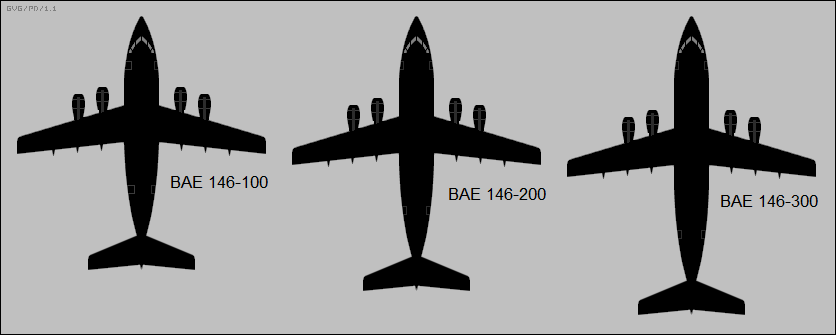
The BAe 146 family comprised three main passenger variants:
- BAe 146‑100: Shortest fuselage, lower capacity, early production model.
- BAe 146‑200: Stretched fuselage, increased capacity, the most widely used variant.
- BAe 146‑300: Further stretch, offering the highest capacity in the BAe 146 range.
The Avro RJ series updated the BAe 146 with improved systems and cabins:
- RJ70: Short‑fuselage model, limited production, used mainly by Crossair.
- RJ85: Mid‑size variant, popular with European regional airlines.
- RJ100: Long‑fuselage model, widely used by Swiss and others on dense regional routes.
In addition to passenger variants, numerous BAe 146s were converted to cargo “Quiet Trader” (QT) and Quick Change (QC)
configurations, while Avro RJ85 and RJ100 aircraft have been adapted as aerial firefighting tankers (RJ85AT / RJ100AT).