
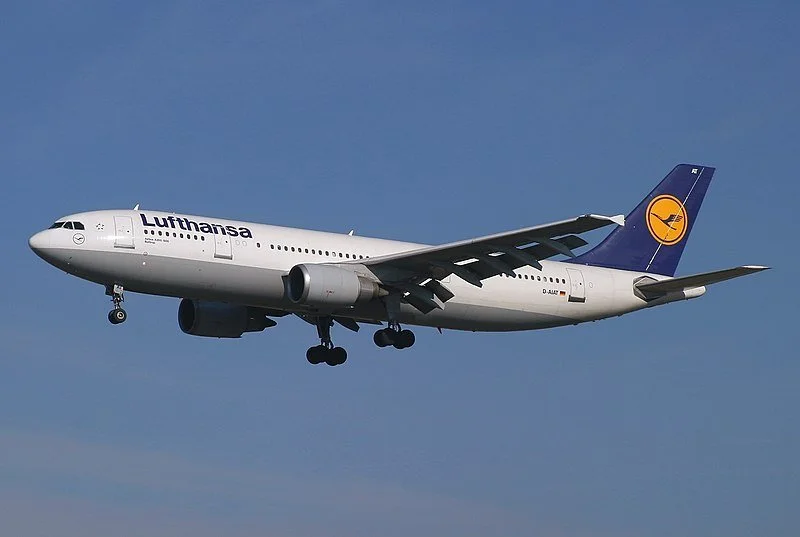
Airbus A300 Beginnings
The 1960s were a time of change in the aviation world. Jet travel was opening up the skies and allowing more people to travel further than ever before. Aircraft were becoming more dependable, and the call for larger-capacity aircraft was being made by airliners. In Europe, it was feared that the market would become dominated by U.S. aircraft manufacturers if there wasn’t a timely and cost-effective European offering to combat this.
The problem with the European market was that it was fragmented. That is to say that each nation had its own aircraft industry producing for a small market. This meant that any aircraft type produced would have a short production life until its market was saturated, which made it very difficult for a manufacturer to recoup development costs, much less turn a good profit.
Nevertheless, in the mid-1960s, aircraft manufacturers saw a need for a 200-seat airliner in the market. To try to build on the technology they already had, they looked at resizing their current stock. For example, Hawker Siddeley looked at stretching their Trident, while the British Aircraft Corporation thought to stretch their BAC 111 to a BAC 211 and BAC 311.
The Plowden Report of 1965 confirmed that production of aircraft in Europe came in at a 20% higher cost than that in the U.S.A., and with shorter production runs, it was recommended that collaboration was the only way to address this problem.
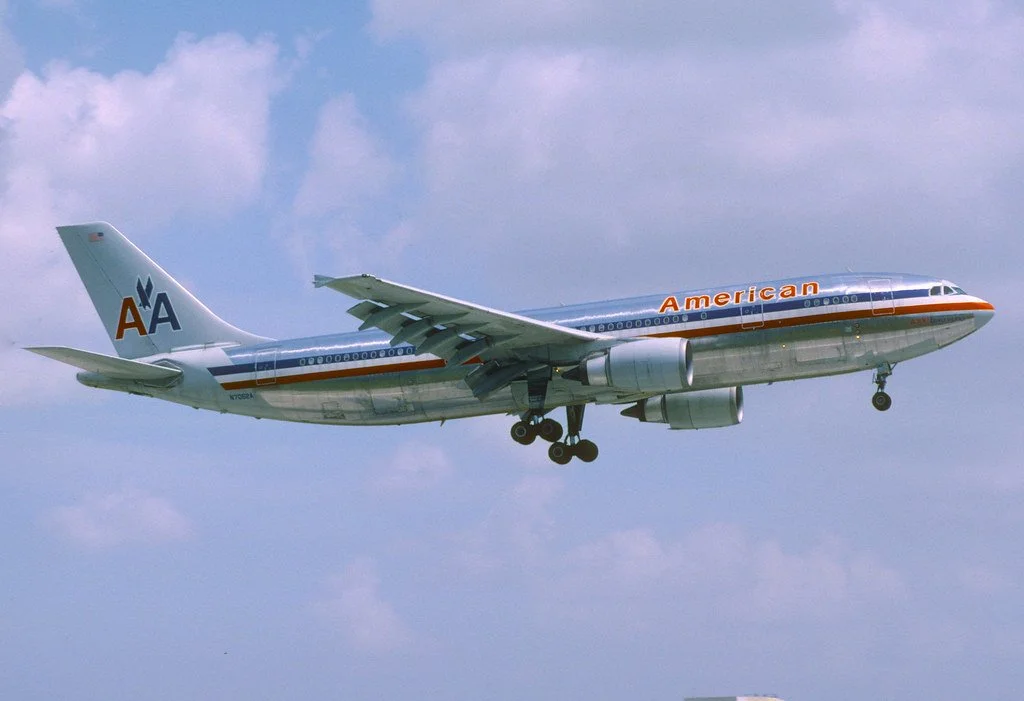
American Airlines Airbus A300-605R N7062A landing at Miami
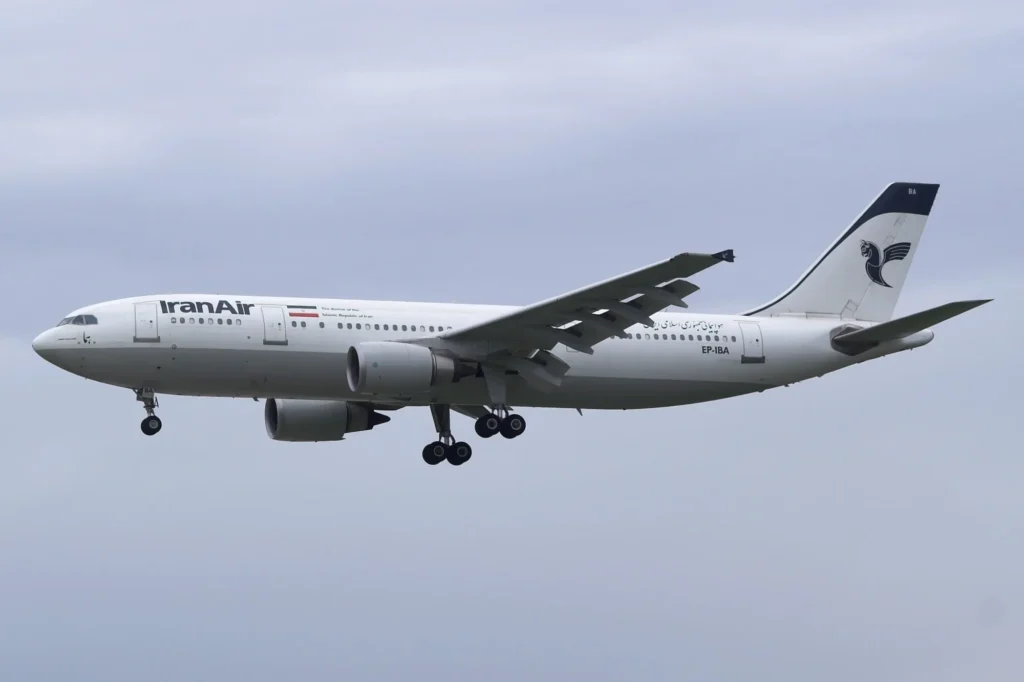
Iran Air A300-600 registration EP-IBA on approach.
History.
A300 Collaboration
Air France was the launch customer for the Airbus A300 with an order of six airframes in September 1970. By the time Air France put their first A300 into service in May of 1974, Airbus was finding it hard to get customers for their launch aircraft. The oil crisis of 1973 caused an aviation downturn and airlines had trouble filling their existing aircraft at the higher prices demanded by more expensive oil.
This put a stop to spending money on newer aircraft, no matter how economical they might be. To broaden its market base, like British pop groups, Airbus knew it had to break into the North American market. Here, they were fighting against an American perception that European plane makers produced high-performance but low-dependability products.
To highlight the dependability of the Airbus A300, Airbus decided to let the world’s only wide-body twin-engine airliner prove itself to its American doubters. In September 1973, the A300 embarked on a six-week Tour of North America. To get there, they flew from Toulouse to Dakar and then via Brazil to Florida. This tour allowed airline executives and financiers to get a first-hand look and feel of the A300. One of those was Frank Borman of Eastern Airlines, which was one of the Big Four in the U.S..
It was becoming evident that the concept of a wide-body short-haul jet might not be what the market was looking for. Airlines that flew the A300 found they had to reduce flight frequency to fill the larger jet. This made the airlines that flew more frequent narrow-body services more popular due to their greater choice of departure times. The attraction of wide-body comfort was not enough of a drawcard. Sales were such that production was dropped to one aircraft every two months, with four white-tailed aircraft kept in storage.
The A300 came into its own in 1977 when the FAA (Federal Aviation Authority) changed the restrictions for ETOPS, which stands for Extended Range Twin Operations (or Engines Turn Or Passengers Swim). This ruling governed the way passenger jets could fly over water and was the reason that in the U.S., the market was dominated by the tri-jets Lockheed L1011 Tristar and McDonnell Douglas DC-10. With the higher proven reliability of the A300, certification was granted for it to fly further from an available airfield than previously enjoyed by any twin-engined airliner. This opened up a whole new market for overwater medium-haul flights.
American Airlines and Air France had already expressed interest in a 200-seat twin jet, and European leaders were very keen to ensure that a European offering would be in the mix. They were keen to stop the domination of U.S.-made airliners, particularly in Germany, whose aviation industry had not yet recovered since World War II.
To this end, in July 1967, a meeting was held between the ministers of France, the U.K. and Germany. The outcome was that they supported the concept of collaboration to produce an Airbus. The word was felt to be descriptive of the desired outcome and translated well into each of the three languages.
This was to be the second European collaboration, with Concorde being the first.
French engineer Roger Béteille was appointed technical director shortly after the ministerial meeting and set about drawing up a work share plan for what would become the A300 project. This plan stated that France would produce the cockpit, control systems and lower centre part of the fuselage. Germany would produce the forward, rear and upper part of the centre fuselage. The Netherlands would produce the moving parts of the wings. Hawker Siddeley of the U.K. would produce the wings, and Spain would produce the horizontal tailplane.
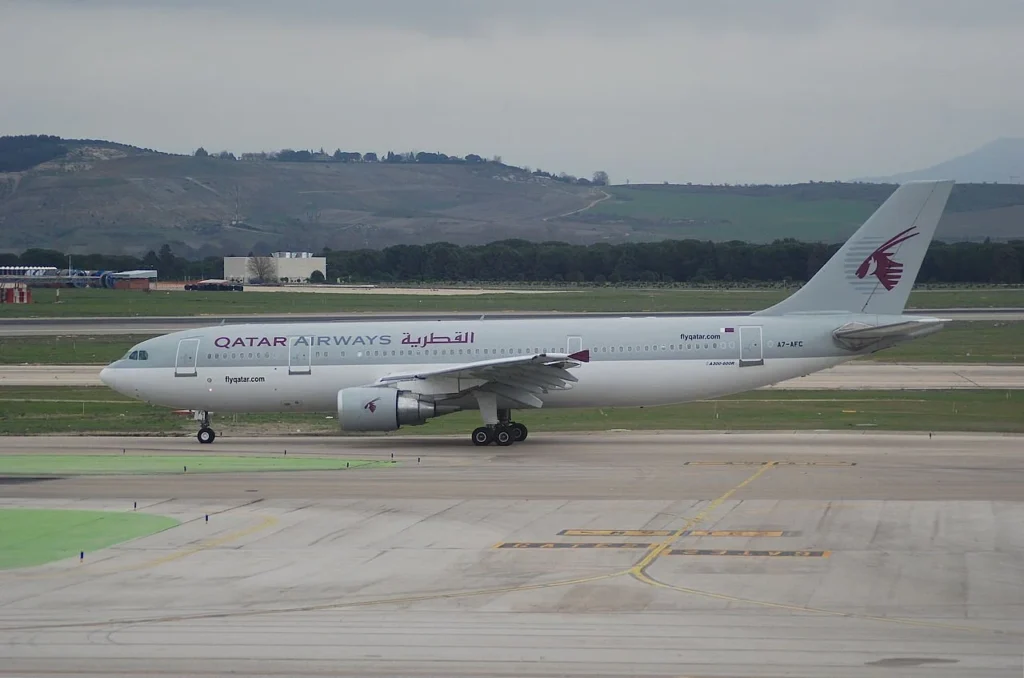
Qatar Airways Airbus A300-622R registration A7-AFC at Madrid 25.02.2007
The Technical Director also specified that the latest technologies must be part of the new offering to create differentiation from current offerings. In addition, metric measurements were avoided in favour of imperial measurements, similar to U.S. aircraft, and English was the working language. These cultural decisions were part of Airbus’ success as they showed that a European company could offer a product familiar to many markets.
The new technologies incorporated into the A300 were many and truly set the stage for a new generation of modern airliners. Some of these include:
First to use fibreglass reinforced plastics for wing leading and trailing edges.
Redesigned wing to allow steeper climb out.
First to use wind shear warning systems.
Advanced autopilot.
Electrically controlled braking.
Cockpit redesign to remove the need for the flight engineer.
Centre of gravity control by pumping fuel to different locations around the aircraft.
Electrical control of secondary flight systems.
ASSEMBLY
The site for the construction of the Airbus A300 was Toulouse-Blagnac. Here, Airbus maintained a just-in-time system where components would arrive at the factory just as they were needed. This eliminated the need to store these components onsite.
As well as the major components mentioned above, parts would arrive from all over Europe and the world. For the larger parts, such as wings and fuselage sections, it was very cumbersome to try to bring them by road, so Airbus acquired two Super Guppies in the early 1970s to transport these parts by air.
The Super Guppy was produced by Aero Spacelines and was based on the military version of the 1950s Boeing 377 Stratocruiser. This system is still employed by Airbus today; however, the parts are now transported by the Beluga and Beluga XL.
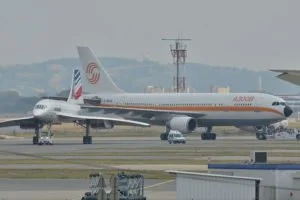
Prototype Airbus A300 and Concorde at Toulouse.
SPECIFICATIONS
A300 Power Plant
The A300 was powered by two underwing turbofan jet engines. One factor that helped keep down the development costs of the A300 was that a new engine did not need to be developed. The underwing engine pods were designed so that engine types were interchangeable and quite capable of accommodating the Rolls-Royce RB211 and Pratt and Whitney JT9D, both of which were developed for the original Boeing 747.
To sweeten the offering for the U.S., Airbus opted for a third offering in the form of the General Electric CF6-50. It was decided to go this way as the Rolls-Royce RB207 was not progressing due to Rolls-Royce concentrating its efforts on the RB211.
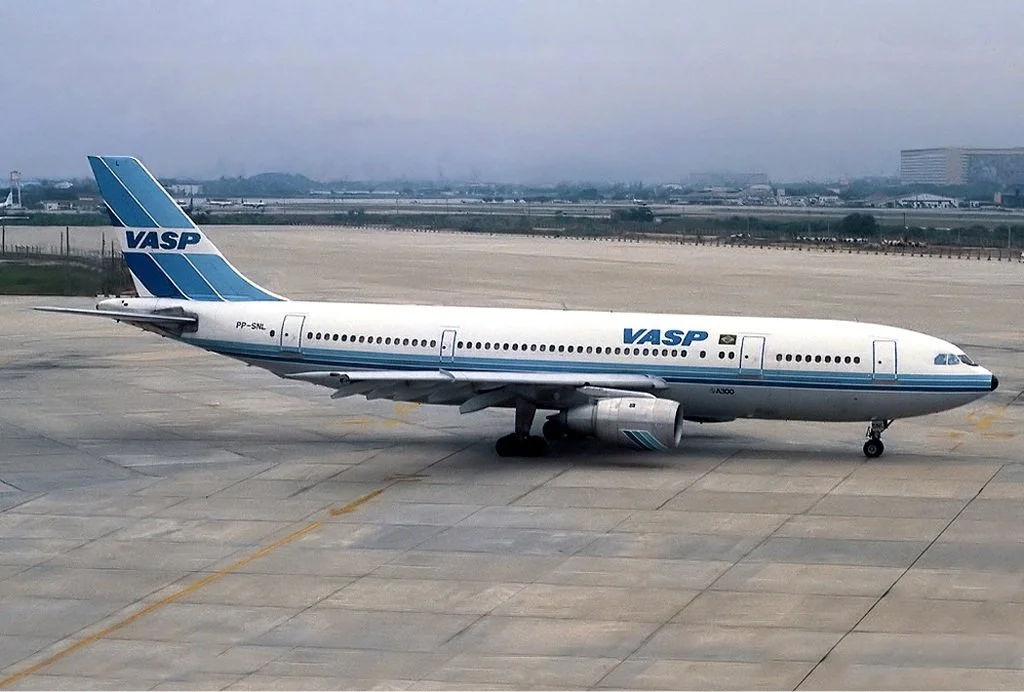
VASP(Viação Aérea São Paulo S/A (São Paulo Airways) Airbus A300B2-203. Aragao. Registration PP-SNL
Airbus A300 Specs Table
| Airbus A300 Specs | A300B4‑200 | A300‑600R |
|---|---|---|
| Flight Crew | 3 | 2 |
| Range | 5,375 km / 2,900 nm | 7,500 km / 4,050 nm |
| Typical / Max Seating | 345 | 345 |
| Fuselage Length | 53.61 m (175.9 ft) | 54.08 m (177.4 ft) |
| Max Cabin Width | 5.287 m (17.35 ft) | |
| Max Cabin Length | 40.7 m (133.5 ft) | |
| Wing Area | 260 m² (2,800 sq ft) | |
| Wing Span | 44.84 m (147.1 ft) | 44.84 m (147.1 ft) |
| Tail Height | 16.72 m (54.9 ft) | 16.66 m (54.7 ft) |
| Freight / Cargo Volume | 20 LD3 + bulk | 22 LD3 + bulk |
| Cruise Speed | Mach 0.78 (450 kn; 833 km/h; 518 mph) at FL350 | |
| Max Payload | 37,495 kg (82,662 lb) | 41,374 kg (91,214 lb) |
| Max Take‑off Weight | 165,000 kg (363,763 lb) | 171,700 kg (378,534 lb) |
| Max Landing Weight | 136,000 kg (299,829 lb) | 140,000 kg (308,647 lb) |
| Max Zero Fuel Weight | 126,000 kg (277,782 lb) | 130,000 kg (286,601 lb) |
| Max Fuel Capacity | 48,470 kg / 62,000 L | 53,505 kg / 68,160 L |
| Ceiling | 12,192 m (40,000 ft) | |
| Engines | CF6‑50C2 or JT9D‑59A | CF6‑80C2 or PW4158 |
| Takeoff Thrust | 230–231 kN | 249–270 kN |

Airbus A300B4-603 Lufthansa
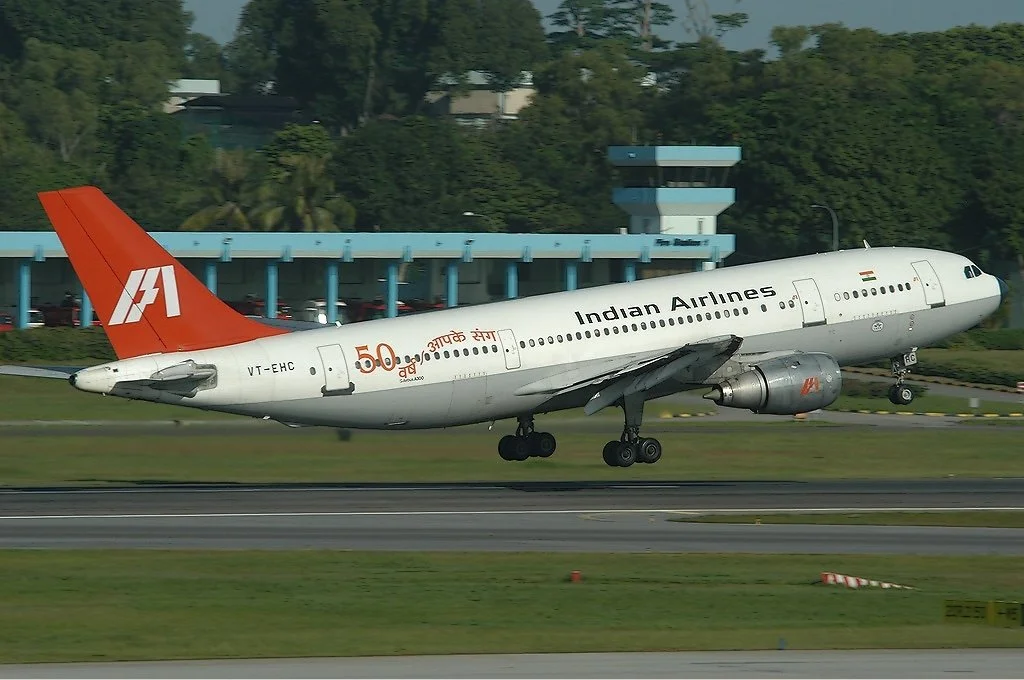
Indian Airlines Airbus A300
Airbus A300 Development Timeline
| Date | Event |
|---|---|
| 26 September 1967 | U.K., France and Germany sign a memorandum of understanding to build an Air Bus. |
| 10 April 1969 | The U.K. withdraws from the agreement. Hawker Siddeley maintains their role as wing maker as a sub-contractor. |
| 29 May 1969 | At the Paris Airshow, French Transport Minister Jean Chamant and German Economics Minister Karl Schiller signed an agreement between the two countries to produce the A300, the worlds first wide-body twin-engine airliner. Each country would have a 50% stake. |
| 18 December 1970 | Airbus Industrie is formed to build the A300. This was formed by Aérospatiale (merged Sud Aviation and Nord Aviation) of France and Deutsche Aerospace of Germany. |
| 03 September 1970 | Air France becomes the launch customer with six airframe orders. |
| 28 September 1972 | The A300 prototype was unveiled to the public for the first time. |
| 28 October 1972 | Maiden flight of the A300. |
| 15 March 1974 | Type certification was granted for the A300 by both German and French authorities. |
| 23 May 1974 | The U.S. Federal Aviation Authority (FAA) issued certification for the A300. |
| 30 May 1974 | The first A300 enters service with Air France flying from Paris to France. |
| September 1974 | After a sales drought, Korean Air ordered four longer-range A300B4s. This was seen by Airbus as the key to breaking into the Asian Market. |
| 1977 | Eastern Airlines leased four A300 to test them and Frank Borman CEO and former astronaut was impressed by the 30% fuel saving over his Lockheed L1011 Tri-jets. They ordered 23 A300s, the first U.S. order. |
| December 1977 | AeroCóndor Colombia becomes the first South American operator of the type. |
| March 2006 | Airbus announced the intended closure of the A300/A310 production line. |
| 18 April 2007 | The final production A300, an A300F freighter for FedEx makes its first flight. Airbus announced a support package to keep A300s flying until at least 2025. 561 A300s were manufactured between 1974 and 2007. |
Cabin Interior.
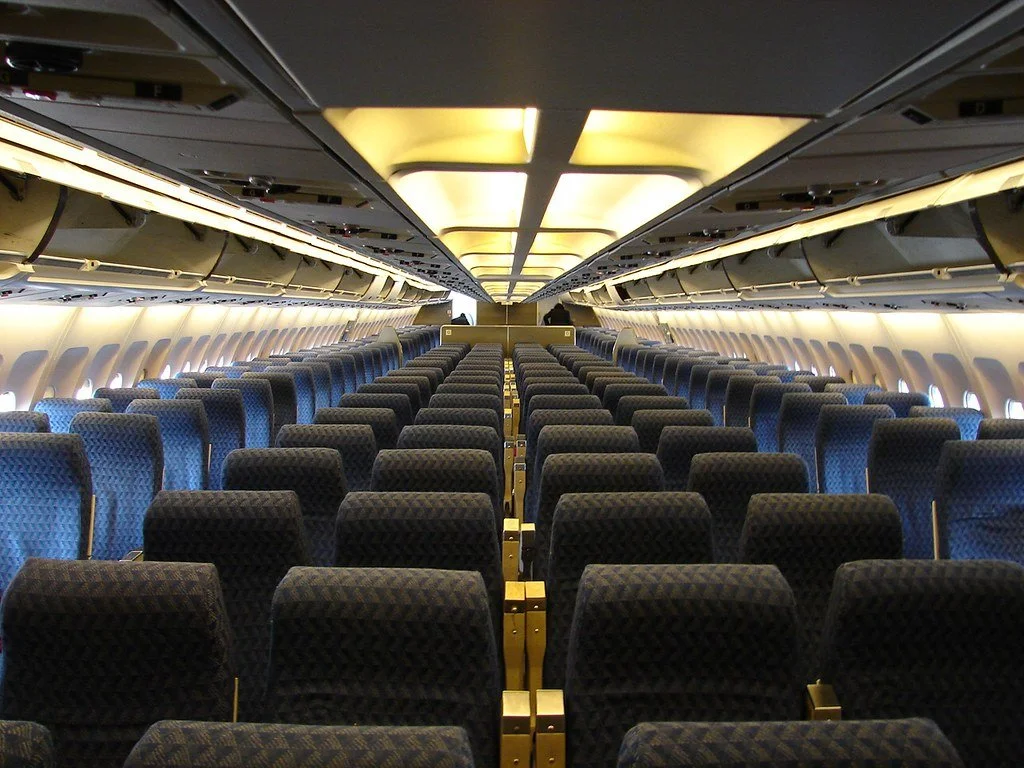
American Airlines Airbus A300 main cabin. Note the configuration of 2x4x2 giving a total of 8 abreast across the cabin.
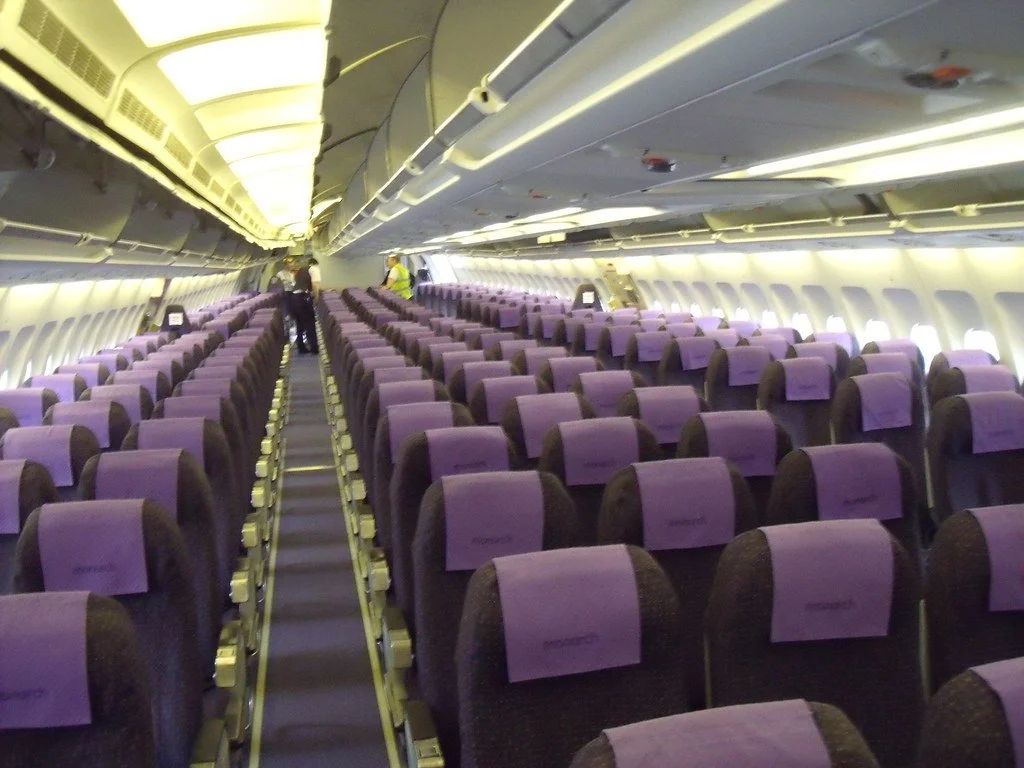
Airbus A300B4-605R(G-MONR ) of Monarch Airlines. Note the higher density configuration here of 3x3x3 giving a total of 9 abreast across the cabin.
Airbus A300 Airline Customers.
| Airline / Customer | Country | Airbus A300 | |
|---|---|---|---|
| Ord | Del | ||
| Governments, Executive and Private Jets | Various | 3 | 3 |
| Aerounion | Mexico | ||
| Afriqiyah Airways | Libya | ||
| Air Afrique | Côte d’Ivoire | 3 | 3 |
| Aircompany KAP KG | Kyrgyzstan | ||
| Air France | France | 23 | 23 |
| Air Hong Kong | Hong Kong | 8 | 8 |
| Air India | India | 3 | 3 |
| Air Inter | France | 8 | 8 |
| Alitalia | Italy | 8 | 8 |
| American Airlines | United States | 35 | 35 |
| Australian Airlines | Australia | 5 | 5 |
| Aviatur | Mexico | 2 | 2 |
| AWAS | Ireland | 8 | 8 |
| China Airlines | Taiwan | 15 | 15 |
| China Eastern Airlines | China | 7 | 7 |
| China Eastern Xibei Airlines | China | 3 | 3 |
| China Northern Airlines | China | 6 | 6 |
| CityBird | Belgium | 2 | 2 |
| Continental Airlines | United States | 3 | 3 |
| Cruzeiro do Sul | Brazil | 2 | 2 |
| Eastern Airlines | United States | 34 | 34 |
| Egyptair | Egypt | 17 | 17 |
| Emirates | United Arab Emirates | 5 | 5 |
| FedEx | United States | 42 | 42 |
| Finnair | Finland | 2 | 2 |
| Galaxy Airlines | Japan | 1 | 1 |
| Galaxy Aviation | Pakistan | ||
| Garuda Indonesia | Indonesia | 9 | 9 |
| Hapagfly | Germany | 7 | 7 |
| Iberia | Spain | 6 | 6 |
| ILFC | United States | 9 | 9 |
| Iran Air | Iran | 8 | 8 |
| Japan Air System | Japan | 32 | 32 |
| JFS – Japan Fleet Service | Japan | 2 | 2 |
| Korean Air | South Korea | 32 | 32 |
| Kuwait Airways | Kuwait | 8 | 8 |
| Laker Airways | United Kingdom | 3 | 3 |
| Lufthansa | Germany | 23 | 23 |
| Malaysia Airlines | Malaysia | 4 | 4 |
| Mahan Air | Iran | ||
| MNG Airlines | Turkey | ||
| Monarch Airlines | United Kingdom | 4 | 4 |
| NACIL Indian Airlines | India | 10 | 10 |
| Odyssey Airlines | United Kingdom | 10 | |
| Olympic Airlines | Greece | 10 | 10 |
| Pakistan International Airlines | Pakistan | 4 | 4 |
| Pan Am | United States | 12 | 12 |
| Philippine Airlines | Philippines | 5 | 5 |
| Polaris | United States | 5 | 5 |
| Qeshm Air | Iran | ||
| SAS | Sweden | 4 | 4 |
| Saudia | Saudi Arabia | 11 | 11 |
| Singapore Airlines | Singapore | 8 | 8 |
| Skyjet | Kyrgyzstan | ||
| Solinair | Slovenia | ||
| South African Airways | South Africa | 7 | 7 |
| Sudan Airways | Sudan | ||
| Thai Airways | Thailand | 33 | 33 |
| Transcarga International Airways | Venezuela | ||
| Trans European Airways | Belgium | 1 | 1 |
| Uni-Top Airlines | China | ||
| UPS | United States | 53 | 53 |
| Varig | Brazil | 2 | 2 |
| VASP | Brazil | 3 | 3 |
| Undisclosed | Various | ||
| Totals | 561 | 561 | |